Get Full Government Meeting Transcripts, Videos, & Alerts Forever!
Get email alerts on the Sheriff Staffing topic
No spam. Unsubscribe anytime.
Collin County judge backs sheriff’s plan to swap four unfilled detention-officer slots for five records positions
Summary
After Sheriff Skinner warned that budget cuts left the sheriff’s office unable to sustain warrant-entry and records work, Collin County Commissioners voted 5–0 to eliminate four unfilled detention-officer positions and use the funding to restore five records positions needed to process warrants and statutorily mandated records work.
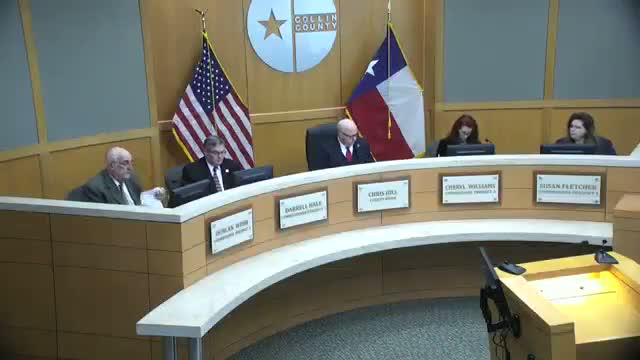
Judge Hill and county commissioners approved a midyear budget reallocation after Collin County Sheriff Skinner told the court his office lacks the personnel to continue the current warrant-entry and confirmation workload.
Skinner said the sheriff’s office is still managing roughly 10,000 outstanding warrants countywide, with about 1,000 of them at felony 1–2 level. He described the impact of summer budget cuts that removed 22 positions from his department and said those reductions left records and detention units short-staffed.
"We currently still have 10,000 outstanding warrants," Sheriff Skinner said, and he outlined how records and a 24-hour NCIC/dispatch terminal are required to confirm warrants and start extradition.
Skinner proposed eliminating four unfilled detention-officer positions and shifting those budgeted dollars to hire five records staff to restore mandatory and backlog work, including expunctions and NCIC confirmations. Judge Hill said the swap is a reasonable short-term fix if the restored records jobs will remain long term.
Commissioners debated interim options before the vote: using the county’s temporary staffing pool to backfill, temporarily reassigning current detention officers, or cost-sharing with cities to centralize pre-indictment warrant entry. Concerns focused on overtime exposure if detention officers are reassigned and on how cities’ capacity to take on pre‑indictment work would be coordinated.
Commissioner Hale and others suggested exploring a cost-sharing arrangement with nearby municipalities and training temporary staff for records work, while the sheriff emphasized that extradition and transportation require experienced sworn staff.
The court voted 5–0 to proceed with the sheriff’s recommendation to fund five records positions by removing four unfilled detention-officer slots, with an understanding the court will revisit backfilling detention positions at the next budget review.
The court also discussed related courthouse security and magnetometer coverage, where three full‑time security positions were cut earlier and one position was vacant at the time; staff reported they will explore contracting or schedule adjustments for heavy jury days.
Next steps: the sheriff will present operational statistics and a budget request during the summer budget workshop to seek longer-term staffing solutions and possible cost-sharing arrangements with local cities.