Get Full Government Meeting Transcripts, Videos, & Alerts Forever!
Get email alerts on the Sheriff Staffing topic
No spam. Unsubscribe anytime.
Collin County court reallocates funding to restore sheriff’s records staff after sheriff warns of overwhelmed warrant-processing system
Summary
After a detailed presentation from Sheriff Skinner about records capacity and extradition workloads, the court voted 5–0 to eliminate four unfilled detention-officer positions and use that funding to restore five records positions to preserve warrant-entry and confirmation functions.
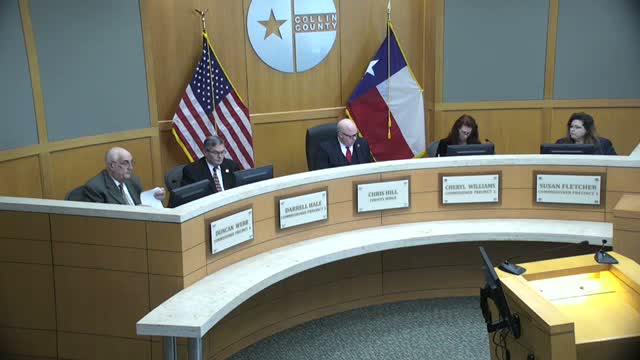
Judge Hill and the Collin County Commissioner’s Court voted to reallocate funding to the Sheriff’s Office after Sheriff Skinner told the court his records unit has been stretched thin and warned that continuing the current staffing model risks compliance failures.
Sheriff Skinner told the court that the sheriff’s office lost 22 positions in the recent budget cycle, with five of those losses coming from records. “We had over 10,000 warrants,” Skinner said, and “we’ve worked that number down now, to right around 1000” for first- and second-degree felony warrants, adding that the remaining outstanding warrants are largely misdemeanors. Skinner said the office no longer runs a C shift and is using dispatch staff to confirm warrants, a makeshift process he described as unsustainable.
Skinner asked the court to eliminate four currently unfilled detention officer positions and reallocate the budgeted salary and benefits to restore five administrative (records) positions, saying the trade would allow the sheriff’s office to continue warrant entry and confirmation work while the county and cities consider longer-term solutions.
Commissioners pressed Sheriff Skinner on operational details and alternatives. Commissioners discussed temporary staffing, a “temp pool” to backfill functions, converting newly hired detention officers temporarily, and a possible regional cost-sharing arrangement with cities for pre‑indictment warrant work. Commissioner remarks centered on minimizing overtime and preserving patrol capacity; Judge Hill emphasized the need to identify sustainable funding and said he would look to uniformed staff for the operational recommendation.
Judge Hill framed the motion before the court as a short-term operational fix tied to the understanding that the county may need to restore detention positions in the next budget: “I fully expect that if we take four off of your platoon, you’re going to need them back,” he said, and added that the court should plan to backfill those detention posts in the next budget cycle.
The court adopted the sheriff’s proposal 5–0. The vote authorizes the elimination of four unfilled detention officer positions and redirects the funding to five records positions in the sheriff’s office. Commissioners and sheriff’s office staff said the action is intended as an immediate mitigation while they develop longer-term options, including centralized processing or interlocal cost-sharing with cities.
The court also discussed courthouse security staffing—three full-time security guard positions had been eliminated during budget adjustments, leaving one fewer security lane open on high‑jury days. County staff advised the court that the security positions are in a different fund and recommended options including contracting for Monday coverage or rescheduling current security staff; Judge Hill asked staff to take that offline and return with options.
Next steps: Sheriff Skinner said he will present statistics and a formal budget request in the next budget cycle and asked the court to consider additional transport and records staffing during the FY2027 budget process. The court recorded no amendments to the motion and did not specify an immediate timeline beyond the near-term staffing swap and a follow-up during the budget process.