Get Full Government Meeting Transcripts, Videos, & Alerts Forever!
Get email alerts on the Tax Abatements topic
No spam. Unsubscribe anytime.
Residents urge Cameron County to reject tax breaks for proposed military contractor; court approves revised public notice
Summary
Multiple public commenters urged Cameron County Commissioners to oppose tax abatements for a company variously named in the record (Saronic/Ceronic/Ceramic), citing environmental, moral and Indigenous-rights concerns; the court voted to publish a revised public notice and set a hearing for June 2.
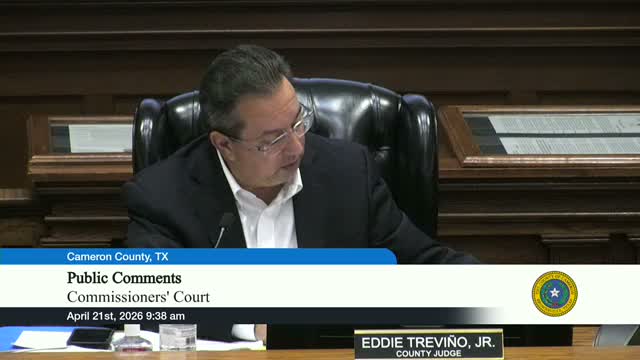
Several people who live in and near Brownsville came to the Cameron County Commissioners Court on April 21 to urge commissioners not to approve tax incentives for a defense-related company that speakers said is being courted to locate operations at the port.
Dr. Etienne Rosas, a Brownsville-based researcher and former congressional candidate, told the court that corporate tax incentives are often “a false panacea” and said subsidies rarely determine where firms locate. “We must end this absurd cycle, not feed into it further,” Rosas said, asking the court to reject subsidies for Saronic (the company name appears in the record with multiple spellings).
Brissette Cruz and Melinda Mello, both local organizers, warned that the company’s project would harm the region’s environment and communities. Cruz said the proposal would “pollute not only the Port of Brownsville, but ... our souls,” and asked the court to oppose any Ceramic/Ceronic technologies. Mello, who identified herself as a community organizer and volunteer with the South Texas Environmental Justice Network, said the project would be built on sensitive native habitat, harm water resources and bring “extractive” jobs rather than long-term benefit to the Rio Grande Valley.
A physician introduced earlier by the court as Doctor Christopher Basalou said the company would “pollute our land and our water” and argued that officials had not consulted the original peoples of the land. Basalou named Indigenous groups and said the project would destroy sacred sites, characterizing the proposal as “immoral.”
After the public comment period, staff recommended the court publish a revised public notice of intent to consider a tax payment agreement with the company (the record uses several spellings: Ceronic, Ceramic, Saronic). Staff said the company had revised its property survey since the March 24 notice and that updating the notice would make the record accurate. The court approved publishing the revised notice; the action was presented as approval of the notice only and the public hearing was scheduled for June 2.
The court’s vote to publish the revised notice was a procedural step; no tax payment agreement or abatement was adopted at the meeting. Commissioner motions and seconds in favor were recorded and the motion carried by voice vote.
Why it matters: The public comments reflect local opposition that ties environmental, Indigenous-rights and economic-equity concerns to a proposed industrial expansion. A revised public notice and a scheduled hearing mean the issue will return to the court with an opportunity for additional public input before any final abatement decision.
What’s next: The court approved the revised public notice and set a hearing date for June 2; commissioners will have the opportunity to hear more testimony and consider any formal applications or agreements at that time.