Get email alerts on the Land Use topic
No spam. Unsubscribe anytime.
Commissioners deadlock 2–2 on Cope 2 replat after executive session; developer sought emergency access easement
Summary
A public hearing and staff review concluded the proposed replat would add a gated emergency-access easement; the court tabled the matter for attorney consultation and, after an executive session, a motion failed 2–2.
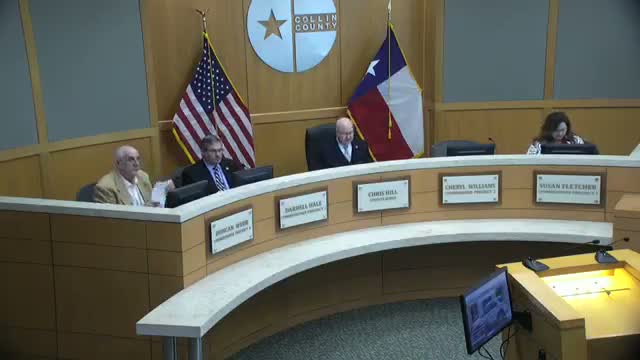
Collin County Commissioner’s Court held a public hearing on a proposed replat of Lot 24 in the Cope 2 Addition that would create a roadway easement to provide a secondary emergency-access point.
Tracy Homfeld (speaker 9), a county staff engineer, told the court the replat’s purpose is to establish a roadway easement for secondary emergency access for the proposed development to the north and said staff reviewed the replat under Texas Local Government Code Section 232.009. Developer representative Kyle Verla (speaker 10) of First Step Homes said the gate would remain closed to through traffic and is intended to meet fire-code requirements that changed since the subdivision was developed; he said the access benefits the existing Cope 2 Addition as well as the developer’s lot.
Attorney Leonard Smith (speaker 3) told the court he circulated materials citing Section 232.009(d) and argued that because staff found the application complies with standards, approval is ministerial and the court “shall approve.” Commissioners debated whether the easement would change the county’s duties into a discretionary determination about adverse effects and whether counsel should be consulted.
The court temporarily tabled the item for executive session to consult with the attorney. Returning to open session, the court noted a prior motion and second but recorded the motion as failing 2–2, leaving no action taken on the replat.
Why it matters: The replat would modify access and emergency-routing conditions for an existing subdivision; the dispute raises statutory interpretation questions about ministerial vs. discretionary duties under Section 232.009(d), and the deadlock leaves the developer and neighbors without a county decision.
AI generated
The text on this page is AI generated. Summaries, highlights, analysis, and video transcripts are all produced from the original source material.
AI can make mistakes, so if you spot one, and we will fix it for everyone.
Note: the source content is unaltered by us. Any content source we link to, be it a video, an audio recording, or a document, is presented exactly as its publisher released it. That publisher is usually a government body, sometimes an individual official or another organisation.