Get Full Government Meeting Transcripts, Videos, & Alerts Forever!
Get email alerts on the Budget topic
No spam. Unsubscribe anytime.
Collin County approves $1.07 million release from contingency for out-of-county inmate housing
Summary
The commissioner’s court unanimously approved releasing $1,070,000 from contingency to cover projected out-of-county inmate housing through February 2026; staff said the request is an over-projection and that actual costs are expected to be lower.
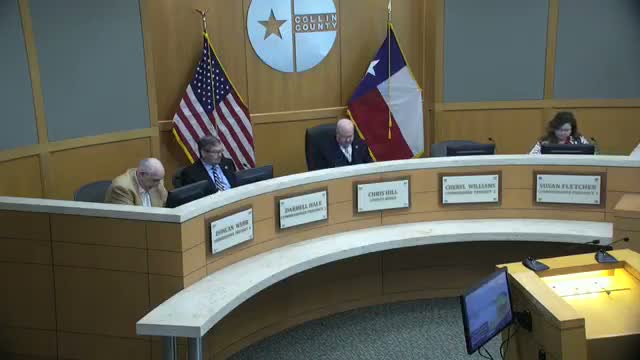
Collin County Commissioner’s Court voted unanimously to release $1,070,000 from contingency funds to cover projected out-of-county inmate housing expenses.
Deputy Langan (speaker 7), presenting for the sheriff’s office, said the FY26 budget initially included $408,800 for out-of-county housing and that the court has set aside $4,000,000 in contingency. He asked the court to authorize a first release from the contingency account to cover projected housing for roughly 100 inmates through February 2026 but described the request as an over-projection, saying the office expected actual needs to be lower.
Deputy Langan outlined recent trends in out-of-county housing: a memo dated Dec. 1, 2025 showed 100 inmates out of county at that time, weeks later that number fell to 84 and at the meeting it was 66, with expectations it could rise to 80. He said the sheriff’s office has worked to reduce overtime and comp balances and to return inmates housed out of county when possible to save money.
Commissioners praised the sheriff’s office for those efforts. The court approved the motion to release the funds by voice vote, 4–0.
Why it matters: The appropriation responds to corrections-system pressures and draws on contingency funds the court set aside, demonstrating how county leaders manage unexpected corrections costs within the fiscal year.