Get Full Government Meeting Transcripts, Videos, & Alerts Forever!
Get email alerts on the Opioid Settlement Spending Plan topic
No spam. Unsubscribe anytime.
Grand Traverse County weighs opioid settlement spending plan, debates foundation’s role
Summary
County commissioners reviewed a draft spending plan for opioid settlement dollars, heard that about $1.99 million has been received to date with projected receipts of roughly $6.4 million through 2040, and debated whether the Grand Traverse Regional Community Foundation or the county health department should administer grants and hold final approval.
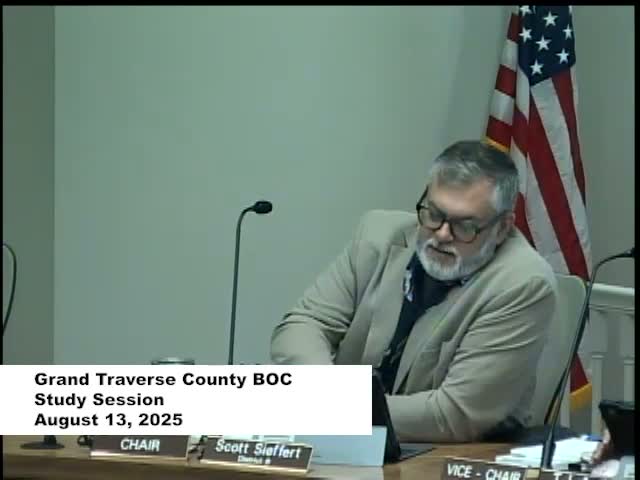
Grand Traverse County commissioners on May 4 reviewed a draft spending plan for opioid litigation settlement funds, heard a cash update and debated whether a community foundation or the county health department should administer and approve grants.
Mike Leahy of the Grand Traverse County Health Department said six wire transfers totalling $320,341.90 were received after the agenda published, bringing cash on hand to just over $1.99 million. He told commissioners outside counsel and the Michigan attorney general have signaled settlements with Purdue and several generic manufacturers that increase the county’s projected total receipts to about $6.4 million to be received through 2040. Leahy said staff will provide the settlement documents and additional detail at the Sept. 3 open session.
The presentation framed two spending “tracks”: Track A for county departments that deliver services and Track B to fund external community partners. Leahy said the plan’s purpose is to improve health outcomes for people most affected by the opioid epidemic while building sustainable programs that can operate after settlement receipts decline.
“Track B funds shall be distributed to external community partners and agencies through a grant application process conducted in partnership with the Grand Traverse Regional Community Foundation or the Grand Traverse County Health Department,” Leahy said, summarizing the options before the board.
Several commissioners urged clarity on governance and final approval. Commissioners pressed whether using the Grand Traverse Regional Community Foundation would let that nonprofit’s board give final approval of grant awards. Staff and counsel said settlement dollars can pass through a nonprofit and be invested by that nonprofit so long as spending follows the settlement’s authorized purposes, but several commissioners voiced policy concerns about ceding decision authority.
“I am not interested in abdicating that responsibility to the Community Foundation,” a commissioner said, urging a hybrid approach in which a citizen committee makes recommendations and the Board of Commissioners retains final approval.
Board members discussed two committee options: separate committees for the two tracks or a single committee overseeing both. The presentation proposed a seven-member panel — including county administration, county health, a commissioner, a sheriff’s office representative, a medical provider, a substance‑use‑disorder provider and a task‑force member — and commissioners discussed adding a prevention specialist and a legal/courts representative.
Commissioners also asked for a chart showing projected timing and amounts of future payments for planning purposes. A board member asked why interest earned on the rolling settlement fund is currently being posted to the county general fund; staff replied that the principal is required to be held in a separate rolling fund by the Department of Treasury but the county could change how interest is allocated.
Several speakers urged explicit emphasis on recovery support and prevention in the plan’s narrative and scoring tool so applicants understand eligibility. Public commenters and commissioners recommended building an outside evaluation into the process (for example, an 18‑month or annual review) so the county can measure whether funded programs achieve intended outcomes.
Commissioners debated whether to front‑load larger one‑time grants to address immediate crisis needs or preserve steady multi‑year funding to sustain personnel and services. Most members favored a balanced approach that allows both immediate impact and long‑term sustainability, and encouraged applicants who can leverage other funds.
The board directed staff to draft an approvable resolution or motion for a forthcoming meeting and indicated they want the item on an upcoming agenda so commissioners can vote. Several commissioners also asked the county to prepare an advocacy resolution urging the Michigan Department of Health and Human Services and state leaders to clarify distribution of the state’s settlement dollars to local communities.
Public commenters Dave Friedman and Dave McGrath urged the board to prioritize advocacy, to build evaluation questions early and to include long‑term needs such as housing and transportation among the plan’s priorities.
The agenda was approved by voice vote at the start of the meeting. No final committee appointments or grant awards were made at the session; staff said fuller documentation and a proposed resolution will be returned for board action.