Get Full Government Meeting Transcripts, Videos, & Alerts Forever!
Get email alerts on the Sexual Assault topic
No spam. Unsubscribe anytime.
Bexar County SART reports nearly 4,000 sexual‑assault reports over two years; court accepts biennial review
Summary
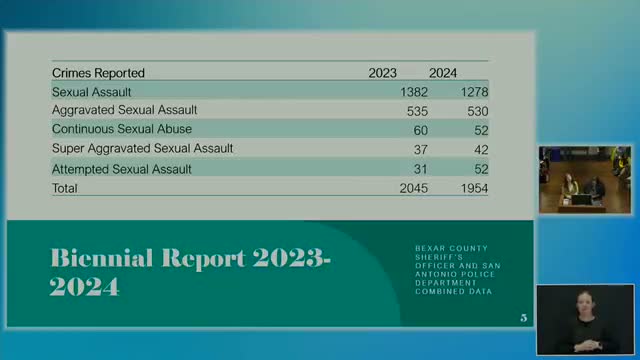
The Bexar County Sexual Assault Response Team reported 3,999 sexual‑assault reports to law enforcement across 2023–2024, 829 hospital forensic exams with advocacy, and recommended standardized hospital protocols and trauma‑informed training; the court accepted the biennial report.
Audrey O'Rearse, SART coordinator, presented the Bexar County Sexual Assault Response Team's 2023–2024 biennial report to Commissioners Court, highlighting incident counts, forensic‑exam throughput, prosecution outcomes and recommended system improvements.
"During the two‑year reporting period, we had 3,999 cases of sexual assault reported to law enforcement," O'Rearse said, and she added that 829 survivors went to hospitals for forensic exams and received advocacy services. The presentation noted that Bexar County's rate of reported sexual‑assault offenses was higher than many Texas counties (about 78.6 offenses per 10,000 residents) and described system responses that include coordinated dispatch through Medcom and advocacy follow‑up.
Prosecution and system measures in the report included 364 cases reviewed for prosecution outcomes and 284 convictions across the two years; the SART team also outlined a case‑review protocol requiring multidisciplinary participation and survivor consent for reviews. The report concluded with recommendations to expand trauma‑informed training, standardize hospital response protocols, strengthen interagency collaboration, and increase outreach to improve survivor access to services.
The court moved to accept the biennial report and approved the motion by voice vote. Commissioners thanked SART members for data compilation and requested follow‑up on implementation of the recommendations.
Next steps: SART leaders recommended continued focus on standardized protocols with hospitals and law enforcement, expanded training and strengthened referral and advocacy capacity; commissioners asked staff to track implementation and report back.