Get Full Government Meeting Transcripts, Videos, & Alerts Forever!
Get email alerts on the Election Administration topic
No spam. Unsubscribe anytime.
Bexar County elections administrator reports record turnout, details fixes and $4M HAVA award ahead of March primary
Summary
Elections Administrator Michelle Carew told the Bexar County Election Commission the office recorded strong turnout in November while addressing vendor, training and site‑availability problems; she announced a $4,000,000 Help America Vote Act grant and outlined steps to reduce line waits and strengthen chain of custody before the March 2026 primary.
Elections Administrator Michelle Carew told the Bexar County Election Commission on Friday that the office delivered a successful November election despite vendor transitions and site‑availability problems, then outlined a series of operational fixes and a $4,000,000 federal grant intended to strengthen polling capacity before the March 2026 joint primary.
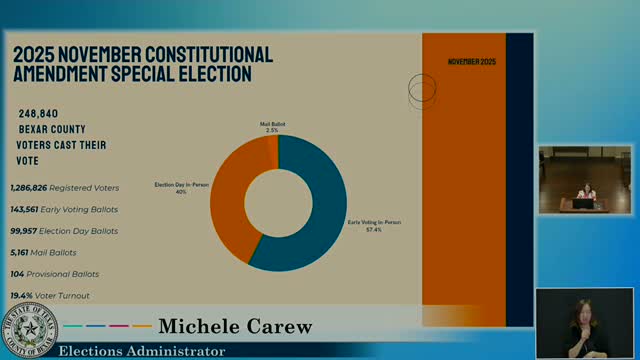
Carew said the county had 1,286,826 registered voters for the November contest and that overall turnout was 19.4 percent, with roughly 248,840 voters casting ballots. Early voting made up about 57.4 percent of participation, election‑day voting roughly 40 percent and by‑mail ballots about 2.5 percent. "We were at 99,957 voters" on election day at one point, she said, summarizing hourly traffic and noting peak lines of several thousand per hour at busy locations.
The administrator told commissioners the county fell short of the state guidance of 388 vote centers and instead operated 285 locations because multiple school districts and some sites declined or were unavailable. That shortfall, combined with a long ballot (Carew cited 17 constitutional amendments during the election), contributed to long lines at several sites.
Carew defended a decision late on election night to delay releasing preliminary early‑voting totals, saying she had consulted Christina Atkins at the Secretary of State's office and relied on provisions meant to avoid influencing voters who were still in line. "I spoke with Christina Atkins... she provided to me these two provisions that would prohibit me from releasing the numbers at 7:00," she said. She also flagged an incoming state law referenced as Senate Bill 2753 that will require combined reporting of early and election‑day results beginning in 2026–2027 and said the county must decide how to implement that change.
On operational fixes, Carew said the office has rolled out a new poll‑worker portal to centralize outreach and training, hired two trainers to provide hands‑on sessions, created a planned user guide with "red/yellow/green" tabs for opening/operations/closing, and required staff to work at poll sites to gain firsthand experience. She outlined changes to chain‑of‑custody procedures after discovering ballots were sometimes not returned directly to county custody: "After the box is sealed, it shall be delivered to the central counting station by two election officers," she read from the Texas Election Code and said the office added lanes and drop‑off procedures to speed return and reduce backlog.
Carew disclosed personnel and cost figures for the backlog and rollout. She said 14 nonexempt full‑time employees logged 1,353 overtime hours and that the county contracted 68 temporary workers who together recorded roughly 5,900 hours; the temporary staffing cost was $156,467.87. She said those temps were essential to clear a backlog that reached about 52,000 voter applications and later averaged up to 72,000 reported application items during the surge when people were also visiting DPS.
On accessibility, the administrator said the county added DeafLink to every voting location and plans to purchase a new rolling apparatus to make voting machines easier to use for voters with disabilities. She also told commissioners that the county had been awarded $4,000,000 in Help America Vote Act funds from the Secretary of State's office; Carew said the grant carries a 20 percent local match and that prior purchases of poll pads can count toward that match. "They initially offered the large counties $86,000. I countered offered with $4,000,000, and they granted us $4,000,000," she said.
Commissioners pressed for more detail on training and data‑cleanup. Several members asked why some poll pads displayed duplicated or garbled addresses; Carew said the voter registration data came from the state TEAM system and contained inconsistencies (for example double street names or former names recorded in the system) that must be cleaned up jointly with the Secretary of State's office. "The data that was there of course, I would be frustrated too... but that's something that we're definitely working with the state on," she said. She described logic‑and‑accuracy tests on poll books and additional trainings but acknowledged the rollout required pivots when the TEAM system and vendor updates arrived at different times.
Carew described other process changes: adding a sealed envelope and copy of application paperwork to early‑voting ballot packets to meet signature verification needs, moving some ballot‑processing steps to a larger mail room with camera coverage while keeping ballots stored in secured rooms, and improving payroll processing so temporary workers receive timely checks.
County leaders praised the staff and urged continued communication with the public and poll workers. The county judge, who convened the commission after a long interval without meetings, said the session was meant to solicit candid feedback and to improve voter education and customer service ahead of the next elections.
Next steps Carew outlined included monthly planning meetings with party chairs through February, a December review of planning and ballot language, a January meeting to finalize early‑voting plans, and expanded outreach to secure more polling locations. The commission did not take formal action at the meeting; members provided feedback for the administrator to incorporate into the office's work plan.