Get Full Government Meeting Transcripts, Videos, & Alerts Forever!
Get email alerts on the Veterans Treatment Court topic
No spam. Unsubscribe anytime.
Judge: Bexar County veterans treatment court to start wait list as demand outpaces staff
Summary
Judge Dominguez and program staff told commissioners the county’s veterans treatment court is serving growing numbers of veterans and faces a staffing shortfall that could force a wait list; the judge asked the court to consider funding personnel and a magistrate judge to expand capacity.
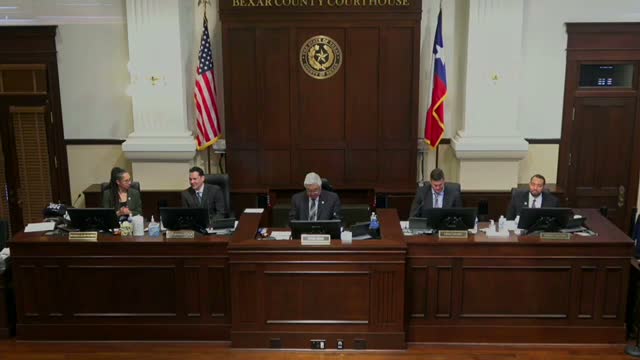
Judge Dominguez, who oversees Bexar County’s Veterans Treatment Court, warned commissioners on Nov. 18 that demand for the program has outstripped available staffing and that the court is preparing to start a wait list unless the county provides additional resources.
"We are preparing to start a wait list because the demand for treatment and supervision now exceeds our staffing capacity," Judge Dominguez said, describing veterans who need timely clinical care and supervision but cannot yet be enrolled.
Roberto Ruiz, project director for the Veterans Treatment Court, told the commissioners that the program has steadily grown: the court served roughly 205 veterans in fiscal 2024 and had a current census of about 134 active participants as of Nov. 18. Ruiz said the program posts high retention and graduation rates and has reorganized dockets by clinical need to improve outcomes.
The judge said requests for added resources are not theoretical. He reported more than 160 veterans were in the Bexar County Jail on Veterans Day and that one of the program’s primary grants may not continue to fully fund personnel. "For the first time since the inception of the veterans treatment court, we are preparing to start a wait list," Dominguez told the court, urging action to maintain access.
Commissioners asked for cost details and operational clarifications. In response, Dominguez said a prior request for magistrate coverage had been roughly $90,000 when the court sought it previously; he also outlined needs for urine‑analysis collections and other clinical supports. Program staff said they would provide follow-up numbers and noted they are prioritizing high‑risk, high‑need veterans for rapid access.
The presentation did not include a formal county appropriation during this meeting; Dominguez asked the court to consider short‑term general‑fund support and to revisit staffing and magistrate coverage at a future session. The court did not vote on a funding motion at the Nov. 18 meeting; staff were asked to return with specific budget figures and options.
What’s next: Veterans Treatment Court staff will return with detailed cost estimates and proposed steps, including the magistrate request and possible general‑fund support, so the commissioners can consider formal budget action.