Get Full Government Meeting Transcripts, Videos, & Alerts Forever!
Get email alerts on the Facilities Master Plan topic
No spam. Unsubscribe anytime.
Grand Traverse leaders weigh renovating, repairing or redeveloping Governmental Center
Summary
County and city officials held a joint study session to review a 2023 facilities assessment and three options for the Governmental Center — modernize, target deficiencies, or vacate and redevelop the site — and assigned the joint building commission to refine costs, cost-sharing and next steps.
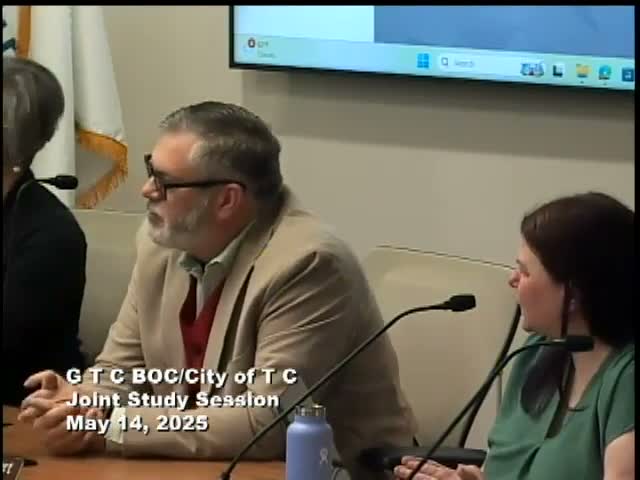
Grand Traverse County and Traverse City leaders met in a joint study session to review a Facilities Master Plan and a 2023 facility assessment for the Governmental Center, weighing three broad options — modernization, targeted repairs, or vacating the site for redevelopment — and directing the joint building commission to refine costs and a timeline.
The session, opened by Chairman Seaford, included a presentation from Ryan Archer of Tower Pinkster, who described the consultant team's multidisciplinary visual assessment of county and city facilities and a line-item costing process based on 2023 prices with an applied 10–15% escalation. Archer said the team rated components as "good, fair, poor and replace," and called out major mechanicals such as air handlers and the chiller as the highest-cost items. "Those are very large costs — basically seven-figure numbers — and if they go down operationally it can have a very large impact on how you do business in the building," Archer said.
Deputy County Administrator Chris Forsyth and other staff framed three options for commissioners: 1) a modernization that updates systems but leaves the building footprint largely intact; 2) addressing deficiencies (focused replacement of items rated poor/replace); and 3) consider whether the parcel and parking could be repurposed or redeveloped to meet broader community needs. Forsyth said the joint building commission — composed of the mayor, city manager, county board chair and the county administrator — should be the forum to "flesh out" the options and next steps, including design, financing and schedule.
John Chase, Grand Traverse County parks and facilities director, described recent operational problems that have raised urgency for some repairs: repeated HVAC events that forced building closures, degraded parking surfaces with potholes, and an aging chiller that currently uses an open-loop system discharging to the river. Chase said the county plans to replace the chiller this fall. "That chiller system is an open loop system that draws from a well and it ejects water when it's finished out to the river. That just isn't something that we can continue to do," Chase said.
Commissioners pressed staff on technical and legal constraints. The consultant said the assessment did not include a full structural analysis — only visual inspection — and that detailed stormwater work was not separately line-itemed in the walkthrough costs. Commissioners also asked how much of county operations must remain in the county seat; staff noted state law requires maintenance of a principal office for elected officials but said many operational functions can be distributed if legal requirements are preserved.
Cost examples surfaced in discussion: Archer described restroom upgrades on the first floor as a per-square-foot estimate (roughly 100–170 square feet per restroom) and said window-frame-and-glass replacements are treated as one-for-one envelope repairs. Commissioners noted a condensed board packet and a fuller report with a different summation number; staff said packet excerpts differed from the full published summation and agreed to reconcile the materials.
A city official asked for clarification on a recent county procurement to replace the chiller, noting the county approved a not-to-exceed bid near $482,000 and saying the city's pro rata share is "roughly 24%, which is about $115,000," and requested guidance on whether the city needs a contract or budget-amendment approval. Forsyth and staff said they would work with the joint building commission to clarify cost-sharing and to ensure parallel commission agendas and consistent communication.
The session also included public comment. Justin Reed, a Traverse City resident, urged elected officials to address governance and finances at Northern Lakes Community Mental Health, citing news reports of an estimated $12,000,000 shortfall and warning counties could be asked to cover deficits if the agency lacks general-fund resources. Bruce Moore, an East Bay Township resident, asked the consultant to include bicycle-parking assessment in site planning.
Commissioners agreed the joint building commission should refine designs, costs and decision points and recommended a follow-up study session (some suggested an evening meeting) within roughly 45 days of the joint session. Staff said if design development advances for any component (for example, an emergency operations / 9-1-1 center), the project team would return with refined budgets and schedules for formal consideration.
The meeting concluded with a procedural adjournment and a volunteer building tour.
The joint commission will be asked to: reconcile packet vs. published report numbers, define cost-sharing protocols for near-term repairs such as the chiller, refine cost estimates and project scopes for the three options, and propose a timeline and public-engagement plan for any redevelopment option.