Get Full Government Meeting Transcripts, Videos, & Alerts Forever!
Get email alerts on the Project Alpha topic
No spam. Unsubscribe anytime.
County approves solar panels and a backup well for Project Alpha buildings
Summary
After a Project Alpha update from the county's construction team, commissioners voted to proceed with rooftop solar on both the Emergency Operations Center and County Office Building and to authorize civil-drawing updates and construction of a backup potable well.
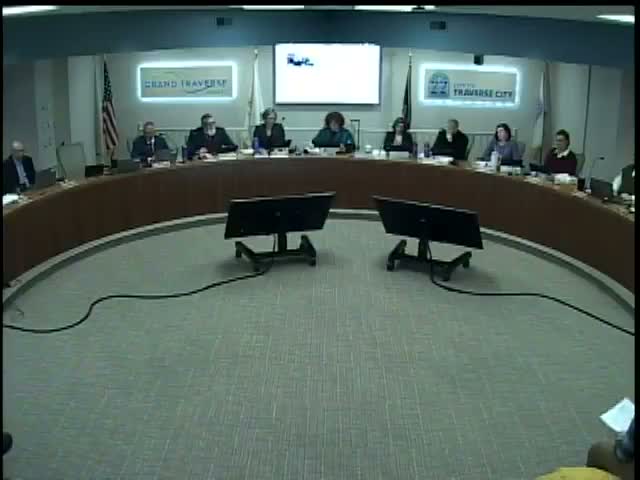
Grand Traverse Countycommissioners on Dec. 3 approved adding rooftop solar arrays for two Project Alpha buildings and authorized civil-design updates and a backup well after receiving a construction update.
Jerry Tomczak of Cunningham Limp Construction reported that final construction documents (CDs) for the EOC and County Office Building (COB) are expected in January. A solar evaluation showed roughly 86-90 kW of capacity on flat-roof areas; with an assumed 30% federal tax credit the estimated payback is about 13.9 years, and without the credit the vendor estimated a 24-year payback. Tomczak said updated pricing came in roughly $200,000 lower than earlier estimates for both buildings combined.
On the well, staff and the contractor reported that removing the previously planned backup tank and fire pump materially reduced cost; the updated plan limits the well to potable backup usage and irrigation, with estimated installation in the $25,000to$30,000 range for potable hookup (contractor figures provided). The well would not be sized for fire suppression, which avoids larger pump and tank costs.
Commissioner Andrews moved to proceed with solar panels on both the EOC and COB, and Commissioner Walter seconded. The board adopted a friendly amendment to approve the $9,000 increase to civil-engineering drawings and to construct the well. The motion passed by voice vote.
Why it matters: The county is designing its emergency and administrative facilities with energy and resiliency measures in mind; the approved solar work and smaller backup potable well aim to offset energy use and provide limited redundancy in the event of public-water outages without incurring the cost of a full fire-suppression well system.
Attributions: Jerry Tomczak (Cunningham Limp) presented cost and capacity numbers; Bobby Peplinski (Cunningham Limp) clarified ROI and well details; commissioners asked for state and utility incentive options and additional procurement follow-up.