Get Full Government Meeting Transcripts, Videos, & Alerts Forever!
Get email alerts on the Court Capacity topic
No spam. Unsubscribe anytime.
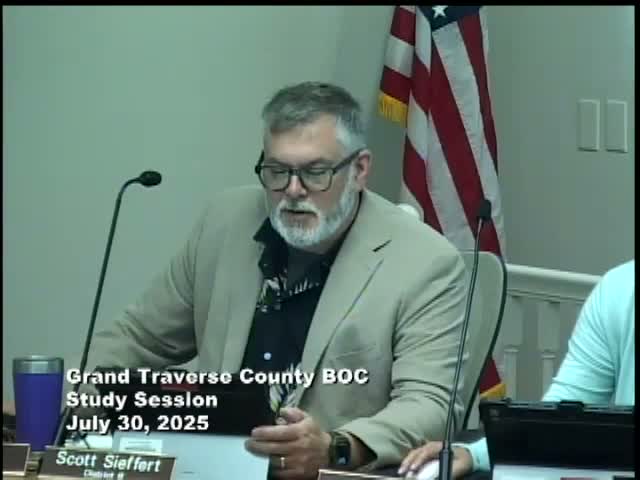
Grand Traverse County commissioners hear request to pursue an additional probate judgeship after state time-study
Summary
Probate Judge Jennifer Whitton told the board a Michigan Supreme Court SCALE time-study found the county 'underjudged by 1.02,' prompting officials to seek a secondary review and submit a letter of support; the state would reimburse a judge's salary but the county must fund benefits and support staff.
Probate Judge Jennifer Whitton told Grand Traverse County commissioners during a study session that a Michigan Supreme Court SCALE time-study found the county's combined circuit and probate dockets "underjudged by 1.02," which the judges interpret as a need for roughly one additional judgeship.
Whitton said an additional elected probate judge would primarily handle family-division work and help shorten hearing timelines that now push criminal trials into early 2026 and delay contested civil and family matters. "We are underjudged by, at least 1 judge," Whitton said, noting the court is participating in a required secondary review by the Supreme Court.
The SCALE review is only the first step in a multi-branch process Whitton described: the Supreme Court's recommendation would go to the legislature (which typically reallocates, rather than adds, judgeships), then to the governor, and finally to an election if the position is approved. Whitton and other presenters said a practical earliest start date for a new judge would be January 2027 if the legislature and governor approve a position in 2025 or 2026.
The presenters told commissioners that while the state reimburses the salary of an elected probate judge, the county would be responsible for benefits and local support staff. They listed likely support roles: a court recorder or court reporter (one or the other), an office specialist, and potentially a staff attorney. Commissioners and presenters discussed approximate salary ranges mentioned in the packet: a staff attorney in the ballpark of $76,000 a year, a court reporter/recorder at roughly $58,000'$78,000, and an office specialist near $49,000, though presenters said exact figures would be refined.
Commissioners pressed for quantification of benefits to the public, asking for current wait times by case type and estimates of how quickly those would shorten with an added judgeship. Commissioner Andrews asked whether specialty courts (domestic violence, juvenile mental-health) or the use of magistrates could be alternatives; Whitton and other presenters said additional judicial capacity would provide the scheduling space to expand specialty dockets and thereby improve outcomes.
Several commissioners raised the political reality that the legislature often shifts judgeships rather than creating new ones, turning the question into a regional contest. "It becomes a political process," a presenter said, cautioning that Lansing could reassign an existing judgeship rather than add one.
Rather than suspend board rules to adopt a same-day resolution, commissioners asked county administration to draft a letter of support to append to the Supreme Court submission and bring a resolution for formal board action at a later regular meeting if needed. Chair directed county administration to prepare the letter for commissioners to review and act on at a future meeting.
Next steps: the county will prepare supporting materials for the Supreme Court's secondary review and the board will consider a formal resolution at a subsequent meeting if commissioners decide to commit local resources or authorize an official endorsement.