Get Full Government Meeting Transcripts, Videos, & Alerts Forever!
Get email alerts on the Ethics Policy topic
No spam. Unsubscribe anytime.
Grand Traverse County commission reviews near‑wholesale rewrite of code of ethics, debates enforcement and panel structure
Summary
The Grand Traverse County Board of Commissioners reviewed a near‑complete redraft of the county’s code of ethics that would standardize definitions and reporting and create an ethics panel for credible complaints involving commissioners or appointees. Commissioners debated whether the panel should be standing or ad hoc, added notice and appeals language, and directed staff to increase the meal‑gift threshold and return with two panel‑structure options.
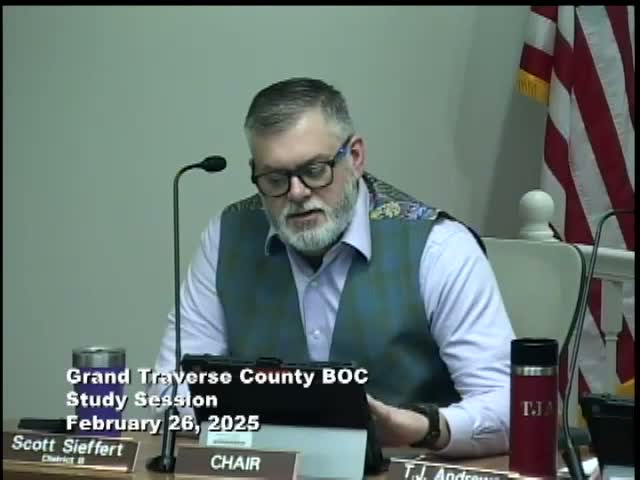
The Grand Traverse County Board of Commissioners on a study‑session meeting reviewed a near‑wholesale redraft of the county code of ethics and debated how complaints would be investigated and enforced.
County staff presenter Matt Gales told the board he rewrote the policy to provide uniform definitions and a consistent reporting and enforcement process covering county commissioners, other elected officials, appointees and employees. “I would consider this, more of a wholesale redraft of a code of ethics for your consideration,” Gales said, summarizing why a redraft was necessary to make reporting and enforcement comprehensible.
Why it matters: Commissioners said the current policy lacks clear teeth for elected officials and asked that the draft explicitly describe how allegations are screened, who appoints an ethics panel and what remedies are available. Several members stressed the public‑accountability role of the policy and the need for due process for respondents.
Key points and debate - Administrative screening vs. immediate panel referral: Gales said the draft contemplates an initial administrative credibility review by HR or administration; credible complaints that involve commissioners, countywide elected officials or board appointees would be referred to an ethics panel. Commissioners pressed whether certain categories of allegations should bypass internal review and go straight to an outside or board‑appointed panel.
- Standing vs. ad hoc panel: Commissioners offered contrasting views. Some supported a standing appointed panel to reduce ad‑hoc political choices and provide continuity; others favored an ad‑hoc panel drawn from an applications pool at the time of an incident to lessen the chance a standing member would have a conflict. Gales said the draft permits board discretion and alternates and indicated he would prepare options.
- Notice, appeal and mediation: Commissioners asked for explicit notice to any person who is the subject of a complaint and an appellate path if someone believes an initial determination was incorrect. Several members supported including mediation as an available outcome; Gales and other participants noted mediation would be voluntary and that the panel’s recommendations would be options for the board to consider.
- Enforcement scope: Commissioners discussed what the policy should enable the board to do short of statutory removal (which is governed by state law), including censure, removal from board appointments, contract invalidation or rebids, and other administrative remedies. Staff clarified that statutory removal of certain appointees follows section 46‑11n and is a separate legal process.
- Gift and meal threshold: The draft included a guideline allowing food or refreshments not to exceed $100 per person; commissioners argued that amount was low and asked to raise it. Gales said he had already increased the meal threshold in his working version to $200.
Outcome and next step: Commissioners did not take action at the study session. They directed Gales to return the policy with clearer language on notice and appeals, an explicit mediation option, and two variants for the ethics panel (standing appointed and ad‑hoc/apply‑when‑needed) so the board can consider those alternatives at a future regular meeting.
Quotes from the meeting “Those policies work best when people are on the side of disclosure,” Gales said, urging broad disclosure of potential conflicts even when not legally prohibited. Commissioner Andrews asked for an affirmative notice provision: “It seems like somebody… should get notice of that.” Commissioner Spence argued a standing appointed panel would reduce political bias and training inefficiencies, while others remained concerned about possible conflicts if commissioners sat on the panel.
What remains unresolved: The board did not settle on standing versus ad‑hoc panel membership, the final wording of the appeals process, or whether some complaint types should bypass administrative screening. Staff will return with revised drafts and alternatives for formal consideration at a future regular meeting.
The board moved on without taking formal action on the item.