Get Full Government Meeting Transcripts, Videos, & Alerts Forever!
Get email alerts on the Homelessness topic
No spam. Unsubscribe anytime.
Grand Traverse County Board approves two‑year funding pledge to help Safe Harbor operate year‑round shelter
Summary
The Grand Traverse County Board of Commissioners approved a resolution to provide Safe Harbor $200,000 in 2025 and to budget $200,000 for 2026 to support a year‑round emergency shelter; the measure includes monthly metrics and a service agreement, and passed after discussion on funding source and oversight.
The Grand Traverse County Board of Commissioners voted to support Safe Harbor’s plan to run a year‑round emergency overnight shelter by approving a resolution that commits $200,000 for 2025 and budgets $200,000 for 2026, subject to a service agreement and agreed reporting metrics.
At a presentation to the board, Sakura Takano, CEO of Rotary Charities, and Patrick Livingston, chair of Safe Harbor’s board, described the shelter as a volunteer‑run nonprofit that runs a 74‑bed seasonal operation and estimates a year‑round budget of about $1.1 million. Livingston said the two‑year county commitment would allow Safe Harbor to hire necessary staff, secure volunteers and complete city permitting so the shelter can operate after April 30. “We are asking Grand Traverse County to make a $200,000 commitment for each of the next two years to close the funding gap needed to operate the shelter year‑round,” Livingston said.
The resolution requires Safe Harbor to provide monthly metrics to the county, including age, gender, county of origin and veteran status, and to work with community partners on coordinated entry and diversion. Commissioners and service‑provider partners said those data will be used to track occupancy, outcomes and whether services are reaching county residents.
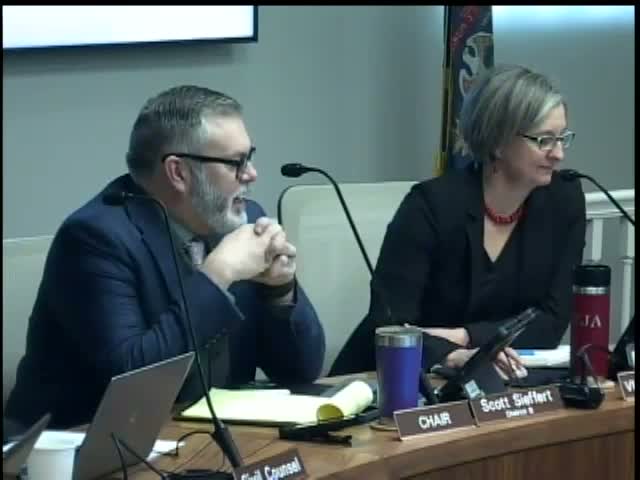
Commissioners debated funding sources and oversight before the vote. Commissioner Nelson opposed using general fund dollars without a formal process and urged the board to consider specific dedicated funds (such as opioid‑ or cannabis‑related revenues) or an application process for grants. “I can’t support putting money out from that bucket of money [the general fund] unless we have an appropriate process,” Nelson said. By contrast, Commissioner Andrews and others argued that the county’s existing fund balance and contingency make the requested amount manageable and that the tasks and metrics in the resolution provide accountability.
Sheriff Mike Shea told commissioners that homelessness affects county services and law enforcement calls for service and urged that enforcement and diversion be part of broader planning. Ashley Halliday Schmitt, director of the Coalition to End Homelessness, told commissioners that providers already collect much of the requested data and that diversion and coordinated entry are part of their existing practice.
The board approved the amended resolution by roll call. The clerk recorded Nelson voting “No”; the other named commissioners present voted “Yes” and the motion carried. The board directed staff to finalize a services agreement incorporating the friendly edits discussed in chamber, including clarifying language about reporting alleged criminal activity and the metrics to be collected. County administration indicated contingency/general fund dollars would likely cover the 2025 payment and that staff will budget the 2026 amount in next year’s budget.
Next steps: County staff will finalize the services agreement and return the agreement or required materials to the board for administrative processing, and Safe Harbor will provide the monthly metrics required by the resolution.