Get Full Government Meeting Transcripts, Videos, & Alerts Forever!
Get email alerts on the Behavioral Health topic
No spam. Unsubscribe anytime.
Munson says new crisis center opened Jan. 5; officials outline phased plan to reach 24/7 services
Summary
Munson Healthcare told the Grand Traverse County Board the new Scribe & Access Center launched phase 1 on Jan. 5, saw 11 patients its first week and will expand in phases to 24/7 operations and licensed residential beds, with a mix of ARPA and state grant support.
Munson Healthcare told the Grand Traverse County Board of Commissioners that the county‑supported mental‑health crisis facility on the Munson Medical Center campus opened Phase 1 on Jan. 5 and will expand in phases to round‑the‑clock services and licensed crisis residential units.
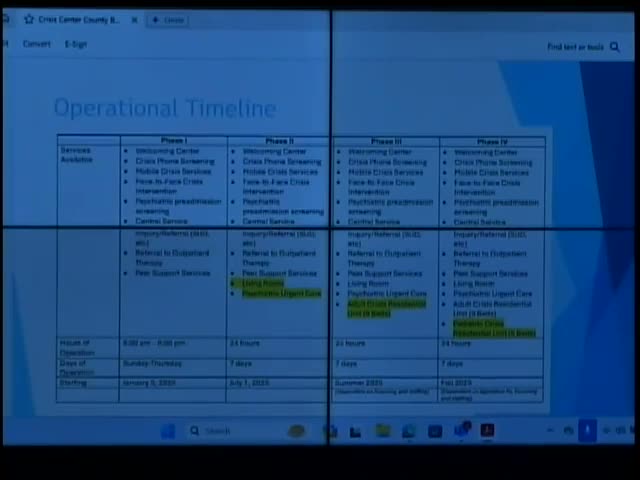
Laura Glenn, chief operating officer of Munson, said the center’s Phase 1 operates 8 a.m.–8 p.m., Sunday through Thursday, and provides a welcoming space, face‑to‑face crisis intervention and referrals to outpatient and peer supports. “We launched phase 1 on Sunday, January 5,” Glenn said, and added that the center saw 11 patients in its first full week, ranging in age from about 20 to 73, with seven patients from Grand Traverse County.
The presentation to commissioners laid out a four‑phase rollout. Phase 2, targeted for July 1, will add a living‑room model and psychiatric urgent care and move the center toward 24/7, 365‑day operations; a licensed adult crisis residential unit with nine beds is planned for the summer (licensure dependent); and a pediatric crisis residential unit with six beds is planned in a later phase.
Glenn and Brian Martinez, interim CEO of Northern Lakes Community Mental Health, said the center’s financing uses a mix of county ARPA funds, state grants and other sources. Glenn said the county’s ARPA contribution remains part of a broader funding package and that the facility also received a $5,000,000 state grant for pediatric services; together with other support, she said the project has about $10,000,000 in grant backing. “We have not expended any of those funds yet,” Glenn told the board; she said some state dollars are being repurposed to support operational startup costs for the psychiatric urgent care.
Commissioners pressed Munson and Northern Lakes about transparency, operations and sustainability. Commissioner Walter asked whether the center is tracking how patients arrive and how referrals are made; Glenn said tracking is currently manual but that staff are building automated data collection into their health‑record systems. Commissioner Andrews asked why the county originally planned the project with Northern Lakes (a public body) and later contracted with Munson (a private health system) and sought clarity about the legal and financial arrangements that govern operations. Munson said there are two written agreements: an operating agreement addressing decision‑making and a lease for space; the operating agreement includes a shared staffing arrangement and clear billing responsibilities to preserve public transparency where Northern Lakes is a public provider.
Munson said long‑term sustainability will rely on billing commercial insurers and Medicaid where possible, supplemented by grants and philanthropy to cover gaps while patient volumes ramp up. Glenn said the pediatric crisis residential licensure poses timing risk and that the licensure process may shift openings later if regulators require changes.
The board did not take formal action tied to the presentation but directed staff to continue monitoring operations, data tracking and licensure progress and to report back with metrics the community advisory group requests.