Get Full Government Meeting Transcripts, Videos, & Alerts Forever!
Get email alerts on the Housing Policy topic
No spam. Unsubscribe anytime.
County adopts interim checklist for tax‑incentivized rental housing amid debate over affordability floor
Summary
The Grand Traverse County Board on Jan. 21 adopted interim guidelines requiring earlier county review of projects seeking tax incentives; commissioners debated a proposed 20% minimum of units rented to households under 100% AMI but approved the checklist as a starting point. 7‑1 vote.
The Grand Traverse County Board of Commissioners voted 7‑1 on Jan. 21 to adopt an interim checklist intended to give the county earlier, concurrent review of rental housing projects that seek tax increment financing (TIF) or payments in lieu of taxes (PILOTs).
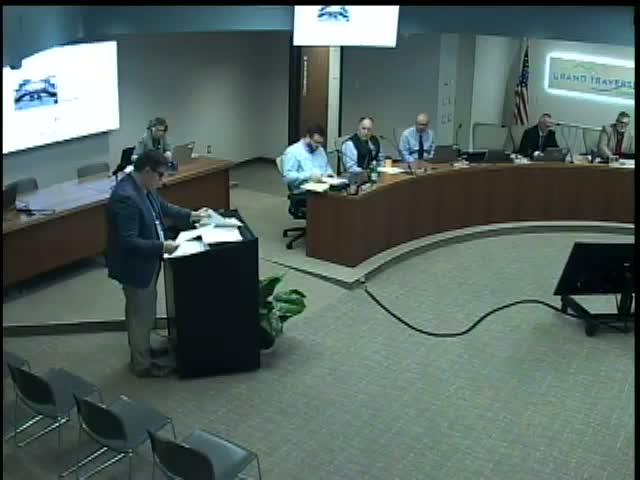
The checklist, introduced by Commissioner Andrews and presented by Maxwell Cameron, the county’s community development coordinator, is meant to funnel proposed projects into a standardized review at the time an application is filed so county staff and commissioners can raise concerns before local approvals are final. “The first item is a proposal to adopt interim guidelines for rental housing projects involving tax increment financing and payments in lieu of taxes,” Cameron told the Board during the presentation.
Why it matters: commissioners said the county has repeatedly seen housing and TIF projects arrive as near‑final proposals, limiting the Board’s ability to shape outcomes. The checklist aims to reduce that last‑minute presentation and make expectations clearer for developers seeking public incentives.
What was debated: A central point of contention was a proposed affordability floor: the draft requires that a minimum of 20% of units in an incentivized rental project be rented to households at less than 100% Area Median Income (AMI) to be eligible for the funding incentives. Commissioner Walter asked directly, “why 20%? That seems low to me,” and other commissioners said they preferred a higher percentage but worried that a higher minimum could deter projects from coming forward. Proponents noted the 20% figure was used in related brownfield guidelines and that the checklist is interim and subject to revision after a future housing feasibility study.
Vote and next steps: Commissioner Andrews moved to adopt the interim checklist; Commissioner Morris seconded. The roll-call vote recorded one no (Commissioner Walter) and all other present commissioners in favor. The board directed administration to implement the checklist as interim guidance and to proceed with a housing feasibility study that could inform future changes.
Board action details: Motion to adopt the interim guideline checklist for rental housing projects involving TIF/PILOTs (mover: Commissioner Andrews; second: Commissioner Morris). Roll‑call recorded in the meeting transcript; outcome approved.
The Board also discussed implementation mechanics — for example, routing application notices to a named staff contact so the county receives project materials at the time they’re filed with local units — and emphasized the checklist is designed to be a living document.
The Board’s adoption of the checklist was the most significant policy vote of the meeting; commissioners asked staff to report back on practical implementation and to return analysis from a contracted housing feasibility study when available.