Get Full Government Meeting Transcripts, Videos, & Alerts Forever!
Get email alerts on the University Strategic Plan topic
No spam. Unsubscribe anytime.
University of Tennessee trustees approve 2030 strategic plan and hear chancellors27 progress reports
Summary
The University of Tennessee Board of Trustees unanimously adopted a systemwide strategic plan to guide 2030 goals for enrollment, research and infrastructure and approved multiple campus items, including a UT Martin student code of conduct and several budget and tuition proposals. Trustees also reviewed campus updates on enrollment gains, research initiatives and capital projects.
The University of Tennessee Board of Trustees approved a systemwide strategic plan aimed at making 20202930 "the greatest decade" for the system and heard a series of chancellor updates on enrollment, research and capital projects at a board meeting in Memphis.
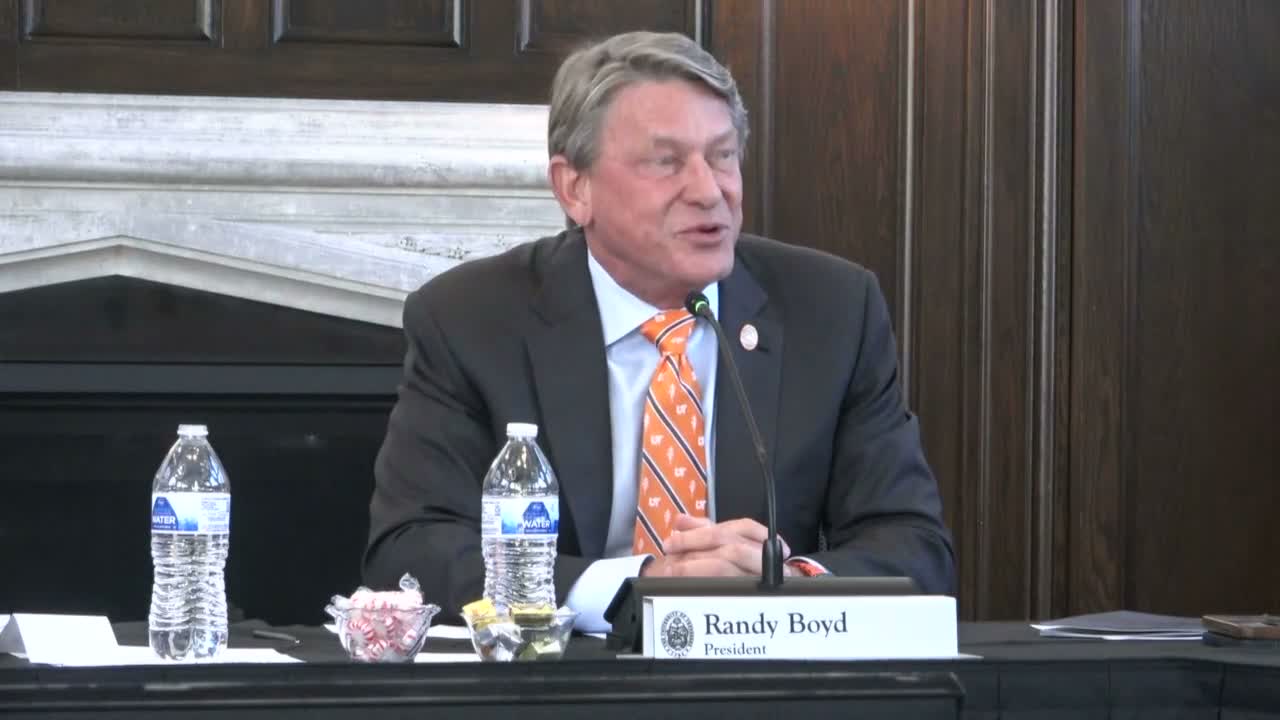
The adoption came after a presentation by President Randy Boyd, who framed the plan around student success, research and innovation, workforce needs and community engagement. Boyd said the plan ties measurable KPIs to system goals and asked trustees to shift from approval to implementation. "This is our roadmap," Boyd said during the presentation, adding the plan includes targets for raising enrollment, lifting retention and growing research expenditures over the decade.
Chancellors used brief, focused updates to report campus-level progress. Peter Buckley, chancellor of the UT Health Science Center, highlighted a Tennessee Department of Health grant and ongoing capital plans: "Tennessee Department of Health enabled us through a $12,000,000 grant late last year to create a center of excellence for rural health care," Buckley said, and described a proposed interdisciplinary building in Memphis that would move to the legislature in April and, if approved, proceed to the state building commission this summer.
Yancey Freeman of UT Martin summarized enrollment and capital priorities for his campus, including new academic programs and a planned 406-bed residence hall. Melinda Arnold said UT Southern is seeing double-digit growth and higher retention after organizational changes; Laurie Bruce at UTC reported record enrollments, a stronger research portfolio and a $1.3 million NSF planning grant supporting quantum-related research.
Trustees also received a report from the Audit and Compliance Committee that a state audit issued an unmodified opinion but identified one control deficiency the auditors classified as a "material weakness." Trustee DeCosta Jenkins summarized the committee's review and said management provided a corrective action plan; Jenkins noted state audit staff told the committee they were "pleased with the corrective action plan to resolve the material weakness." The board heard that management will track remediation through the committee process.
Votes at a glance: The board adopted the UT strategic plan by voice vote after a motion from the floor; the board then approved multiple committee recommendations and consent items. The Education, Research and Service Committee27s recommendation to revise the UT Martin student code of conduct was approved by roll call (Aye; unanimous). The Finance Committee's package—including the 2026 operating budget, the UT Health Science Center 2027 tuition proposal and a 2027 state budget amendment request—was likewise approved. The full consent agenda (minutes, resolutions, the Cherokee Mills acquisition and other items) passed by voice vote; Trustee Bill Rhodes recused himself from the Knoxville bank-loan matter.
What trustees asked and next steps: Board members pressed chancellors on the infrastructure and program support needed to meet enrollment and research targets and discussed priorities for tracking persistence and graduation metrics across the system. President Boyd and chancellors emphasized that many initiatives (new degree modalities, capital projects, research districts and public-private facility leases) will require further approvals and legislative support. Trustees were told the proposed Memphis medical/health sciences building currently has $311 million in the governor's budget toward a $350 million project and that the system is actively fundraising to close the roughly $39 million shortfall.
The board concluded with committee reports and direction for follow-up items; several requests for additional data and continued committee oversight were recorded. The meeting recessed with plans to continue work on implementation and monitoring of the approved strategic plan.