Get Full Government Meeting Transcripts, Videos, & Alerts Forever!
Get email alerts on the Vector Control Surveillance topic
No spam. Unsubscribe anytime.
Acting vector control chief reviews 40 years of county work, flags avian-flu findings in wild birds
Summary
Adena Y, acting chief of the Alameda County Vector Control District, told the Health Committee the district has expanded from sewer rodent control into broad disease surveillance, laboratory testing and wildlife monitoring — and confirmed multiple wild-bird avian influenza positives during 2023–24 testing.
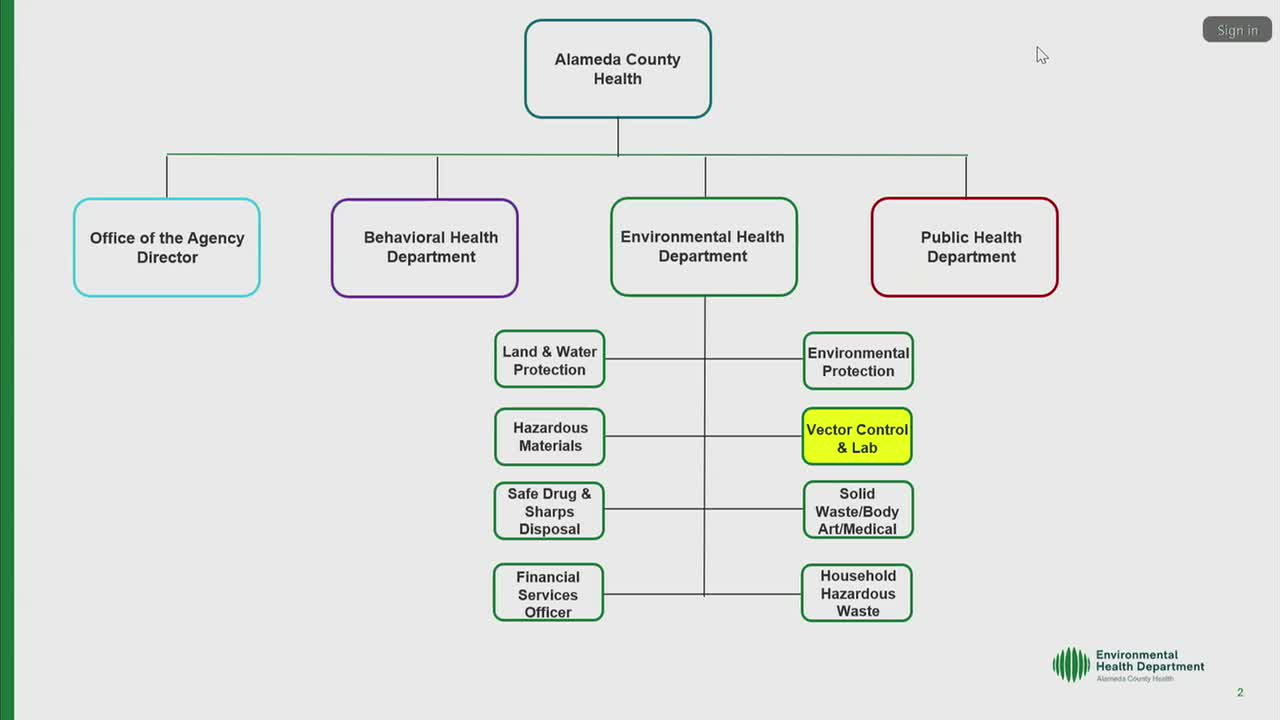
Adena Y, acting chief and scientific program manager for the Alameda County Vector Control District, told the Alameda County Board of Supervisors Health Committee on Feb. 24 that the district has grown from a sewer-focused rodent program into a countywide disease-surveillance operation that now tests wildlife, conducts molecular diagnostics and partners with state and federal agencies.
The presentation traced the program’s roots to early mosquito control in the Bay Area and described the county’s separate mosquito-abatement district and the vector-control district formed in 1984 to handle rodents and other non-mosquito vectors. "We inspect over 8,000 manholes a year," Adena Y said, describing a long-running sewer-baiting program funded in part by a local assessment in Oakland.
Why it matters: The district’s expanded laboratory and surveillance work helps local public health officials detect and respond to animal-borne pathogens before they spread to people or commercial flocks. Committee members pressed staff on funding, jurisdiction and how the district coordinates with state and federal agencies when wildlife or agricultural interests are involved.
Key program details: Adena described a 2019 laboratory upgrade that added molecular testing capacity and enabled countywide surveillance for pathogens including flea-borne rickettsial infections (Adena said the district has found Rickettsia felis in opossums, raccoons, skunks, coyotes, cats and feral pigs), hantaviruses (trapped deer mice in rural parks for testing), and an expanded tick-surveillance program after discovery in 2023 of a newly named tick pathogen the presenter called Rickettsial lanii. She said the district also restarted plague surveillance in recent years (all negative) and partners with the California Department of Public Health (CDPH), USDA Wildlife Services and Fish and Wildlife for cross-jurisdictional work.
Avian influenza findings: Adena reported the district began avian influenza surveillance in 2023 and coordinated with the California Department of Food and Agriculture and federal partners when cases emerged. "Out of those 27 birds, 16 tested, 10 came back positive for avian influenza," she said, adding the positive birds were native wild species (songbirds, shorebirds, waterfowl) across multiple cities. The district triages testing toward birds with known human contact or those found in sensitive locations and notifies public health when human exposure is possible.
Funding and service model: The district is funded by benefit assessments, which Adena said provide full program funding (not ad valorem tax dollars) but do not fully cover expanding surveillance costs; existing assessments may increase by up to 3% annually. She noted the longstanding Oakland supplemental assessment of $1.28 remains unchanged since it was placed on the rolls decades ago and does not cover the full cost of the sewer program.
Public concerns and response: In public comment a resident from San Leandro described ongoing neighborhood rat problems and asked if the county sets traps in high-rate areas and how feral cats are monitored. Adena urged the resident to re-contact the district for a site visit, said staff do set traps where practical but are limited by capacity, advised against using feral cats because of disease risks, and emphasized sanitation of chicken coops as a prevention step.
Next steps: Adena said the district will continue the encampment and rodent surveillance programs, expand wildlife testing and pursue publication of new rickettsial findings so other counties can be alerted. The Health Committee did not take formal action; the presentation closed with a brief Q&A and the committee opened and closed the public-comment period.
(Quotes sourced to Adena Y, acting chief and scientific program manager, Alameda County Vector Control District; Anika Choudhry, Alameda County Health, provided the presentation introduction.)