Get AI Briefings, Transcripts & Alerts on Local & National Government Meetings — Forever.
Council reviews two annexation requests, asks staff to prepare separate resolutions and seek attorney guidance
Summary
Enumclaw staff outlined two annexation petitions and recommended modifying their boundaries to include adjacent parcels; council signaled support to process them as separate resolutions and asked staff to ask the city attorney whether applicants could be required to pay consultant costs to manage the workload.
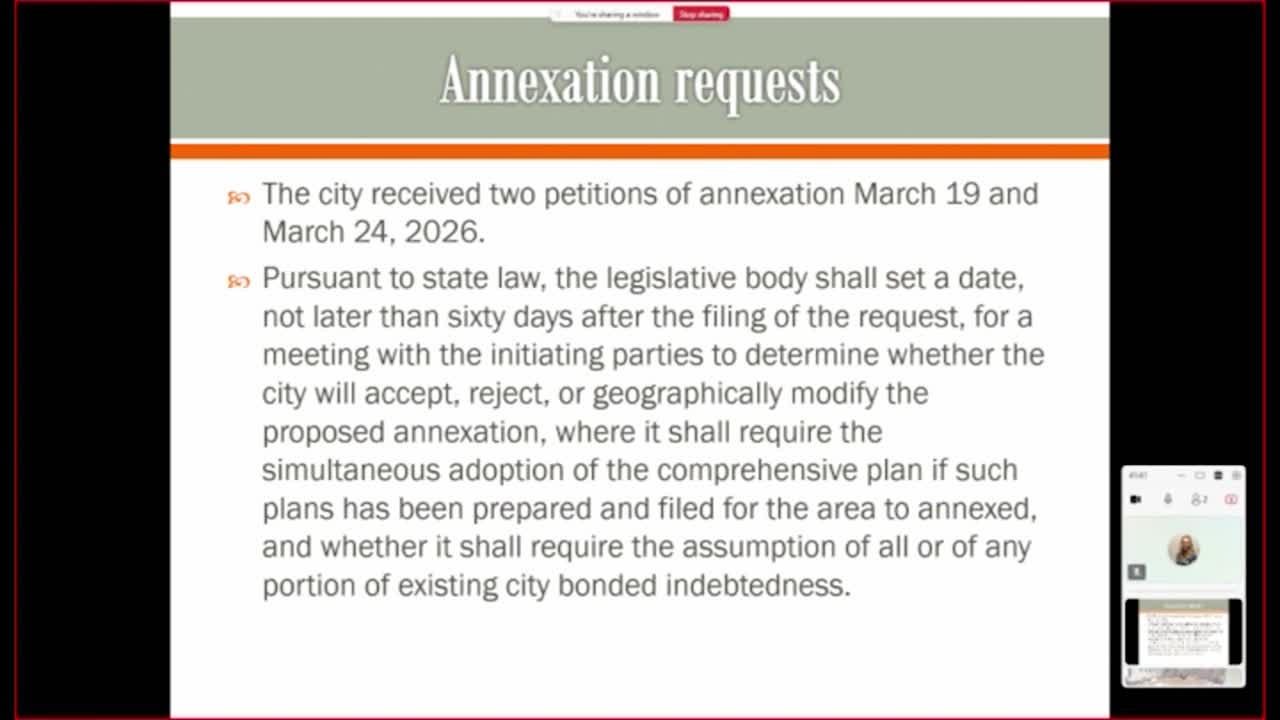
Enumclaw’s city council on April 27 heard a staff presentation on two recent annexation petitions and signaled support for moving the proposals forward as two separate actions while asking staff to seek legal guidance on possible consultant-fee conditions.
Community Development Director Chris Massenet told the council the city received two petitions in March covering five parcels (about 18 acres) and that staff recommended modifying the submitted boundaries to add adjacent parcels for a more regular city limit. With the additional parcels included, staff estimated the total area would be roughly 38 acres with an assessed valuation of about $8.5 million.
“Staff does recommend that it should be processed as 1 annexation request,” Massenet said, while noting the Community & Economic Development committee had reasons to suggest processing them separately.
Council members pressed staff on procedural details, including whether the Tarragon parcels alone would meet the state’s 60% petition threshold for the petition method. Massenet said the largest Tarragon parcels do not by themselves reach 60% of the modified area’s valuation and that, if processed separately, appellants would need at least one additional property owner to sign.
A council member raised concerns about city workload and asked staff to consult the city attorney about whether the council could require applicants to cover the expense of a city consultant to run the annexation process rather than having staff absorb that burden. The council indicated a preference for preparing two separate resolutions (one for each area) with modified boundaries and asked staff to return with attorney guidance and proposed resolutions at the next meeting.
Massenet outlined benefits and trade-offs: annexation would provide city police and utility connections and allow property owners to use zoning options inside the city, but it also can make development easier and reduce the council’s direct discretion over certain regulatory approvals. He cautioned that annexation involves multiple steps including signature collection, county verification and Boundary Review Board review before an ordinance might be adopted.
Next steps: staff will consult the city attorney about the requested consultant‑fee option, prepare draft resolutions reflecting the modified boundaries, and return to council for formal action at an upcoming meeting.