Get Full Government Meeting Transcripts, Videos, & Alerts Forever!
Committee backs staff direction to remove Bethesda development cap, tighten monitoring and advance rec‑center and park changes
Summary
County planning staff recommended removing the downtown development cap in a Bethesda Minor Master Plan amendment after scenario testing, proposing a clarified monitoring regime, transportation measures, a prioritized downtown recreation center, a shifted Veterans Park expansion, an increased park impact payment ($15.57/sf) with split collection, and a framework to credit privately owned public spaces; committee members asked for clearer language, data and examples and asked staff to return.
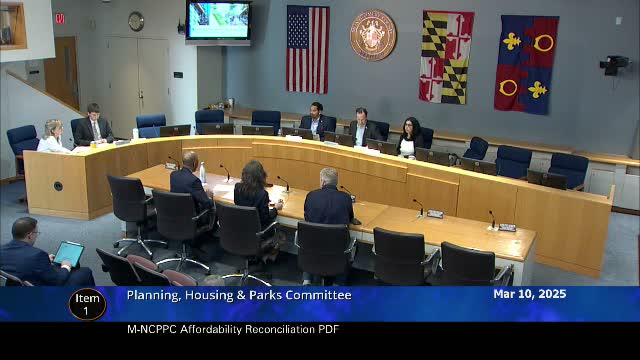
Montgomery County planning and parks staff presented a package of changes to the Bethesda Minor Master Plan that would lift the downtown development cap, tighten monitoring and implementation mechanisms, and push several community priorities — including a downtown recreation center and clarified direction for Veterans Park — while increasing the Park Impact Payment and creating a framework to credit privately owned public spaces.
Council staff explained that ‘‘minor’’ master plan amendments revisit focused elements of an adopted plan without reopening the entire 2017 Downtown Bethesda plan. Planning staff said their core recommendation would remove the square‑foot development cap in the Bethesda overlay zone and that they tested three growth scenarios (about 11 million, 16 million and 21 million additional square feet over the plan baseline through 2045) to evaluate transportation, school capacity and climate effects.
The transportation analysis measured five adequacy metrics — auto and transit accessibility, travel times, vehicle miles traveled per capita (VMT), non‑auto driver mode share, and low‑stress bicycle accessibility — and found all three scenarios would raise accessibility and low‑stress bicycle access while producing modest increases in travel times (roughly one to two minutes) and mixed effects on VMT. Planning staff said cluster‑level MCPS projections show surplus seats in the Bethesda‑Chevy Chase cluster but cautioned that cluster‑level surplus does not…
Already have an account? Log in
Subscribe to keep reading
Unlock the rest of this article — and every article on Citizen Portal.
- Unlimited articles
- AI-powered breakdowns of topics, speakers, decisions, and budgets
- Instant alerts when your location has a new meeting
- Follow topics and more locations
- 1,000 AI Insights / month, plus AI Chat