Get Full Government Meeting Transcripts, Videos, & Alerts Forever!
Get email alerts on the Bethesda Mmpa topic
No spam. Unsubscribe anytime.
Committee backs staff direction to remove Bethesda development cap, tighten monitoring and advance rec‑center and park changes
Summary
County planning staff recommended removing the downtown development cap in a Bethesda Minor Master Plan amendment after scenario testing, proposing a clarified monitoring regime, transportation measures, a prioritized downtown recreation center, a shifted Veterans Park expansion, an increased park impact payment ($15.57/sf) with split collection, and a framework to credit privately owned public spaces; committee members asked for clearer language, data and examples and asked staff to return.
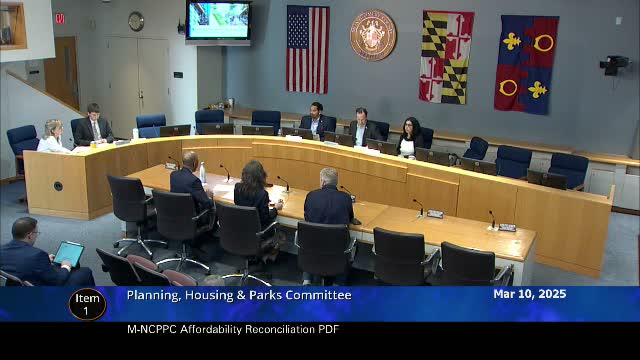
Montgomery County planning and parks staff presented a package of changes to the Bethesda Minor Master Plan that would lift the downtown development cap, tighten monitoring and implementation mechanisms, and push several community priorities — including a downtown recreation center and clarified direction for Veterans Park — while increasing the Park Impact Payment and creating a framework to credit privately owned public spaces.
Council staff explained that ‘‘minor’’ master plan amendments revisit focused elements of an adopted plan without reopening the entire 2017 Downtown Bethesda plan. Planning staff said their core recommendation would remove the square‑foot development cap in the Bethesda overlay zone and that they tested three growth scenarios (about 11 million, 16 million and 21 million additional square feet over the plan baseline through 2045) to evaluate transportation, school capacity and climate effects.
The transportation analysis measured five adequacy metrics — auto and transit accessibility, travel times, vehicle miles traveled per capita (VMT), non‑auto driver mode share, and low‑stress bicycle accessibility — and found all three scenarios would raise accessibility and low‑stress bicycle access while producing modest increases in travel times (roughly one to two minutes) and mixed effects on VMT. Planning staff said cluster‑level MCPS projections show surplus seats in the Bethesda‑Chevy Chase cluster but cautioned that cluster‑level surplus does not guarantee school‑level capacity.
A required county carbon analysis shows total emissions in the plan area would rise under the scenarios but per‑capita emissions would decline — planning cited an estimated 10% reduction in energy emissions driven by newer, more efficient construction and increased density.
Council staff expressed concern that the Planning Board’s added section on ‘‘measuring the cumulative experience of implementing the plan vision’’ was too vague and recommended replacing it with a clearly defined, comprehensive five‑year review process; the committee generally supported aggregating detailed monitoring methodology in plan attachments or appendices (so it can be updated) and asked staff to return with draft language.
On transportation, staff proposed five recommendations that largely preserve the 2017 plan: continue local area transportation review (LATR) funding mechanisms, support loading‑management districts and a planning–MCDOT curbside study, prioritize correct handling of construction‑related sidewalk closures, and support MCDOT’s enhanced transit service and required support facilities.
Committee members debated congestion metrics and data: planning said the 2022 monitoring report measured intersection delay against county standards but the 2024 monitoring report collected counts without an adequacy comparison (Bethesda is a RED policy area measured via travel time and accessibility). Staff agreed to include the 2024 intersection‑delay counts and an apples‑to‑apples comparison in the March 24 packet.
Parks and planning elevated a downtown recreation center as a top amendment priority and suggested overlay‑zone tools to leverage development review for dedication or funding. Parks staff asked staff to confirm whether Silver Spring’s rec center had required a height increase to be viable; committee members asked staff to return with that confirmation.
The amendment includes a material refinement for Veterans Park Civic Green: planning and Parks recommended focusing expansion on the existing public open space on the west side of Woodmont Avenue (a Montgomery Parks property with frequent activation) rather than the block between Woodmont and Wisconsin Avenue; committee members endorsed clarifying the recommended location.
Staff proposed raising the Park Impact Payment (PIP) using a cumulative‑inflation methodology to $15.57 per square foot (staff noted prior biennial adjustments had moved the rate from $10 to $12.49/sf). To ease cash‑flow concerns, staff recommended splitting the PIP into two payments (half at building permit, half at certificate of occupancy), consistent with other impact‑fee practices.
To incentivize public space, the amendment would allow a PIP reduction for privately owned public spaces (POPS) if they meet Parks and Planning conditions (maintenance to Montgomery Parks standards and ensured public access). Parks and planning emphasized POPS should not receive the same credit as full parkland dedication and proposed a not‑to‑exceed cap (committee discussion suggested 75%) with Planning Board discretion, supported by specific standards and examples to be returned to the committee.
On housing, staff recommended extending existing incentives when developers deliver family‑sized MPDUs (three or more bedrooms) or deeply affordable MPDUs, and noted the plan area has yielded over 400 MPDUs with more approved for construction. The amendment also includes language to ‘‘strive for no net loss’’ of naturally occurring affordable housing (NOAH); planning staff committed to provide a NOAH map and unit counts (including HOC properties omitted from the current map) to council staff for the next packet.
Planning also recommended adding a small block east of Arlington Road into the height‑incentive area so projects there could access additional height to support affordability; some committee members supported the concept but raised process concerns because the change was not in earlier public briefings. Staff agreed to propose compromise language (for example, directing a study or recommending study) and to return with specific wording.
Committee members generally voiced support for staff direction while asking for clearer draft language, apples‑to‑apples traffic data, examples of POPS credit outcomes and confirmation of how rec‑center projects were enabled in earlier cases. Staff committed to return at the next meeting with refined language, the requested data and illustrative examples; the committee adjourned.