Get Full Government Meeting Transcripts, Videos, & Alerts Forever!
Get email alerts on the Governance And Insurance topic
No spam. Unsubscribe anytime.
Board authorizes PSC notification of vacancies; hears insurance agent on switching from NFIP to private policy
Summary
The board voted to authorize the attorney to notify the Public Service Commission about vacancies and appointments. Separately, an insurance presenter outlined a federal NFIP flood policy and a lower-cost private alternative and discussed cancellation logistics; staff agreed to pursue paperwork, pending interim-chair signature.
The Martin County Water District voted to authorize the board attorney to notify the Public Service Commission about current vacancies and a recent appointment.
Chair (speaker 1) moved to authorize the attorney to send the required notice to the PSC about the vacancy and appointment of named positions; the motion was seconded and passed by voice vote. "All in favor signify by saying aye," the chair said; the motion carried.
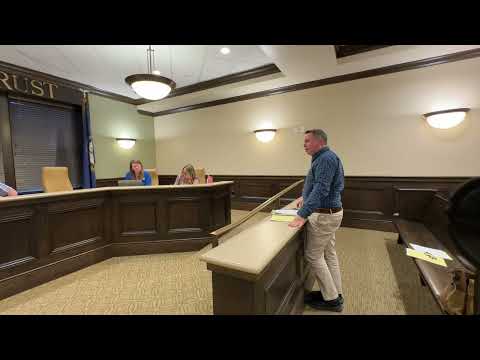
In a separate agenda item, an insurance presenter (speaker 8, introduced as Arlena) reviewed the district’s flood insurance options for the sanitation plant. She said the district currently has a National Flood Insurance Program (NFIP) policy with structure coverage of $500,000 and contents coverage of $276,000; the annual premium listed for that policy is $13,009.07 and it is effective at midnight unless canceled. She also presented a private-market quote with identical limits (building $500,000; contents $276,000) and a much lower premium — approximately $1,476.60 — but with a $5,000 deductible and a 15-day waiting period before coverage becomes effective.
The presenter cautioned that private policies are not federally backed and that some lenders or grant agreements may require NFIP coverage. She also warned the board that canceling an NFIP policy after purchase may result in refund penalties (she estimated a reverse fund assessment of roughly 25 percent) and that private coverage generally cannot take effect immediately. "If you look at the page on the building, 276,000 in contents... This 1 is the 1 that is backed by the federal government... This 1 could not come into effect for 15 days," she said.
Board members discussed logistics: an interim chairman may need to be elected to sign cancellation or application paperwork before deadlines, and staff agreed to try to complete necessary signatures before leaving the meeting so the district could seek a refund if cancellation is possible.
Why it matters: Choosing a lower-cost private policy could reduce near-term premiums substantially, but it may carry lender acceptance and waiting-period tradeoffs that affect coverage continuity.
What’s next: Staff will pursue cancellation and application paperwork as feasible before the NFIP policy takes effect, and the board will address interim-chair signing authority as needed.