Get Full Government Meeting Transcripts, Videos, & Alerts Forever!
Get email alerts on the Beliefrade Zoning Workshop topic
No spam. Unsubscribe anytime.
Planners present draft Belgrade planning-area zoning; marijuana treated as conditional commercial use in draft
Summary
Consultants and city/county staff presented a draft zoning map and regulations for the Belgrade planning area, reviewed the history of earlier efforts, outlined public engagement, and highlighted a draft approach that treats marijuana uses as commercial and permits them conditionally in business-commercial or manufacturing districts.
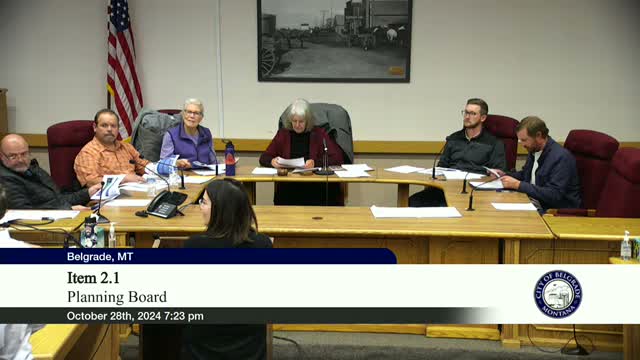
Belgrade Planning Board members heard a workshop on a draft zoning regulation and map for the Belgrade planning area, led by consultants Alex and Nicole with staff. Presenters framed zoning as a tool to provide predictable land-use outcomes, avoid conflicts such as gravel pits adjacent to homes, and implement the future land use map the county adopted in July 2024.
Alex opened the presentation by explaining zoning basics — building height, setbacks and permitted uses — and describing the project team and timeline. Nicole and staff traced the project history to a 2010 draft and a 2022 code effort that was delayed by legislative and legal review, then picked back up in 2023. The draft map and regulation are posted on BeHeardBelgrade.com and the team plans neighborhood meetings, stakeholder sessions and an open house before a revised draft is prepared for board review in late winter or early spring.
Staff highlighted a draft approach to marijuana uses that treats any state-licensed marijuana activity as a commercial use and allows it only conditionally in business-commercial and manufacturing-industrial districts. "It considers marijuana uses as commercial uses," the consultant summarized, noting that Gallatin County currently treats some growing operations as agricultural. Board members raised practical concerns about shared commercial spaces, ventilation and potential odor impacts; staff said conditional-use approvals could include tailored mitigation measures (for example, requiring detached buildings or ventilation systems) to address neighbors' concerns.
Board members also discussed outreach and noted the need to reach farming and ranching communities and to explain that agricultural operations would generally remain exempt in some districts. Staff reiterated the public-engagement plan, an interactive map on the project website, and multiple venues to solicit input.
The workshop was informational; no board action was required on the draft at this meeting.