Get Full Government Meeting Transcripts, Videos, & Alerts Forever!
Get email alerts on the Consumer Protection topic
No spam. Unsubscribe anytime.
Assembly committee advances bill to regulate small‑business merchant cash advances after testimony citing 235% APR
Summary
The Assembly Banking and Finance Committee voted to send AB 2,116 to Appropriations. Sponsor Assemblymember Schiavo said the bill would close a regulatory gap for merchant cash advances; a small‑business owner described signing for financing that carried a 235% APR, and opponents urged technical amendments.
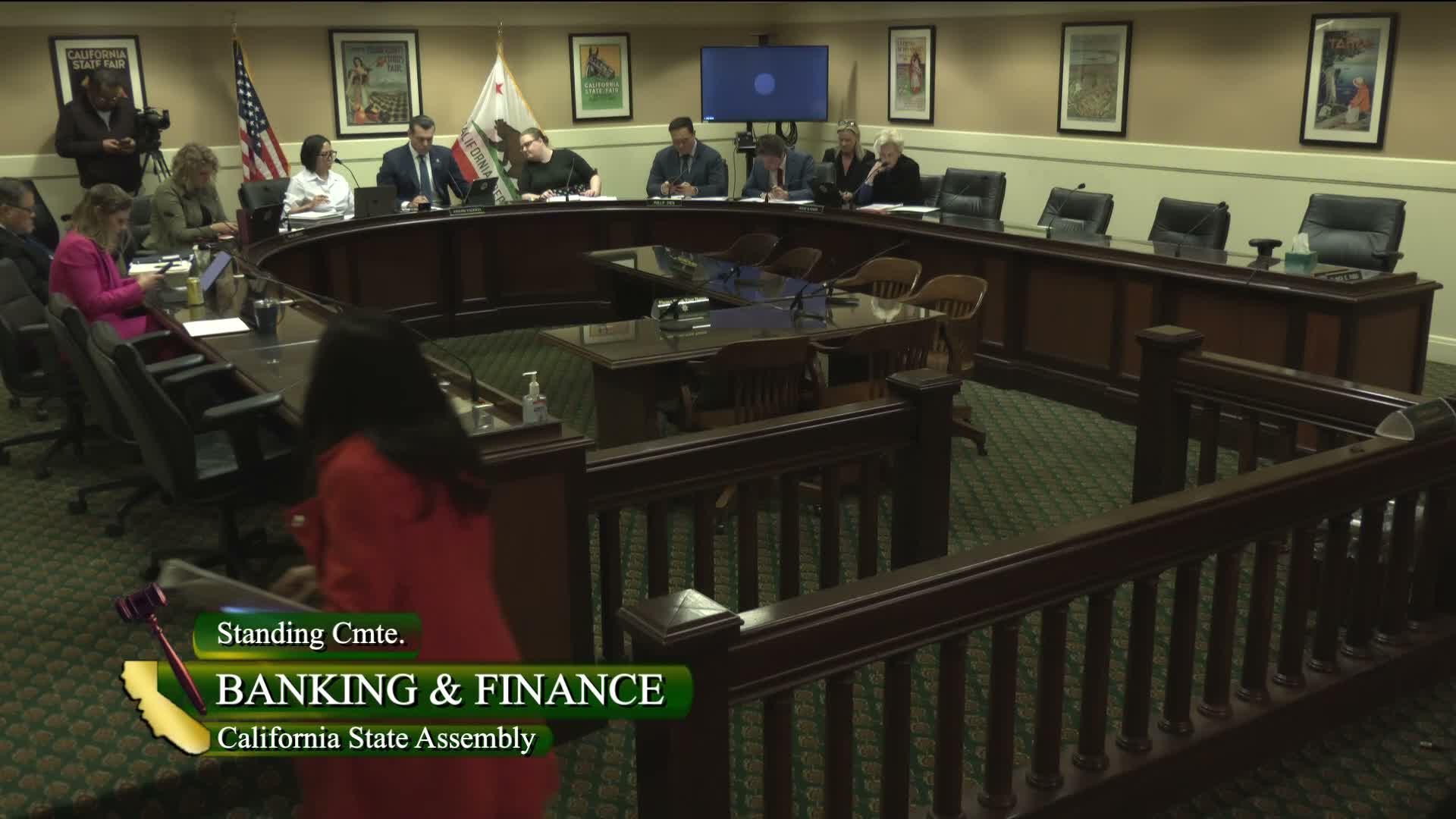
The Assembly Banking and Finance Committee on an unspecified date voted to pass AB 2,116, the California Consumer Financial Protection Law, to the Committee on Appropriations after testimony from supporters and opponents.
Assemblymember Schiavo, the bill’s author, said the measure would not ban merchant cash advances but would require providers to register with the California Department of Financial Protection and Innovation, impose basic standards of conduct and prohibit pre‑default confessions of judgment and similar provisions that can freeze bank accounts without notice. "What it does is close a dangerous oversight gap," Schiavo said.
Supporters included Small Business Majority and individual business owners. "Only after signing did I learn that the APR was actually 235% APR. This was never disclosed," Paloma Corona, a small‑business owner whose written testimony was read in part for the record, said of a financing product she used. "If it had been, I would have chosen a different option."
Consumer advocates urged broader enforcement. Robert Harrell, executive director of the Consumer Federation of California, said products with APRs in the hundreds of percent should be outlawed and that stronger disclosure and registration are needed.
Speakers opposing or urging changes included representatives of revenue‑based finance providers. Carol and Bill Hunter, speaking for the Revenue Based Finance Coalition, said they support the bill’s aim to ban pre‑default confessions of judgment but raised three concerns: inconsistent definitions of "small business" across statutes; conflating consumer and commercial regulation; and registration requirements that mirror consumer rules and could hamper commercial lending without additional resources. "With targeted amendments in these areas, AB 2,116 can protect small businesses without cutting off the capital they depend on," Hunter said.
Committee members did not ask substantive questions of the author before the roll call. The secretary recorded votes in favor and the chair declared the bill passed out of committee and sent to the Committee on Appropriations.
Next steps: AB 2,116 advances to the Appropriations Committee for further consideration.