Get Full Government Meeting Transcripts, Videos, & Alerts Forever!
Get email alerts on the Zoning Laughlin Farms topic
No spam. Unsubscribe anytime.
Council sends Laughlin Farms rezoning back to the table after residents press concerns about density and infrastructure
Summary
After a lengthy presentation by the developer and more than an hour of public comment, the City of Rockwall council voted to deny without prejudice a rezoning request for the 536-acre Laughlin Farms development, sending the applicant back to negotiate further with neighbors over lot sizes, buffers and infrastructure timing.
Mayor Trace Johannesson opened a public hearing on Oct. 21 over Z2024‑048, a request to rezone a 536.4297‑acre Laughlin Farms tract from agricultural to a planned development to allow 885 single‑family lots and about 41 acres of general retail. City planner Ryan Miller told the council the revised plan reduces the number of small lots and that Planning & Zoning recommended approval 5–1.
Developer Ryan Joyce, representing Michael Joyce Properties in partnership with Qualico, told the council the latest submission cuts the smallest 62‑foot lots by roughly 30 percent, increases 82‑ to 100‑foot lots, and adds tree‑preservation easements, berms and expanded amenity sites. "We started at 2.36 units per acre and are now at 1.65 — well under the future‑land‑use maximum of 2 units per acre," Joyce said, outlining a build timeline that would begin site work in spring 2025 and phase in homes through the late 2020s.
Neighborhood speakers said the revisions do not go far enough. "This still feels like high density when you drive the streets," said Susan Langdon of Bear Claw Lane, who urged the council to prioritize estate‑scale buffers and larger lots near existing homes. Resident Richard Henson showed maps and asked the council to compare his five‑acre lot to the proposed small lots: "Thirty‑three of his lots will fit inside my five acres," he said, urging a no vote. Other residents cited traffic, limited nearby schools, and concerns that amenity and commercial details were undefined.
Council members debated whether the plan met the comprehensive plan’s low‑density goals and whether recent revisions addressed neighbor requests. Some members praised the reduced density and infrastructure coordination — Ryan Joyce pointed to funded TxDOT projects on SH‑205 and the 205 widening — while others said phases 1–3 still contained too many 62‑ and 72‑foot lots adjacent to estate properties.
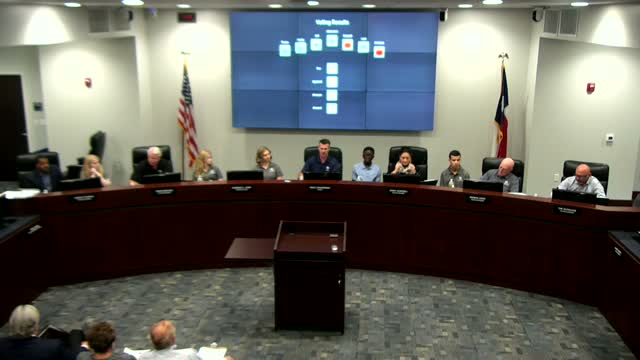
A motion to approve Z2024‑048 failed on a 3–3 vote. Councilmember McCallum then moved — and the council approved — a motion to deny the request without prejudice so the developer could return after additional neighborhood meetings and plan revisions. The denial instructs the applicant to work further with affected neighborhoods and staff; no final zoning change was adopted.
What happens next: the developer may revise the PD and return to Planning & Zoning and city council. The denial without prejudice preserves the applicant’s ability to refile. The council also noted that site plans, flood studies and other technical approvals would be required before construction could begin.
Quotes that matter: "We are not just hired — we are financially vested in this project," Joyce said of his partnership with Qualico; "If everybody has to compromise, then everybody has to compromise," said resident Susan Langdon. Council member Thomas, who seconded the final motion to deny without prejudice, said the developer had made changes but "we're not done yet."