Get Full Government Meeting Transcripts, Videos, & Alerts Forever!
Get email alerts on the High Speed Rail Oversight topic
No spam. Unsubscribe anytime.
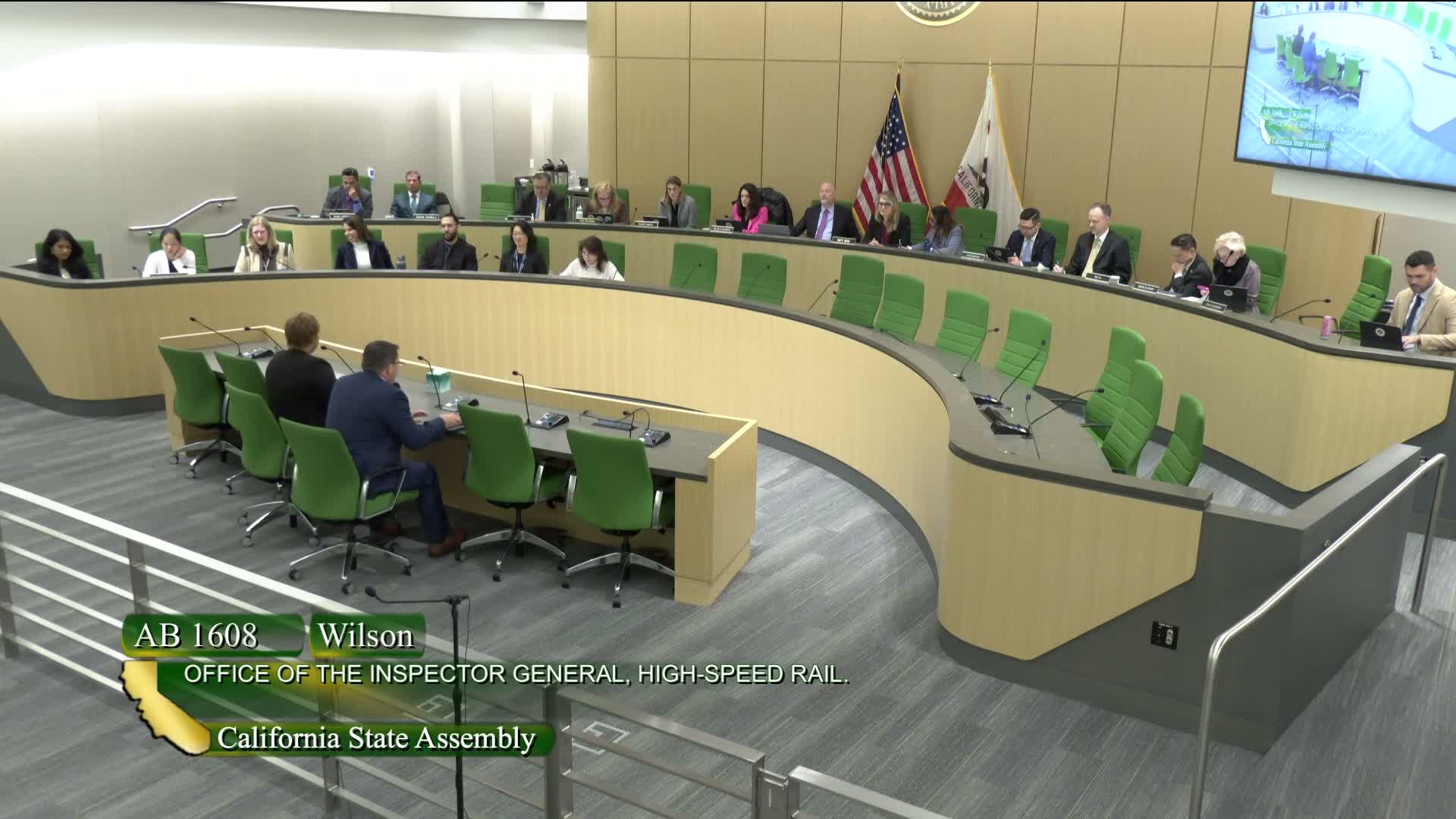
Panel advances bill to bolster High-Speed Rail inspector general amid transparency debate
Summary
The Assembly Appropriations Committee advanced AB 1608 to give the High-Speed Rail inspector general hiring and purchasing authority and public-reporting rules. Supporters said it strengthens oversight; a committee member pressed whether the bill could permit temporarily withholding fiscal information.
Assemblymember Wilson urged the Appropriations Committee on April 22 to approve AB 1608, saying the bill would strengthen the Office of the Inspector General for the California High-Speed Rail by granting it position classifications and contracting authority to hire specialized staff and obtain services more quickly.
"This bill strengthens the inspector general's office by giving it position, classifications, and contract authority it needs to hire staff with the appropriate qualifications and acquire specialized services in a timely manner," Wilson said, arguing those authorities would improve oversight while increasing transparency.
Ben Belknap, identified himself as "Ben Belknap, inspector general," told the committee his office is reviewing procurement, business planning and construction-quality programs and warned the project faces schedule risks without near-term financing. "My office estimates that we are only 2 years away from major schedule delays caused by a lack of near term funding," Belknap said, urging lawmakers to provide tools for more timely oversight.
Committee member Tongabaugh pressed whether AB 1608 would allow the inspector general to withhold information of fiscal consequence, citing a recent "$530 plus million dollar" change-order settlement and asking, "To the inspector general, this now empowers you to hide information from the public." Wilson and Belknap replied that the bill lists narrow categories that may be temporarily confidential — for example, information security, physical security, fraud-detection controls and pending litigation — and that any confidentiality would be time-limited and subject to quarterly review.
"No. That is not listed in the law," Belknap said when asked whether the law would permit hiding general funding shortfalls, and he described the confidentiality exceptions as specific matters that are not public now.
Wilson closed by saying the measure would equip the inspector general "with everything it needs to ensure the high-speed rail construction project is a success" and asked for the committee's support. The committee moved, seconded, and the motion carried; AB 1608 was advanced and taken out on an Assembly roll call.
The bill also references a current $500,000,000 spending cap imposed by SB 198 on expenditures outside the Merced–Bakersfield segment; Belknap testified the authority has signaled it may seek relief from that cap as it pursues additional procurements. The committee's action sends AB 1608 to the next steps in the legislative process for consideration by the full Assembly.
What happens next: AB 1608 was advanced out of Appropriations on a roll call and will proceed to later hearings and floor consideration where fuller debate and the formal vote record will be produced.