Get Full Government Meeting Transcripts, Videos, & Alerts Forever!
Get email alerts on the Vmt Mitigation topic
No spam. Unsubscribe anytime.
Assembly debate narrows use of VMT mitigation bank as authors and advocates agree to keep negotiating
Summary
AB 2,552 would limit a CEQA lead agency's ability to require use of the state's VMT mitigation bank unless it is no more costly than the project's alternative mitigation. Supporters emphasize cost-effectiveness; housing and conservation groups warn a cost-only rule could undermine the bank's ability to deliver location-efficient housing.
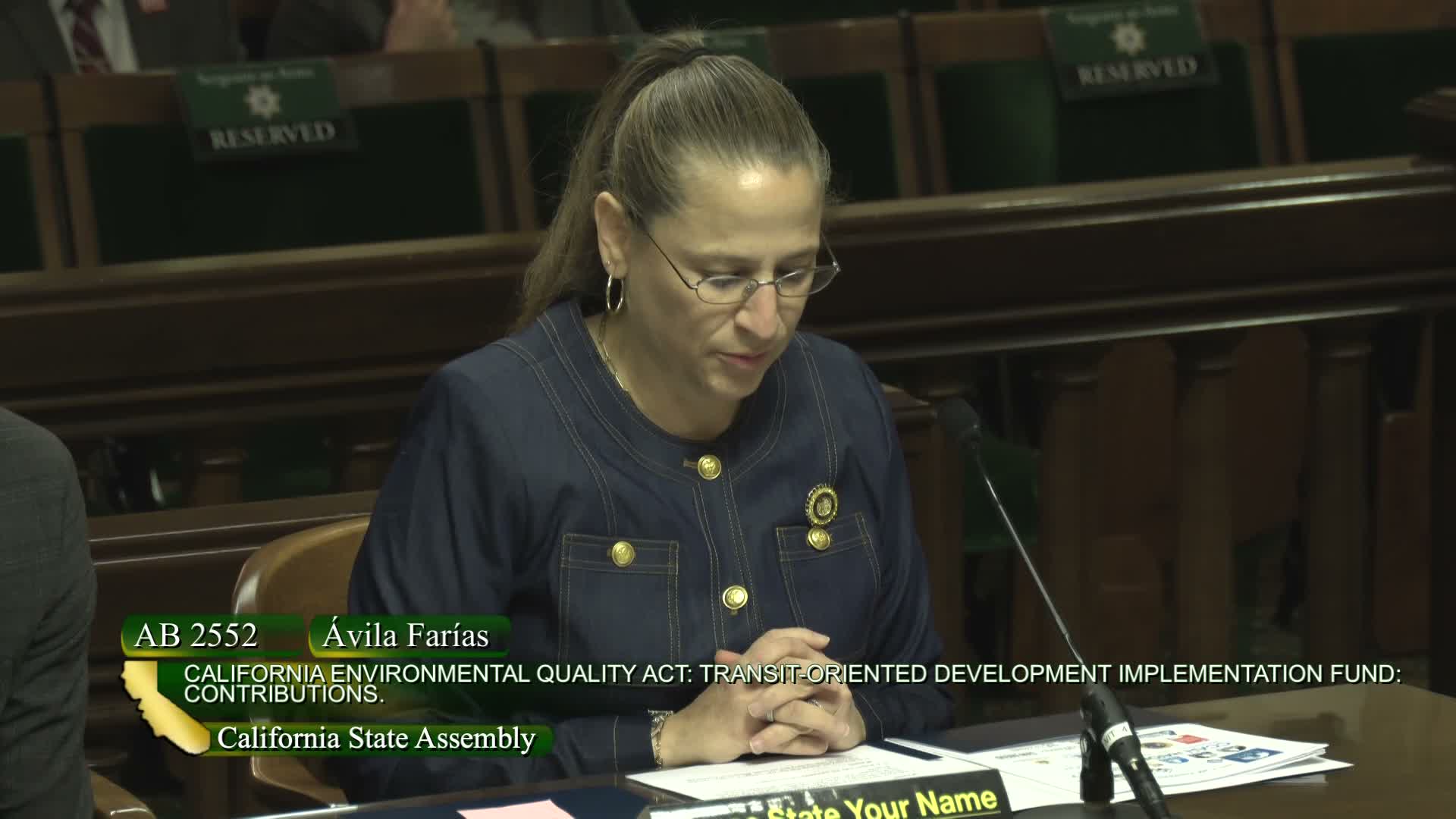
Assemblymember Alex Lee introduced AB 2,552 to clarify when a CEQA lead agency may require a land-use project to use the state's Vehicle Miles Traveled (VMT) mitigation bank. Lee said the bill is intended to ensure the mitigation bank reduces housing costs rather than increasing them and noted the governor's Land Use and Climate Initiative (LCI) is developing guidelines for the bank.
The bill drew support from industry groups. "Our members would like to use this program," said Silvio Ferrari of the California Building Industry Association, adding that the bank must be cost effective and avoid opening projects to litigation. Horacio Gonzalez (California Business Roundtable) and Stephanie Jimenez (Bay Area Council/California Council for Affordable Housing) also voiced support.
Opponents said recent amendments risk hobbling the VMT mitigation bank before it begins. "I'm here today in respectful opposition to AB 2,552," Natalie Spivak of Housing California said, arguing the Natural Resources Committee amendments "undermine the state's new VMT mitigation bank" and that "making cost the singular threshold requirement will reduce the chances that the VMT mitigation bank will be used." Matthew Baker of the Planning and Conservation League warned the change could force the bank's valuation to target the lowest price and "undercut the efficacy of the program." Taisha Watts of the California Housing Partnership said her group opposed the bill but sought continued engagement on amendments.
Committee members expressed concern about the tension between statewide policies that seek to direct development and local VMT mitigation requirements. Several members said they would advance the bill to allow further negotiation with the governor's office and stakeholders. The committee took a motion and second to move AB 2,552; the clerk recorded the motion to advance the bill to the Assembly Committee on Appropriations and noted the author and supporters would continue discussions with opposition groups.
Next steps: The committee advanced AB 2,552 and the author and stakeholders committed to continue negotiations on language and implementation guardrails. The motion to advance the bill was recorded during the hearing; the transcript does not include a full, unambiguous rollcall tally for that motion.