Get Full Government Meeting Transcripts, Videos, & Alerts Forever!
Get email alerts on the Audit Finance topic
No spam. Unsubscribe anytime.
Yuma County receives clean FY2025 audit; auditors flag recurring IT control deficiencies
Summary
Contract auditors and the Arizona Auditor General presented an unmodified (clean) opinion on Yuma County's FY2025 financial statements but reported two significant deficiencies tied to information‑technology controls; county officials said a corrective action plan and a cross‑department working group are addressing issues.
County officials and external auditors told the Yuma County Board of Supervisors on April 20 that the county’s fiscal year ending June 30, 2025 received an unmodified (clean) audit opinion, while auditors identified two significant deficiencies related to IT controls.
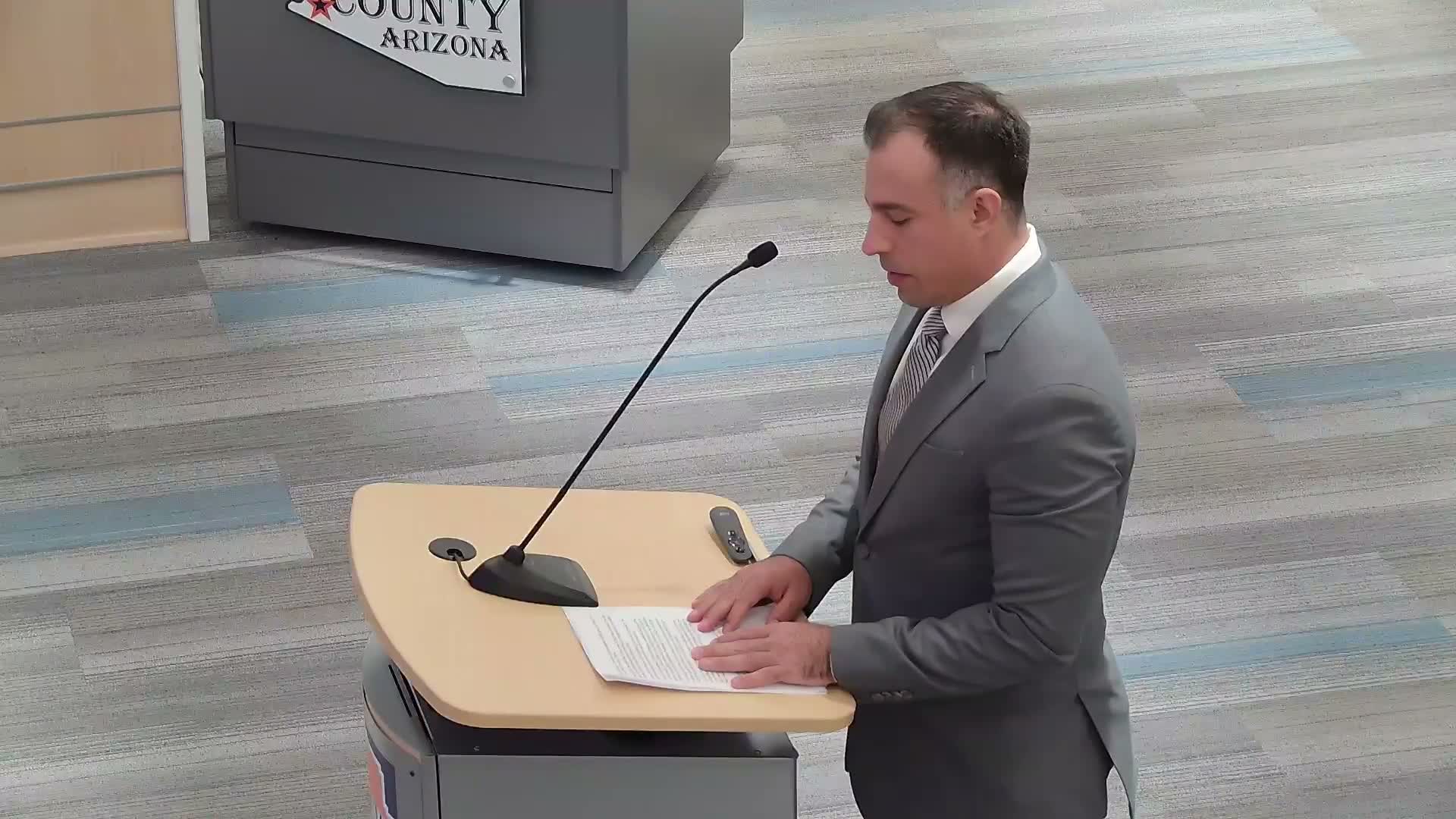
Ben Herr of Vester and Chapman, the contracted auditor, delivered the audit summary and said the county’s financial statements were presented fairly “in all material respects” under GAAP. He also reported two internal‑control findings, both connected to information‑technology risk assessments, policies and procedures. The contracted auditor said the findings are included in the audit report and described them as system‑level IT control matters rather than single‑item failures.
Carla Wall, a technical manager with the Arizona Auditor General’s Office, explained the Auditor General’s role overseeing contracted county audits and introduced the contract audit team. Wall and the auditor said the Auditor General’s office reviewed the draft report for consistency with standards before presentation to the board.
Auditor Herr also presented a brief financial overview: total assets and deferred outflows of approximately $850 million, total liabilities and deferred inflows of about $269 million, net positions and capital‑asset values roughly $455 million, and reported revenue and expense summaries for the year (total revenue ~ $306 million; total expenses ~ $248 million). The auditor said selected federal programs were tested in a single‑audit and no compliance findings were reported for the major programs chosen for testing.
Supervisors pressed staff on the corrective steps. County Administrator Ian McGehee and other officials acknowledged the IT findings were recurring but said the county is making measurable progress and has an ongoing corrective action plan. McGehee said the county formed a working committee combining ITS, risk management, county administration and financial services to address the matters. Supervisor comments praised the finance team and named CFO Humberto del Castillo and the county’s new CIO as actively addressing the issues.
The board heard questions about why IT findings have appeared in multiple years and whether policies and monitoring are fully implemented. Auditors answered that remediation can be time‑consuming because it involves documenting, implementing and monitoring enterprise‑wide policies and procedures. No disagreements between auditors and management were reported.
The presentation concluded with board recognition of staff efforts; the board took no separate action beyond receiving the audit presentation.