Get Full Government Meeting Transcripts, Videos, & Alerts Forever!
Get email alerts on the School Meals topic
No spam. Unsubscribe anytime.
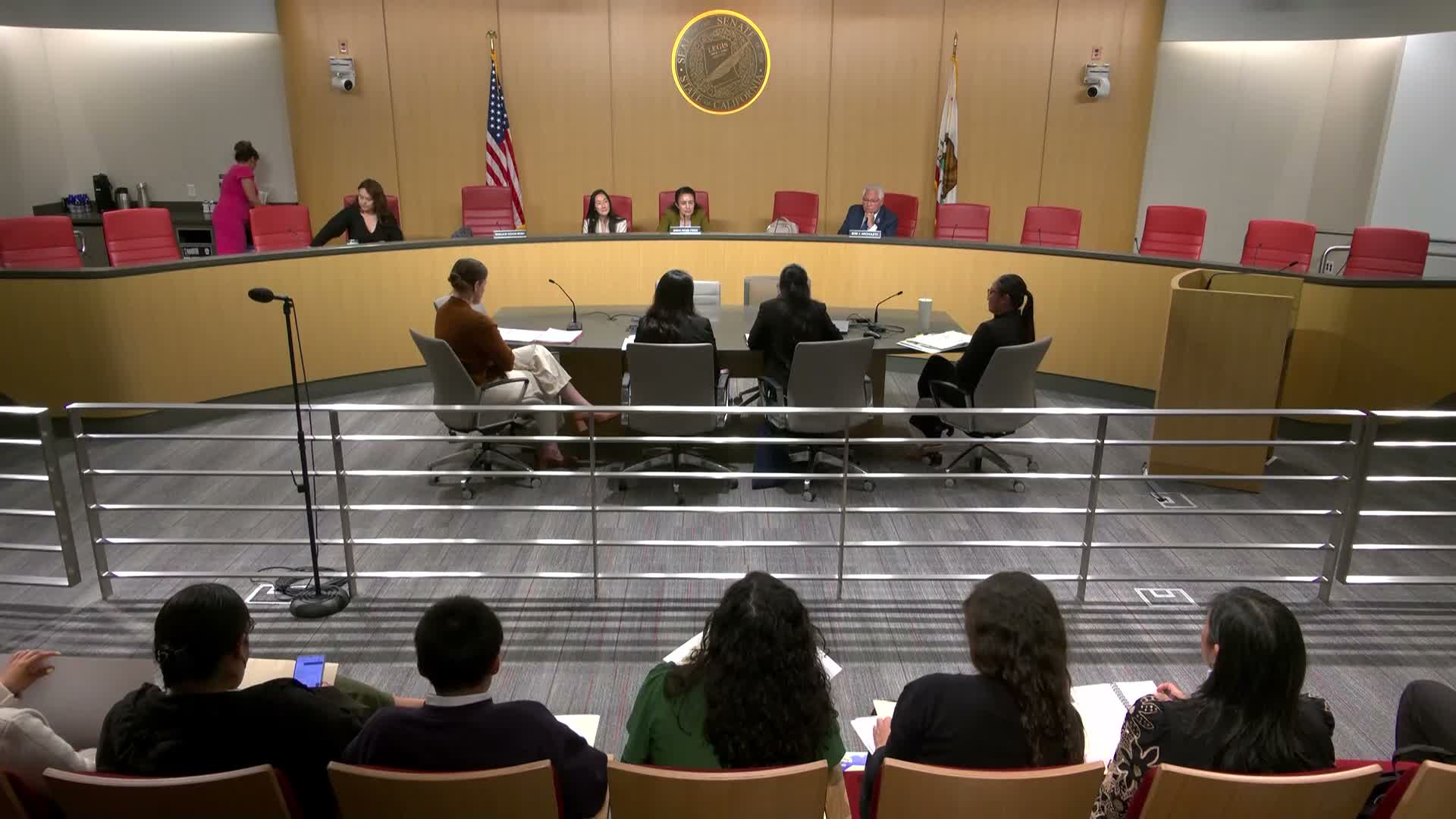
Budget staff and analysts debate new round of kitchen infrastructure grants for School Meals for All
Summary
Department of Finance presented a request for $1.8 billion for Universal School Meals and an additional $100 million one-time Proposition 98 for a fourth KIT grant round; the LAO recommended rejecting or restricting another round until earlier rounds are spent and clearer goals are set.
The subcommittee reviewed presentations on the governor's Universal School Meals proposal and a proposed fourth round of Kitchen Infrastructure and Training (KIT) grants intended to expand freshly prepared, locally sourced meal capacity.
Chaudhary of the Department of Finance told the panel the governor's budget includes $1.8 billion Proposition 98 General Fund for Universal School Meals in 2026-27 and proposes $100 million one-time Proposition 98 for a fourth KIT grant round, building on roughly $910 million previously invested to support kitchen upgrades and training.
Kimberly Rosenberger (CDE) supported the proposal, noting that more than 62% of California students qualify for free and reduced-price meals and that prior KIT rounds have enabled schools to buy equipment and make small infrastructure improvements; she said larger overhauls remain needed and stressed the importance of state investment as some federal support declines.
Sarah Cortez of the Legislative Analyst's Office recommended rejecting the fourth round of KIT funding while prior rounds (about $755 million) are still being spent or awarded and urged any future funds be tied to specific legislative goals and measurement of outcomes. Committee members asked about federal programs such as Summer EBT, potential match requirements (CDE noted USDA approval and a likely 50% state match for admin costs) and how underreporting of eligibility data could affect federal drawdown and state costs.
School nutrition advocates and district staff in public comment urged continuing KIT funding and stressed supply-chain and state architect delays that have slowed prior rounds from being spent, calling for timely additional funds to build kitchen capacity for freshly prepared meals.