Get Full Government Meeting Transcripts, Videos, & Alerts Forever!
Get email alerts on the Broadband topic
No spam. Unsubscribe anytime.
State reports progress on Golden State middle‑mile broadband; LAO urges scrutiny of operations and sustainability
Summary
California’s middle‑mile broadband initiative has activated an initial segment and signed an operator; the state says 70% of the network is permitted and roughly 423 miles are complete and ready to connect, while the LAO flagged accountability and long‑term sustainability questions about the new three‑party operating model.
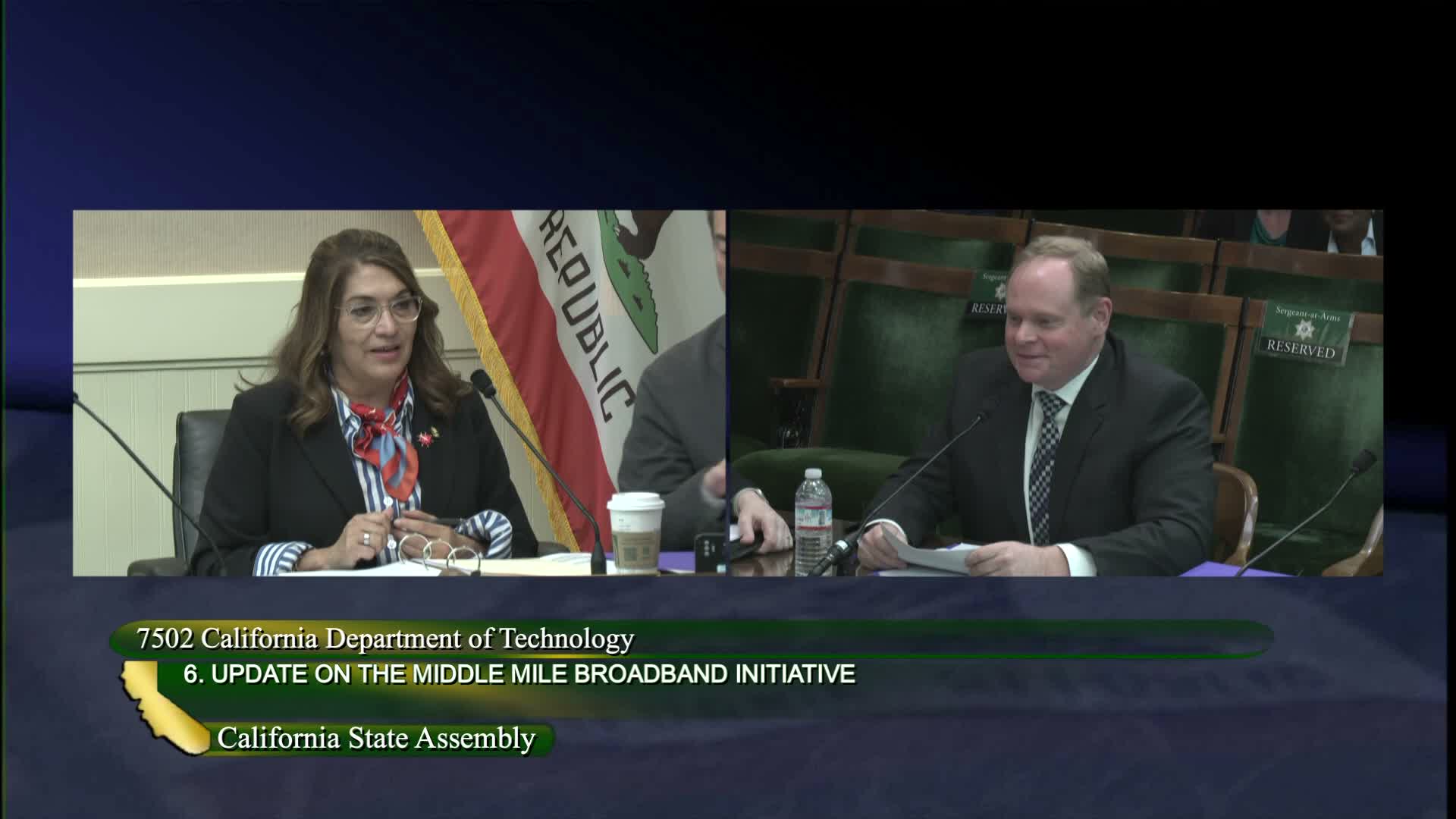
California Department of Technology officials told the Assembly Budget Subcommittee 5 that construction and permitting for the Golden State middle‑mile broadband network continue to advance and that the state recently activated an initial segment and began delivering last‑mile service in one community.
Mark Monroe, deputy director for the Middle Mile Broadband Initiative at CDT, said the state activated the first approximately 423 miles of the network along Highway 395 and that the Bishop Paiute tribe became the first last‑mile community to receive Internet service via the new infrastructure. “This important milestone underscores exactly why this investment matters,” he said.
CDT said more than 70% of the network is now permitted and that it expects roughly 5,300 miles of fiber to be completed by December 2026 (with 4,300 miles ready to connect to federal funding account projects and last‑mile partners). The department said Skyline Technology Solutions was selected to operate the network and that a third‑party administrator (Golden State Net) will manage and supervise operations on CDT’s behalf.
LAO concerns: The Legislative Analyst’s Office noted about 423 miles are complete and ready to connect and flagged the novel three‑party structure (department, third‑party administrator, and operator) as raising potential operational and accountability issues—particularly around responsibility for service disruptions and whether the network can sustain its operating costs without ongoing state support.
Why it matters: The middle‑mile network aims to close persistent gaps in broadband access across rural, tribal and underserved urban communities. The committee asked CDT how responsibilities are split among CDT, the third‑party administrator and the operator, and pressed the department on long‑term financial sustainability of operations.
What’s next: CDT expects to light additional segments as construction completes and to begin serving roughly 1,300 miles as early as July; members asked for further detail on encumbrances, liquidation of appropriations and operator oversight structures.