Get Full Government Meeting Transcripts, Videos, & Alerts Forever!
Get email alerts on the Vehicle License Fee topic
No spam. Unsubscribe anytime.
San Mateo officials urge Assembly subcommittee to restore $157 million in vehicle license fee backfill
Summary
San Mateo County supervisors, local officials and service providers told the Assembly Budget Subcommittee 5 that the governor’s January budget removes in‑lieu vehicle license fee backfill and would force deep cuts to shelters, rental assistance, public safety and mental‑health services; the Department of Finance called the payments discretionary.
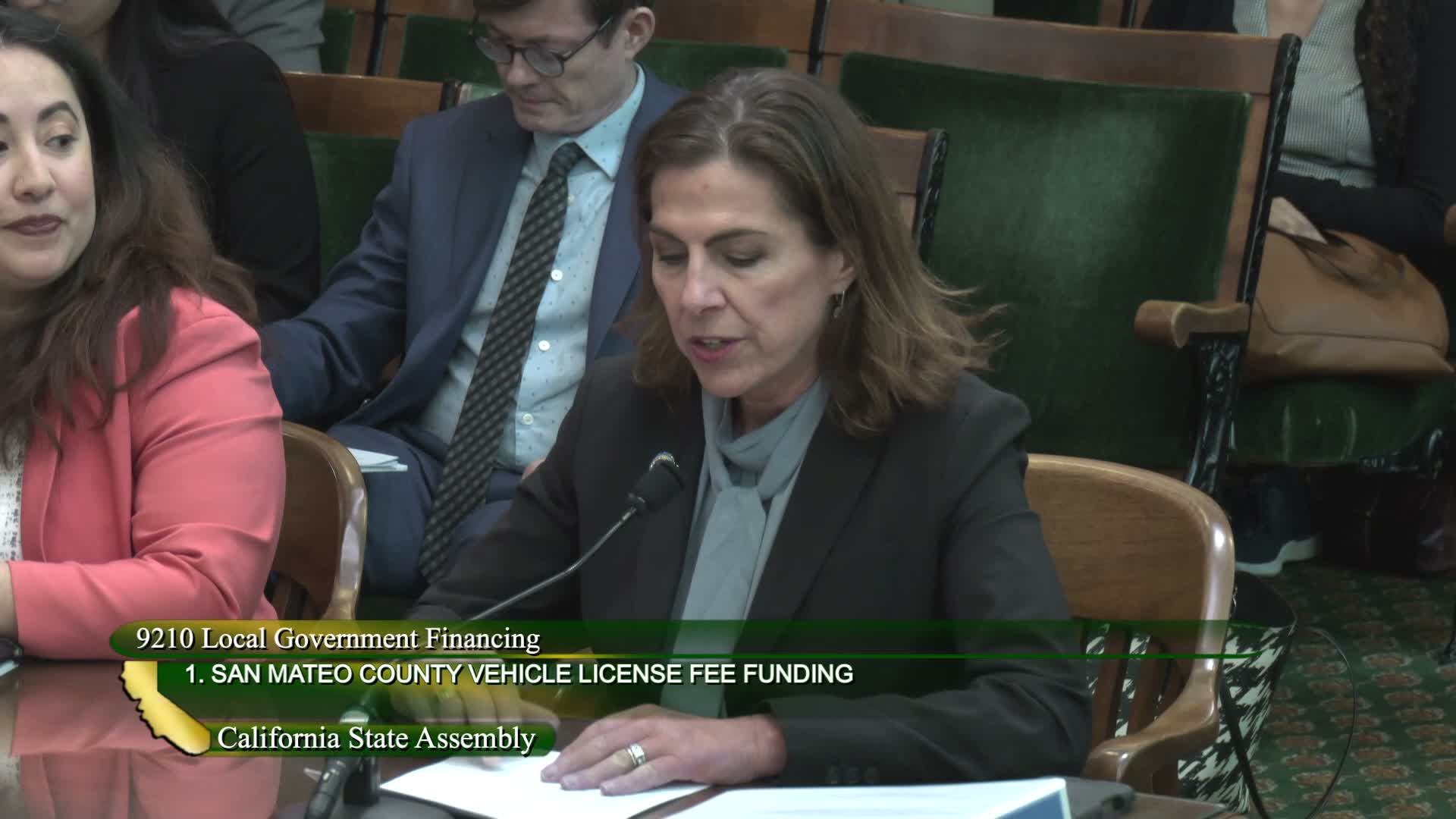
San Mateo County officials told a California Assembly subcommittee on Monday that the state’s proposed budget would eliminate roughly $157 million in vehicle license fee (VLF) backfill and cause immediate cuts to homelessness services, rental assistance and public safety.
“California help us help you,” one county representative told the Assembly Budget Subcommittee 5, urging the Legislature to restore full payment of the in‑lieu VLF the county says it is owed. San Mateo supervisors and dozens of city leaders, union representatives and nonprofit executives described program‑by‑program impacts, including the potential closure of shelters and layoffs of frontline staff.
Why it matters: County leaders said the 2004 VLF swap—when the state reduced the local VLF rate and backfilled revenues—no longer works for certain counties because of high property values and declining student enrollment that altered the funding formula. San Mateo officials said the change would erode roughly 18% of the county general fund and ripple across local services.
Supervisor Noelia Corzo, president of the San Mateo County Board of Supervisors, listed specific cuts she said the county would face without a fix: “closure of 8 shelters displacing nearly 3,000 formerly unhoused residents; elimination of rental assistance to 5,500 low income families and seniors; cuts to production of 437 units of affordable housing; elimination of psychiatric services for 600 homeless individuals and 500 youth.”
Supervisor Jackie Speer asked lawmakers for “the full payment of the $157,000,000 in lieu vehicle license fees owed to San Mateo County and its 20 cities” and for “a more workable permanent fix,” warning the loss would force reductions in police and fire staffing and weaken wildfire‑mitigation work.
Department of Finance response: Chris Hill of the Department of Finance told the subcommittee the administration views the payments differently. “The provision of these funds is not statutorily mandated, but is discretionary,” he said, adding the administration does not view the sum as sustainable in the current fiscal situation. Hill also noted the matter is the subject of ongoing litigation.
Community testimony: Dozens of local elected officials and service providers echoed supervisors’ warnings. Pacifica’s vice mayor, city council members, firefighters’ union leaders and nonprofit executives described threatened layoffs, reduced 911 response capacity and cuts to programs that serve seniors, veterans and children. Several speakers quantified local shortfalls—city and town figures were provided to the committee by participants—but committee members cautioned some numbers may be approximate and asked staff for clarifications.
Committee action and next steps: Members expressed strong sympathy for San Mateo officials and said they would consider short‑term budget action while seeking a longer‑term statutory fix to the formula. The chair held the item open for further review; no budget vote was taken on this item during the hearing.
What’s next: The subcommittee said it will review the issue ahead of the May budget revision and pursue further analysis of downstream impacts to homelessness, public safety and education funding before taking final action.