Get Full Government Meeting Transcripts, Videos, & Alerts Forever!
Get email alerts on the Public Comment topic
No spam. Unsubscribe anytime.
Speakers at Transportation Committee urge action on alleged false arrests and scheduling conflict at county meetings
Summary
Two public commenters told the committee they have unresolved personal and civil-rights grievances: Taiwan Sims cited multiple court cases and alleged false arrests and loss of parental access; George Blakemore criticized scheduling that he said prevented attendance at a City Council meeting. The committee took no formal action on the complaints.
Two people used the Transportation Committee’s public comment period to press the county for action on personal legal grievances and to criticize the committee’s scheduling.
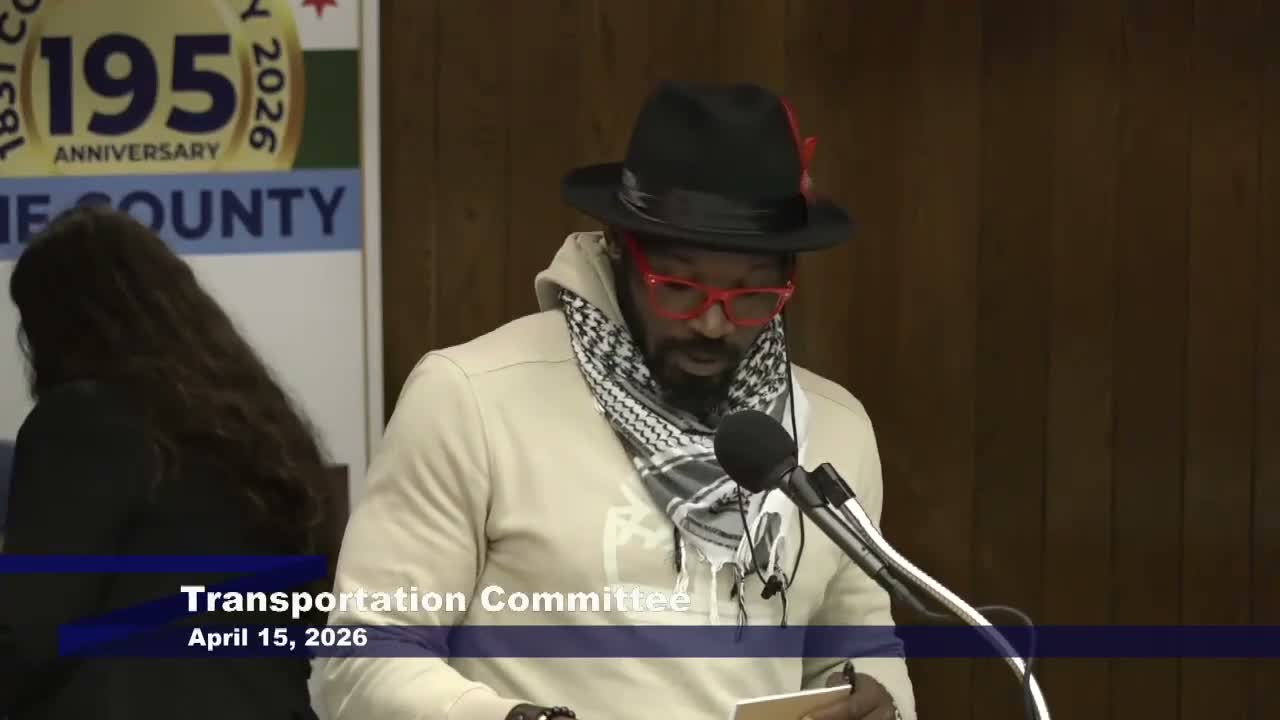
Taiwan Sims (introduced by staff at the start of public comment) said he has pursued multiple court cases — citing case number 23D79597 and two other case numbers referenced during remarks — and alleged false arrests at 121 North LaSalle. "It's been a total 2 years without seeing my child," Sims said, framing his remarks as violations of parental rights and constitutional liberties and saying he had provided information to an official named Lamont Williams but had seen no remedy or follow-up. Sims asked the committee, which he described as having investigatory and oversight resources, to help; the committee did not indicate a follow-up in the meeting record.
George Blakemore (announced as the next speaker) criticized scheduling the county board meeting at the same time as a City Council meeting, saying the overlap denied him the right to attend both and characterizing the choice as unfair. Blakemore asked why meetings were scheduled simultaneously and suggested the scheduling had a racial dimension. Committee members and staff interjected during his remarks; staff reminded speakers of time limits and ultimately ended the public comment period.
No formal response, referral or investigative action was recorded on the meeting record for either speaker’s complaints. The clerk concluded public comment after the two speakers, and the committee proceeded to the consent agenda. Public commenters’ allegations cited case numbers and locations, but county staff did not provide a timeline or next steps in response during the meeting.