Get Full Government Meeting Transcripts, Videos, & Alerts Forever!
Get email alerts on the Tyler Implementation topic
No spam. Unsubscribe anytime.
Cook County officials say Tyler software defects are delaying bulk refunds and detailed distribution reporting
Summary
County IT and treasurer’s staff told the Technology and Innovation Committee that defects in the new Tyler ISWorld property‑tax system have blocked bulk processing of refunds for an estimated 87,000 residents and left taxing districts without transaction‑level distribution detail. Officials urged faster defect triage and asked Tyler to attend future meetings.
Cook County technology and treasury officials told the county’s Technology and Innovation Committee that defects in the new Tyler ISWorld property‑tax system are preventing the mass processing of refunds to residents and leaving taxing districts without the detailed transaction reports they expect.
David Burns, chief of staff to the Treasurer’s Office, told commissioners the office is attempting to process refunds in bulk but continues to encounter a variety of data defects as staff coordinate with Tyler Technologies. "Our staff is trying to process refunds in bulk, to approximately 87,000 Cook County residents who are owed refunds," Burns said, adding that some issues are resolved quickly while others "continue to languish" with Tyler.
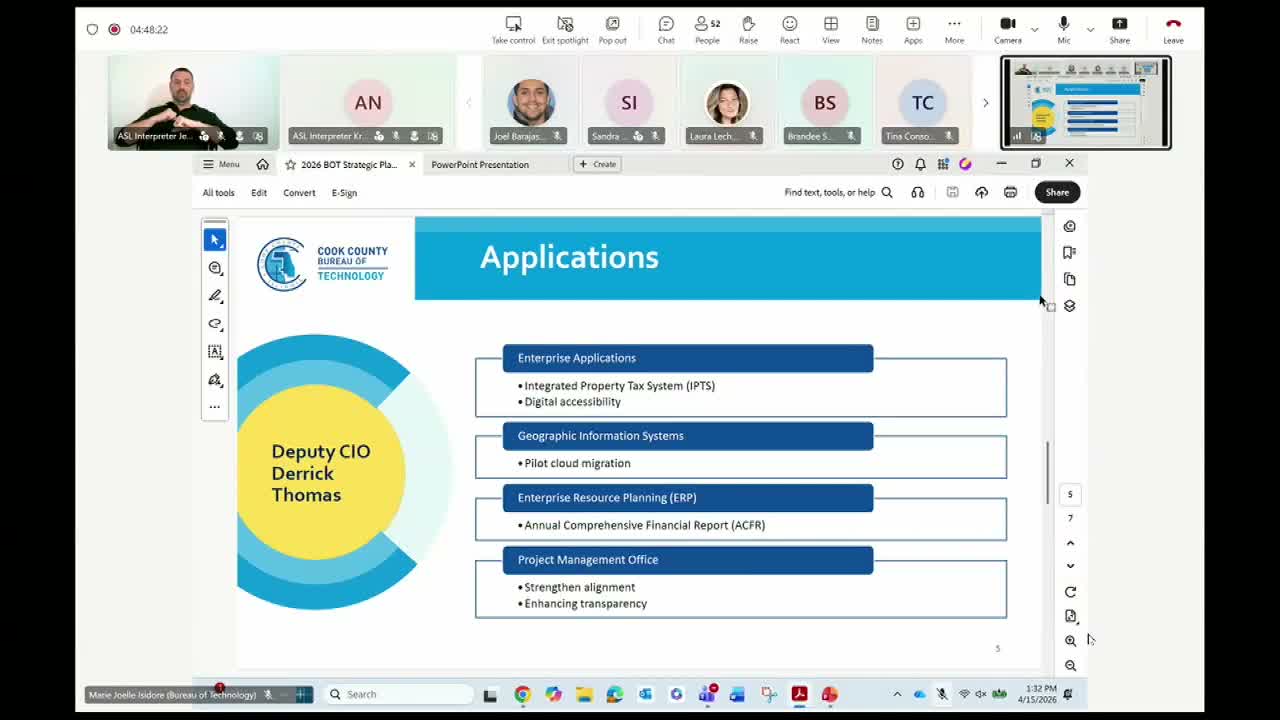
Deputy CIO Derek Thomas said production defects and historical data edge cases are the primary causes of the backlog. He told the committee the County had completed first‑installment mailings and that the Clerk’s redemption and tax‑sale functionality remain a project component not yet live; he warned that the planned mainframe decommission in July creates urgency to finish remaining work. Thomas said the legacy migration will yield roughly $6.5 million in annual savings once complete.
Dave Verne, chief of staff in the Treasurer’s Office, said distributions of roughly $3 billion were sent to taxing bodies but that Tyler currently lacks the granular reporting some agencies require to allocate funds to sub‑entities such as libraries, park districts and bonds. "The dollars are flowing to them. What we are missing from the Tyler system is the detail by which they allocate those distributions accordingly," Verne said.
Commissioners pressed for greater accountability and for Tyler Technologies to appear at future meetings. Commissioner Degnan and others said a workflow analysis should have been completed before procurement so vendors and county staff could have anticipated data translation problems; Bureau of Technology officials said data validation and multiple rounds of testing in 2025 missed many edge cases and that some defects now revealed decades‑old, siloed data problems.
Treasurer’s staff told the committee there are 61 open defects that are currently blocking the bulk majority of property‑tax refunds. Officials said some refunds are being issued where logic permits, but many cases require manual review and reconciliation before funds can be released to ensure accuracy.
Tom Lynch, Cook County Chief Information Officer, said the Bureau of Technology holds daily meetings with Tyler and has escalated issues when needed; he also said Mark Hawkins, Tyler’s property‑division president who typically attends these meetings, was unavailable for this session because of recent eye surgery.
The committee did not take new formal action on the Tyler contract at the meeting. Commissioners asked the Treasurer, Clerk and Bureau of Technology to continue convening stakeholders and reporting progress and to invite Tyler representatives to the next meeting so members can review defect‑resolution timelines and benchmarks.
The committee is expected to receive written status benchmarks and an updated defects tracker ahead of the next Technology and Innovation Committee meeting.