Get Full Government Meeting Transcripts, Videos, & Alerts Forever!
Get email alerts on the Vac Report Capacity topic
No spam. Unsubscribe anytime.
VAC reports rising demand and constrained capacity; officials urge more investment
Summary
The Veterans Assistance Commission of Cook County told commissioners that emergency financial aid and claims activity rose sharply in Q1, the VAC operated with just two accredited VSOs and projected far greater benefit delivery if staffing and system access expand.
The Veterans Assistance Commission of Cook County told commissioners that demand for emergency financial assistance and benefit claims has risen sharply and that limited staffing and system access are constraining its ability to meet veterans’ needs.
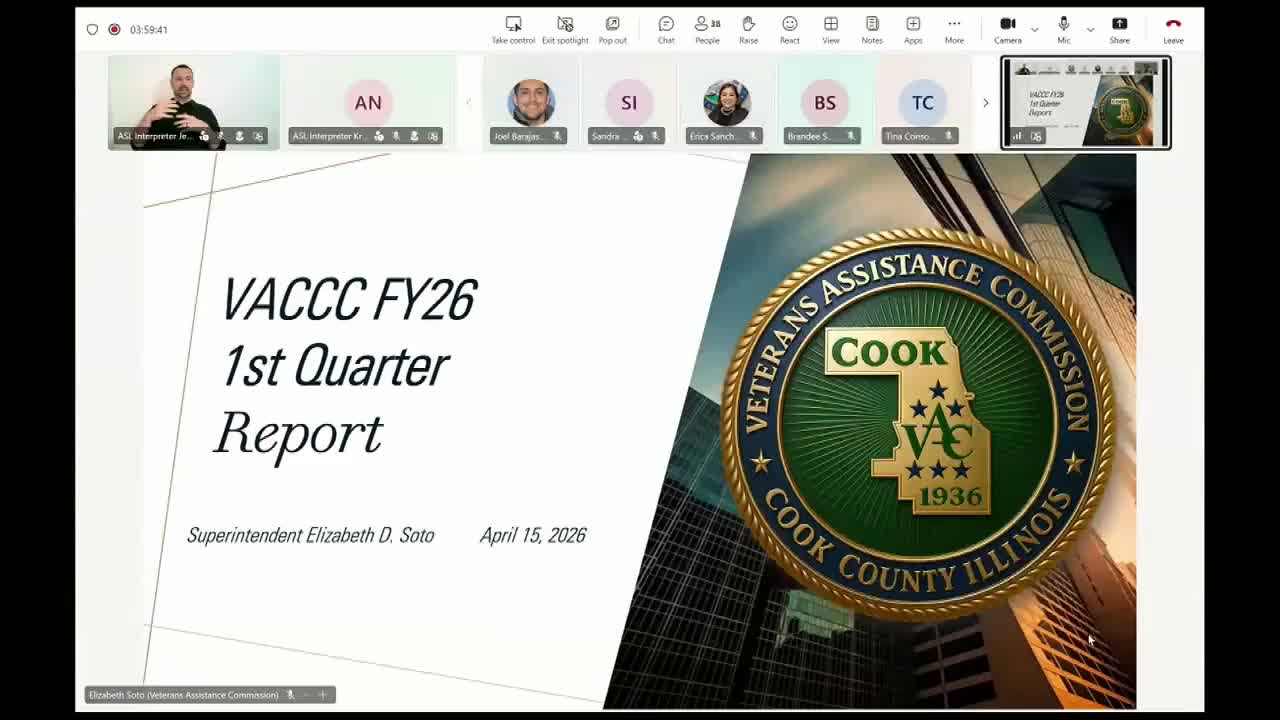
Superintendent Elizabeth So to presented the VAC’s FY26 first-quarter report, saying the commission distributed $273,892.43 in direct emergency financial assistance from December through February — roughly $90,000 per month — and is poised to exceed $1,000,000 in total direct assistance by the end of the fiscal year, an increase the presentation described as about 28% over FY25’s $849,000. So to said the top three categories of Q1 assistance were rental aid ($56,835.81), food assistance ($50,800) and burial and funeral assistance (reported as $57,330.30). The report said those emergency services supported 907 Cook County veterans in the quarter, including about 150 who were new to the VAC.
The VAC’s claims operation also showed heavy activity. Derek Giffin, the VAC’s veteran service officer manager, reported that FY25 included 976 total claim actions (including powers of attorney, intents to file, new disability claims and appeals) and that two accredited VSOs produced over 900 claim actions in a single quarter while generating millions in benefit payments to veterans. Giffin described the current model as "high performing" but operating "under limitation, not at scale," and presented a conservative projection that with five accredited VSOs the VAC could scale to more than $23,000,000 in annual compensation delivered to veterans.
Justina Berry, a VSO manager, said she and Derek now have full access to VA systems and described a recently launched Military Sexual Trauma claims clinic (staffed with separate coordinators for men and women) based at 69 West Washington, Suite 1420, with virtual options to reach veterans who cannot attend in person. Berry said the clinics provide trauma-informed, confidential one-on-one assistance intended to reduce barriers to reporting and accessing VA benefits.
Connor Entries, communications and outreach manager, summarized outreach work and intake upgrades. Entries said the VAC ran roughly 200 outreach events across Cook County in FY25, directly assisting 899 veterans and interacting with nearly 3,200 people. For Q1 the VAC reported 85 outreach events (including 42 VetConnect events) and direct assistance to about 282 veterans in the quarter. The commission has piloted QR-code tracking and an online intake form (about 1,000 unique scans reported) and plans to integrate a Power App to better track individual veteran requests and create an auditable record.
Commissioners praised the report. Commissioner Lowery called it comprehensive, and Commissioner Aguilar thanked Superintendent Elizabeth So to for quick responses to veterans in his district. The meeting voted to receive and file the FY26 Q1 report and then adjourned.
The report and presenters repeatedly stressed two connected points: outreach is finding veterans who were previously unconnected to services, and the VAC’s ability to translate outreach into benefits depends on expanding accredited VSO staffing and system access.