Get Full Government Meeting Transcripts, Videos, & Alerts Forever!
Get email alerts on the Transmission Infrastructure topic
No spam. Unsubscribe anytime.
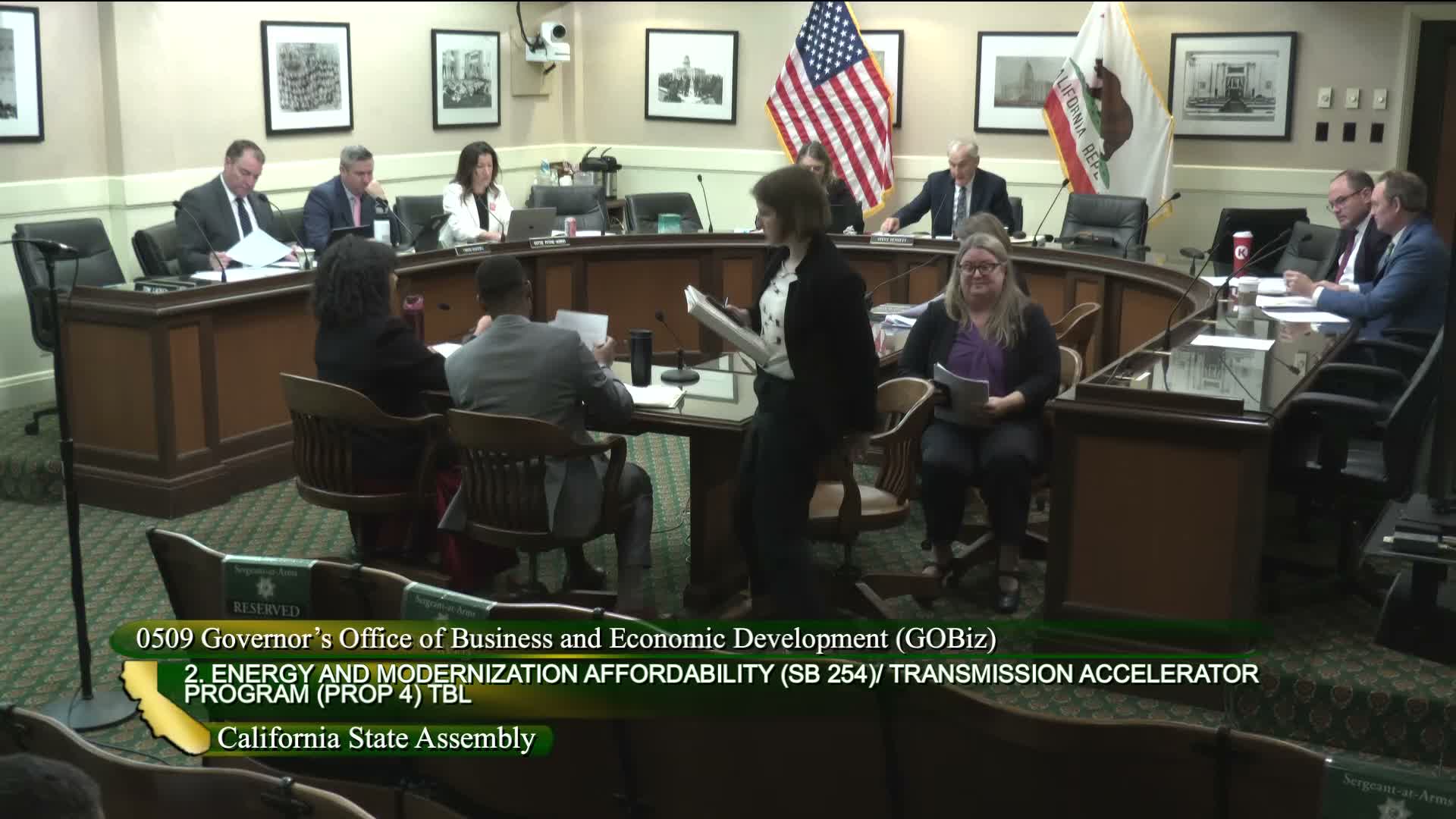
Lawmakers and GO‑Biz debate state transmission accelerator financing and potential ratepayer savings
Summary
GO‑Biz and IBank officials outlined staffing and funding needs to implement SB 254’s transmission accelerator; lawmakers pressed for clarity on state liability, ownership, and realistic estimates of long‑term ratepayer savings (range presented: ~10–40% lifetime savings in some structures).
Rahima Mali of GO‑Biz presented the BCP and staffing request for the transmission infrastructure accelerator authorized in SB 254, which would assemble a multi‑agency accelerator (PUC, CEC, CAISO, IBank) to evaluate competitive transmission projects and provide state financing or loan support. Mali said the accelerator would assess projects identified by CAISO’s competitive transmission solicitations and would use Proposition 4 and other funds; the BCP asks for roughly $26 million over five years, including limited‑term positions and administrative support.
Members asked how state financing would affect ownership, liability and subsequent rate requests at FERC. GO‑Biz and IBank staff explained the state’s role would be limited to financing eligible projects selected through CAISO’s planning and competitive process; projects remain owned and operated by the winning developer, but state financing could reduce the portion of project cost included in subsequent FERC‑allowed rate bases. Legislators asked whether the state could structure financing to deliver greater savings; staff described a wide range of potential lifetime cost savings depending on structure—estimates presented in the hearing materials ranged from about 10% to 40% of lifetime project costs in favorable permutations—but cautioned savings are project‑ and structure‑specific.
The Legislative Analyst’s Office recommended the Legislature memorialize policy objectives and oversight expectations in the budget language because this is the first program of its kind funded at scale and the financing structures will shape long‑term outcomes for ratepayers. Lawmakers asked for further detail on the amount of Prop 4 funding to be allocated to offshore wind port development and how that interacts with transmission priorities.
Public witnesses representing transmission developers and trade groups later urged the committee to preserve competitive access for independent transmission developers while ensuring the accelerator’s rules allow private participants to bring cost‑saving innovations.