Get Full Government Meeting Transcripts, Videos, & Alerts Forever!
Get email alerts on the Demand Response topic
No spam. Unsubscribe anytime.
Assembly hearing examines plan to shift CalSHAPE and general‑fund dollars to shore up emergency demand‑response programs
Summary
Lawmakers pressed state finance, energy and PUC officials on a plan to move roughly $26.9 million of general‑fund DEBA money to the Demand‑Side Grid Support program and to use about $70 million in CalSHAPE interest to cushion a transition toward a PUC‑run Emergency Load Reduction Program (ELRP). Legislators urged extensions to DSGS and sought clearer comparisons between DSGS and ELRP.
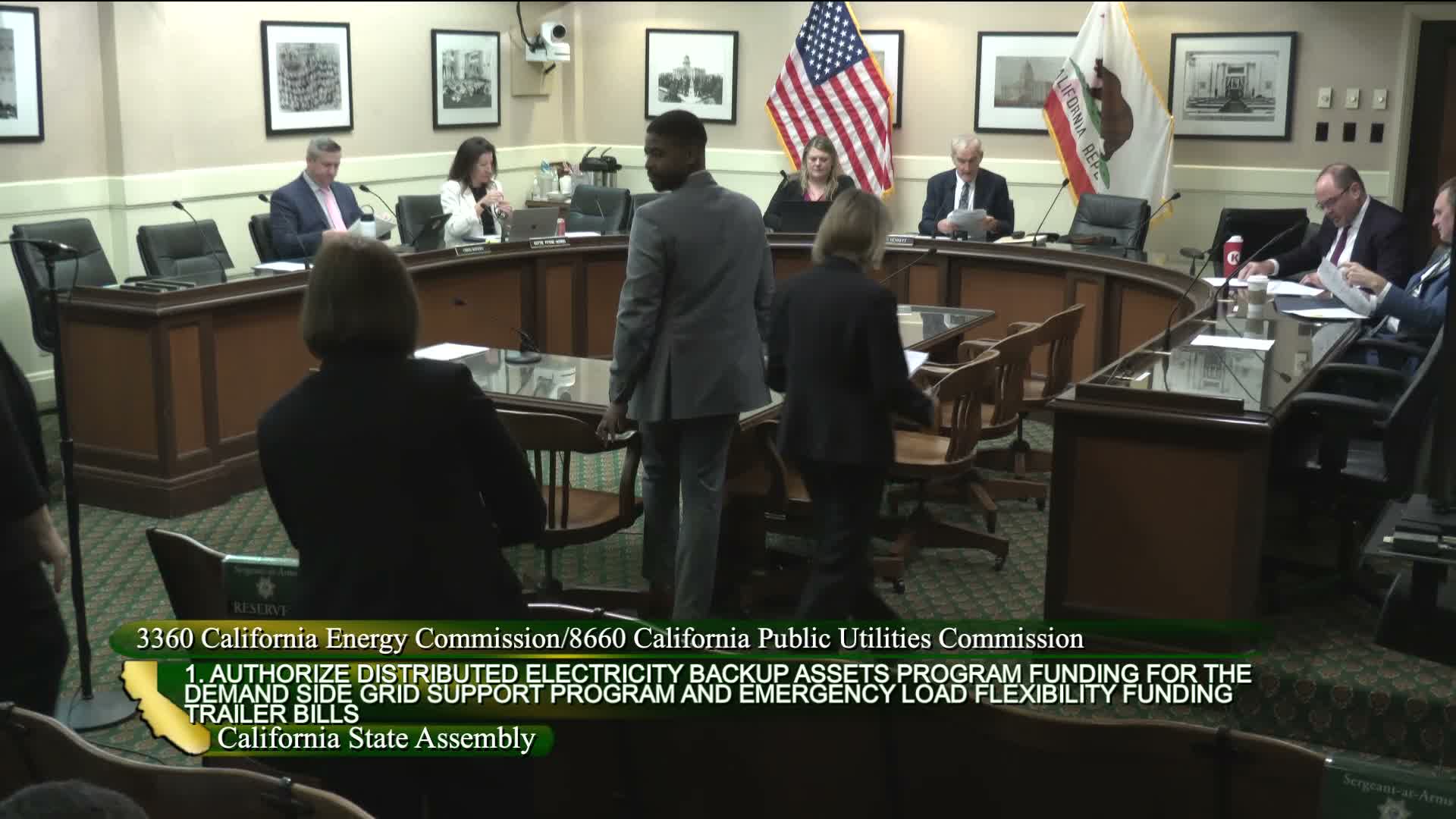
Chair Bennett convened the subcommittee and opened discussion of issue 1, a set of trailer‑bill proposals the administration says will preserve California’s emergency demand‑response capacity while moving program funding toward longer‑term, sustainable sources.
David Evans of the Department of Finance told the panel the governor’s proposal would reallocate roughly $26.9 million in general‑fund appropriations originally intended for the Distributed Energy Backup Assets program to bolster the Demand‑Side Grid Support (DSGS) program for summer 2026. Evans also said the administration would authorize the use of about $70 million in accumulated interest from the CalSHAPE program to provide ratepayer relief or bridge funding for an ELRP successor in 2027–2028, and directed the CPUC and CEC to collaborate on transitioning customers into the successor program.
The proposal prompted immediate questions from assemblymembers who said DSGS has been a rapidly scaled and well‑subscribed program since its 2022 launch. Dina Carrillo of the California Energy Commission said the CEC had awarded roughly $789 million in grants across more than 1,100 awards covering some 6,000 schools; CEC reported spending about $9.6 million of $30 million in CalSHAPE administrative funds and estimated roughly 15% of school projects risk failing to meet current encumbrance deadlines. Carrillo said DSGS’s 2025 expenditures totaled about $50 million—about $45 million in performance‑based incentives and $5 million in administrative costs—and cited a demonstrated incremental capacity of roughly 525 megawatts in test events.
Luan Tesfaye for the California Public Utilities Commission said ELRP had an authorized 2025 budget of about $219 million across the three investor‑owned utilities, and that CPUC practices of derating enrolled megawatts produced a figure of about 237 MW of realistic available capacity; CPUC staff said roughly 3.7 million customers were enrolled in ratepayer‑funded ELRP constructs. Tesfaye and CEC staff both stressed the two programs are not directly comparable—DSGS pays some participants simply for enrollment or a capacity reservation and has multiple participation pathways while ELRP’s structure is different—so the April 8 CPUC ruling opening a demand‑response proceeding is intended to gather data to create an apples‑to‑apples comparison.
Legislators repeatedly urged caution about sunsetting DSGS before a successor program is in place. Several members said DSGS’s fast start and higher enrollment argue for keeping the program at the CEC and extending its funding through 2027–2028 while the CPUC completes a rulemaking. The Legislative Analyst’s Office offered a framing question: if the Legislature does not direct funds to DSGS, will it prefer a general‑fund savings or preserving the program’s investments? Department of Finance officials described the action as driven by current budget constraints and the aim of transitioning toward ratepayer‑funded structures for ongoing emergency demand response.
The hearing closed the DSGS discussion with members asking the administration and agencies for additional data—particularly for an apples‑to‑apples performance and cost comparison of DSGS and ELRP—and several public commenters and stakeholder groups urged extending DSGS funding through 2028 and using CalSHAPE interest to support DSGS rather than ELRP in the near term.
The committee moved the record along with several follow‑ups requested of CPUC, CEC and DOF staff, including written details on encumbrances, administrative cost comparisons, and the timeline for CPUC’s proposed decision on successor program design, which the CPUC said it expects to issue in 2026 with a final implementation path to be operative for 2027.