Get Full Government Meeting Transcripts, Videos, & Alerts Forever!
Get email alerts on the Universal School Meals topic
No spam. Unsubscribe anytime.
Panel debates $1.8B universal meals proposal and $100M kitchen grant round
Summary
The subcommittee reviewed the governor’s $1.8 billion proposal for universal school meals (2026‑27) and a $100 million one‑time kitchen infrastructure grant round; the LAO urged pausing the fourth round until prior rounds are spent and recommended clearer legislative goals and data collection; CDE and nutrition researchers said needs are largely long‑term and multiyear.
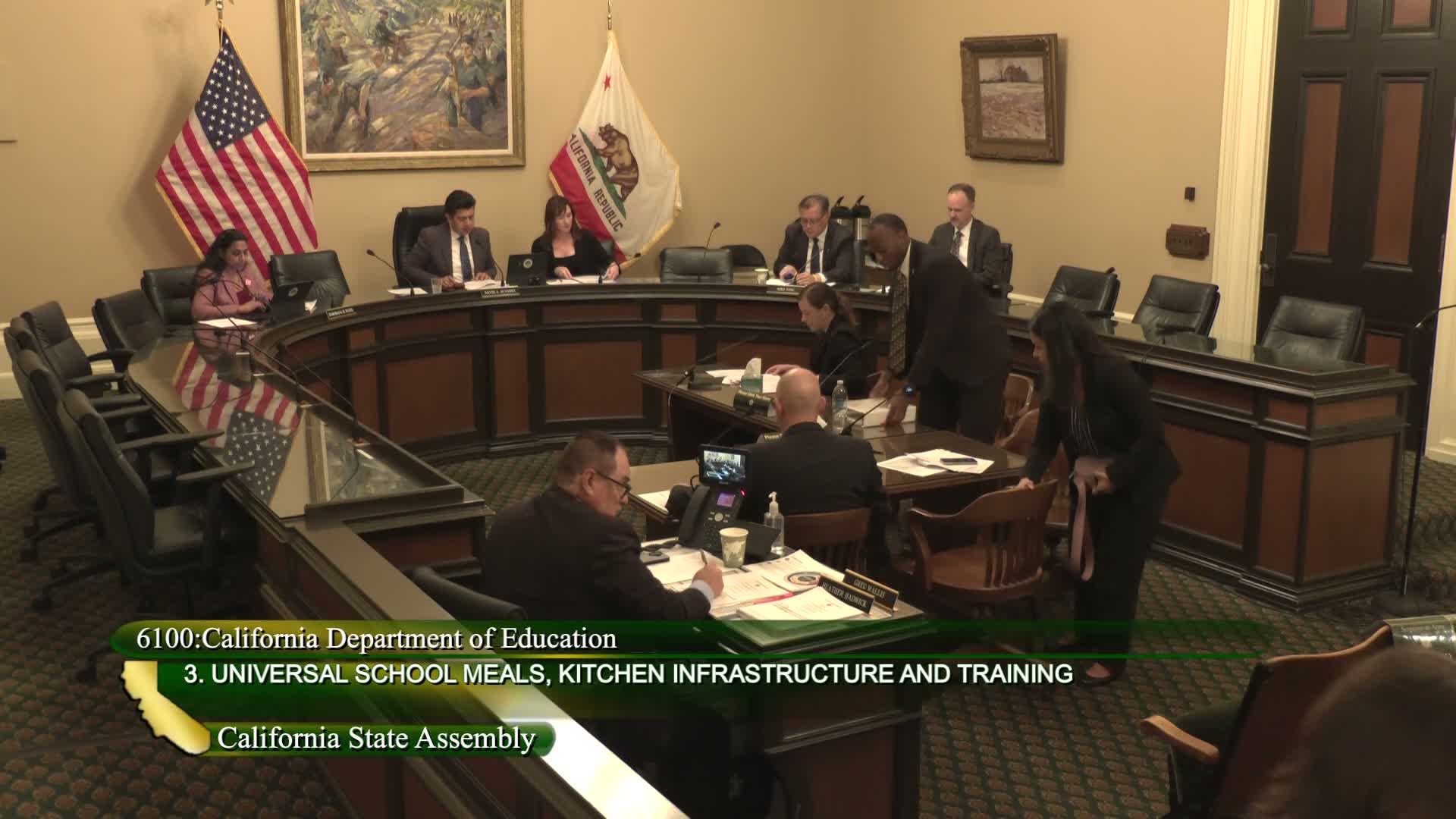
The subcommittee examined the governor’s proposed expansion of the universal school meals program and an additional competitive round of kitchen infrastructure grants.
The Department of Finance said the governor’s 2026‑27 budget includes $1.8 billion Proposition 98 to support universal school meals and an additional $100 million one‑time for a fourth round of kitchen infrastructure and training grants. “These resources support a projected total of 910 million meals in 2026‑27,” DOF testified.
The Legislative Analyst’s Office recommended rejecting the fourth round and instead restricting any future funds to legislative goals with measurable data collection because earlier rounds (second and third) — totaling roughly $755 million — remain in the spending pipeline. “Given the wide range of allowable uses, it is difficult to say what the unmet need is,” Sarah Cortez (LAO) said.
CDE described research and forthcoming survey work (Nutrition Policy Institute) that will produce preliminary results this summer and said early reporting shows many districts are using funds for equipment purchases (cooking, refrigeration, transportation), which often uncover deferred‑maintenance needs in older kitchens. “We do think the funding needs are there — it’s just that the planning and need are multiyear,” Kimberly Rosenberger said.
Committee members asked whether kitchen funds are reaching the highest‑need schools (Community Eligibility Provision/provision 2) and how flexible state funds could be used for innovations such as food pantries while complying with federal meal program restrictions. Finance staff said eligibility mirrors prior rounds (LEAs operating federal meal programs), with prioritization for high‑poverty schools and those not previously awarded kits. Committee members held the issue open pending updated survey and spending reports.