Get Full Government Meeting Transcripts, Videos, & Alerts Forever!
Get email alerts on the Expanded Learning topic
No spam. Unsubscribe anytime.
Assembly panel hears competing views on stabilizing ELOP tier‑2 funding
Summary
At a May hearing, the Assembly Budget Subcommittee examined the governor’s proposal to set a $1,800 minimum tier‑2 expanded learning opportunities program (ELOP) rate and urged better data on how ELOP, ACES and 21st Century funds overlap. The LAO recommended fixing tier‑2 at $1,579; CDE said site‑level participation data will not be available until mid‑2027.
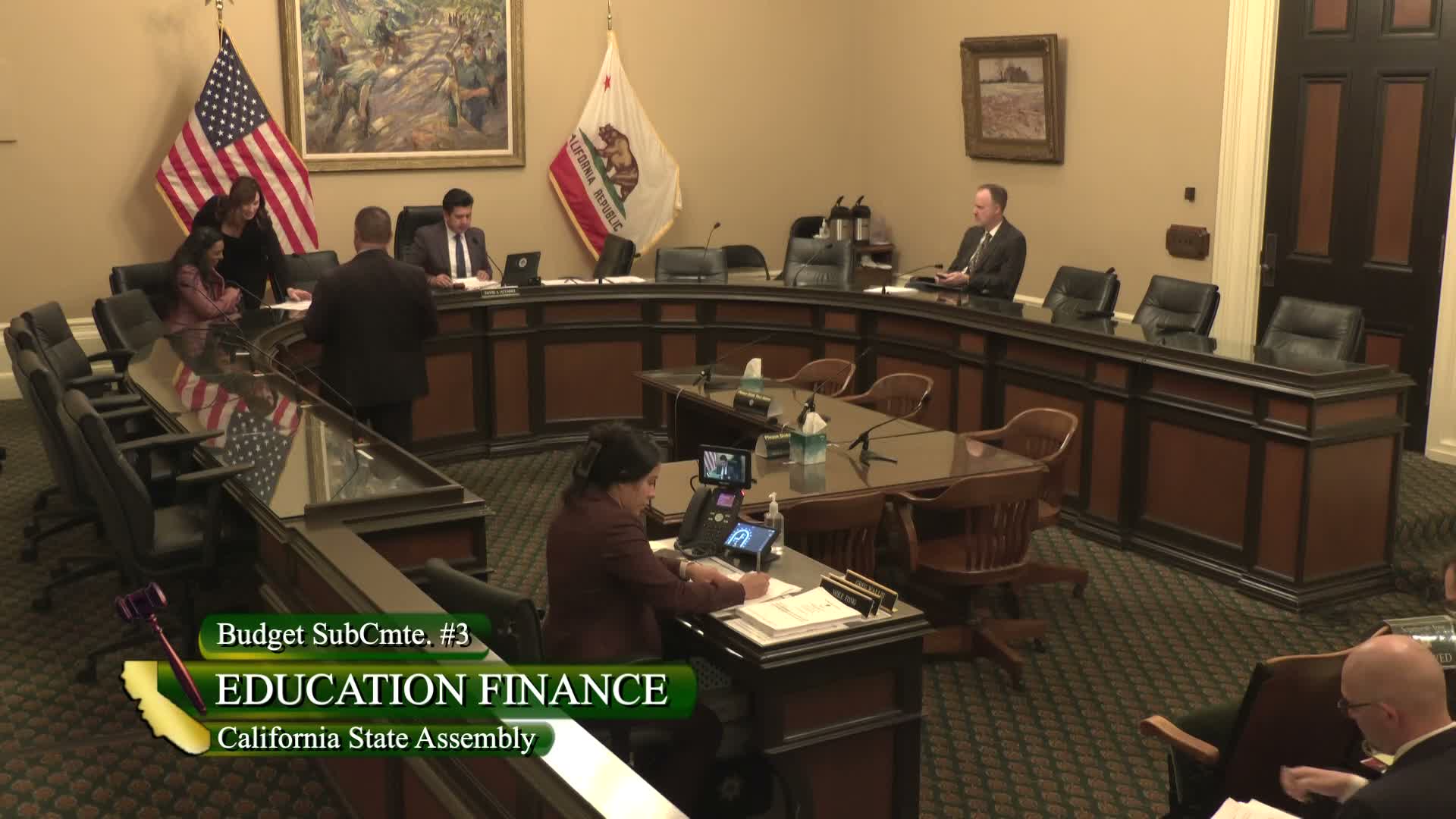
The Assembly Budget Subcommittee No. 3 on Education Finance debated whether to lock in a higher minimum rate for tier‑2 school districts in the state’s Expanded Learning Opportunities Program and sought clearer data on who is served by multiple after‑school funding streams.
The Department of Finance told the committee the governor’s 2026‑27 budget proposes $4.7 billion in ongoing Proposition 98 funding for ELOP and allocates $62.4 million to set a $1,800 per‑pupil minimum tier‑2 rate. “This is meant to provide stability to tier‑2 LEAs by setting a $1,800 per‑pupil minimum,” Italys Perez of the Department of Finance told the subcommittee.
The Legislative Analyst’s Office urged a different approach. “We recommend fixing the tier‑2 rate at the $1,579 level that districts have been planning around,” Dylan Hoxiflutzo of the LAO said, arguing that a fixed, lower rate would reduce planning uncertainty and that any future increases should be tied to changes in program requirements.
Kimberly Rosenberger of the California Department of Education said statewide outcome data show positive program effects but that the department lacks site‑level CALPADS reporting for ELOP enrollment patterns. “We expect to have more robust data by mid‑2027,” Rosenberger said, adding that CDE’s biannual report will include student breakdowns but not immediate site‑specific lists of which students are served by overlapping programs.
Committee members pressed agencies on how tier‑2 rates were computed and how ELOP interacts with other state grants such as After‑School Education and Safety (ACES) and 21st Century grants. The CDE reported 52 LEAs combine ACES, 21st Century and ELOP, 475 LEAs combine ACES and ELOP, and that 51 LEAs have opted out of ELOP participation (mostly charter schools), but it cannot yet say which students at which sites are funded by multiple streams.
Chair Alvarez and members called for follow‑up data to identify whether funds are duplicatively covering the same unduplicated students at some sites and whether allocations could be targeted to underserved middle and high schools that currently lack ELOP access. The committee held the issue open and requested updated spending and participation data from DOF, LAO and CDE.
The subcommittee will revisit the ELOP tiering and data questions after CDE’s reporting timelines and LAO follow‑up analyses are available.