Get AI Briefings, Transcripts & Alerts on Local & National Government Meetings — Forever.
Assembly commends 50 years of Coastal Act while one lawmaker criticizes commission's role
Summary
The California State Assembly adopted ACR 149 honoring the 50th anniversary of the California Coastal Act; supporters stressed conservation, public access and economic value while one member criticized the Coastal Commission's recent decisions. The resolution passed by voice vote with co‑authors added.
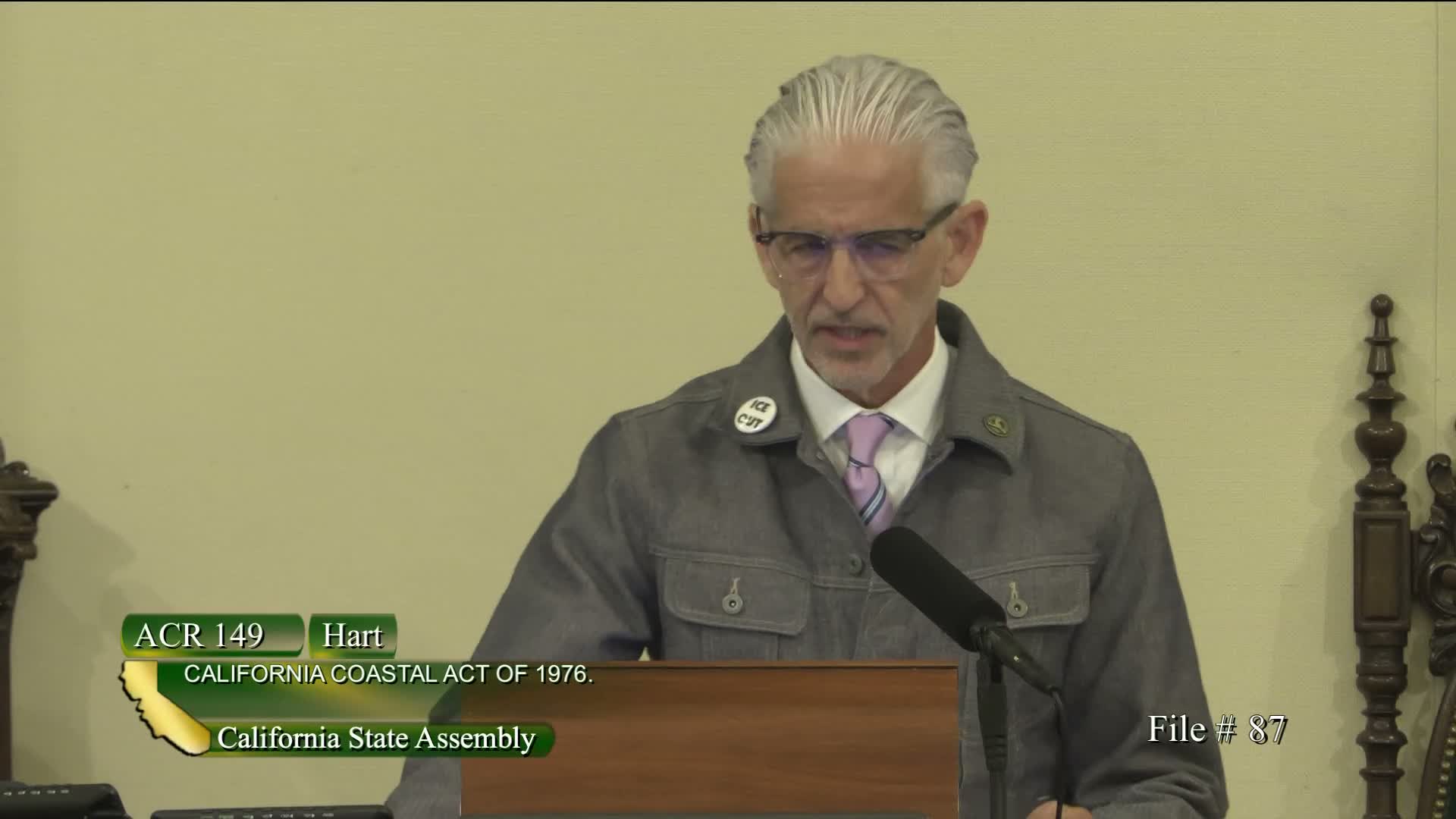
The California State Assembly adopted ACR 149 on March 25, 2026, commemorating the 50th anniversary of the California Coastal Act and recognizing the work of the California Coastal Commission and the Coastal Conservancy, Assemblymember Tim Hart said on the Assembly floor.
The resolution, presented by Assemblymember Hart, credited the Coastal Act with protecting public access to the coastline and with long‑term conservation efforts. “Our coastline is central to our environment, economy, and way of life,” Hart said, asking members to join in celebrating ‘‘50 years of invaluable work done to protect one of California’s greatest treasures.” Supporters highlighted the coast’s economic contribution and the role of the Coastal Act in habitat restoration and public access.
Not all remarks were celebratory. Assemblymember DeMaio urged members to vote against the resolution, saying the Coastal Commission has “lost our mind” on certain policies and “is literally driving up the cost of housing,” citing recent controversies including a fireworks prohibition in Long Beach as examples of overreach. DeMaio concluded, “We have to rein in the Coastal Commission, not give it a pat on the back.”
Several speakers pushed back or emphasized different priorities. Assemblymember Addis, identifying as co‑chair of the California Legislative Central Coast Caucus and joint author of the ACR, stressed the Coastal Act’s balanced decisions between development and conservation and warned about federal threats to coastal protections. Assemblymember Pellerin and others detailed local examples where coastal protections preserved public access and agricultural lands.
The Assembly opened a roll for co‑authors during consideration; the Clerk reported that 46 co‑authors were added before the item proceeded to a voice vote. The presiding officer announced, “The ayes have it,” and ACR 149 was adopted. After adoption, Hart recognized former Coastal Commission chairs and conservation leaders present in the gallery, thanking them for their service.
Why this matters: Members framed the resolution both as an acknowledgment of environmental stewardship and as a reminder of ongoing policy tensions — balancing coastal protection, housing needs and local control. The resolution itself is ceremonial (a commemorative concurrent resolution) and does not change law; adoption signals bipartisan support for continued coastal stewardship while spotlighting disagreements over the Commission’s policies.
The Assembly moved on after adoption; Hart noted that the next 50 years of coastal protection will continue to require sustained work and vigilance.