Get Full Government Meeting Transcripts, Videos, & Alerts Forever!
Get email alerts on the Education Instructional Materials topic
No spam. Unsubscribe anytime.
Assembly committee advances AB 26 15 as cleanup to last year’s AB 715 amid free‑speech and implementation concerns
Summary
AB 26 15, presented as technical 'cleanup' to last year’s AB 715, was advanced to appropriations after hours of testimony from authors, civil‑rights groups and education organizations who clashed over whether the bill’s 'factually accurate' language could chill classroom instruction. Authors accepted amendments and pledged continued stakeholder talks.
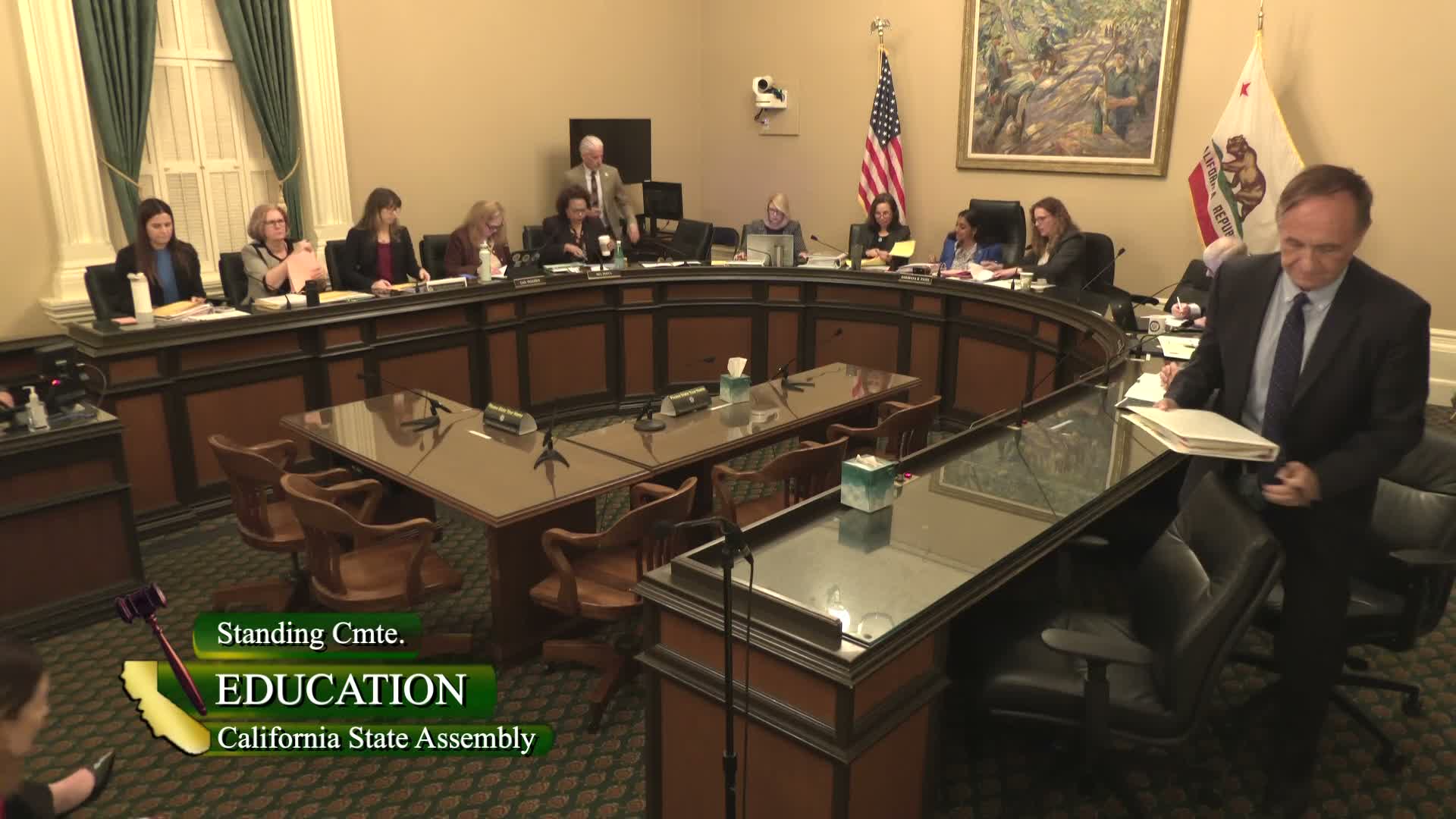
Assemblymember Zuber and coauthor Assemblymember Addis told the Assembly Education Committee that AB 26 15 is a narrow "cleanup" to AB 715 intended to clarify several points stakeholders raised during last year’s debate, including the meaning of "factually accurate" instruction and the process for handling discriminatory instructional materials.
"What this bill does is that we believe it does address the issue that we agreed to," Assemblymember Zuber said, explaining that the amendment ties the instruction standard to the existing Education Code standard for instructional‑material adoption in paragraph 3 of subdivision (c) of section 60200.
Opponents, including the California Teachers Association and civil‑rights organizations, warned the change does not fix core implementation problems. "If left as amended, the bill will have serious consequences for teaching and learning that will hinder education rather than support it," Seth Bramble of the CTA said, arguing the language could be read to require that "all instructional materials...shall be factually accurate" in a way that reaches routine classroom acts such as teacher‑created handouts or classroom discussion.
Uzum Mafaddim of the California chapter of the Council on American‑Islamic Relations said stakeholders remained concerned about definitions that could chill speech: "This definition is being weaponized...and denounced...for the chilling effect it creates on free speech," the witness said, urging that the bill be adjusted to avoid vagueness.
Authors and several members stressed their intent to preserve arts and literature instruction and said the amendments aim to apply the same statutory interpretation used elsewhere in the Education Code. "We agreed to address four specific issues," Zuber said, adding that the language is meant to ensure the standard is applied the same way it is to adopted instructional materials.
Several members pressed for further clarification about which office enforces the removal of discriminatory material and how that will work if broader governance reforms change oversight roles. Zuber acknowledged potential implementation questions as other reforms advance and said the authors would continue stakeholder conversations.
After debate and an exchange about legal challenges and constitutional questions, the committee voted to move AB 26 15 as amended to the Appropriations Committee. The roll call and chair’s announcement recorded the committee vote in favor and left the roll open for add‑on votes.
Next steps: AB 26 15 will go to the Assembly Appropriations Committee; the authors said they will keep meeting with stakeholder groups to refine language on the 'factually accurate' standard and oversight mechanics.