Get Full Government Meeting Transcripts, Videos, & Alerts Forever!
Get email alerts on the Foster Care Trs topic
No spam. Unsubscribe anytime.
Officials urge careful sequencing as California prepares first‑in‑nation foster‑care tiered rate structure
Summary
State and county officials outlined the tiered rate structure (TRS) to fund foster‑care services by child needs rather than placement, described implementation steps and costs, and urged the legislature to fund the full package or risk fragmenting services that must operate together.
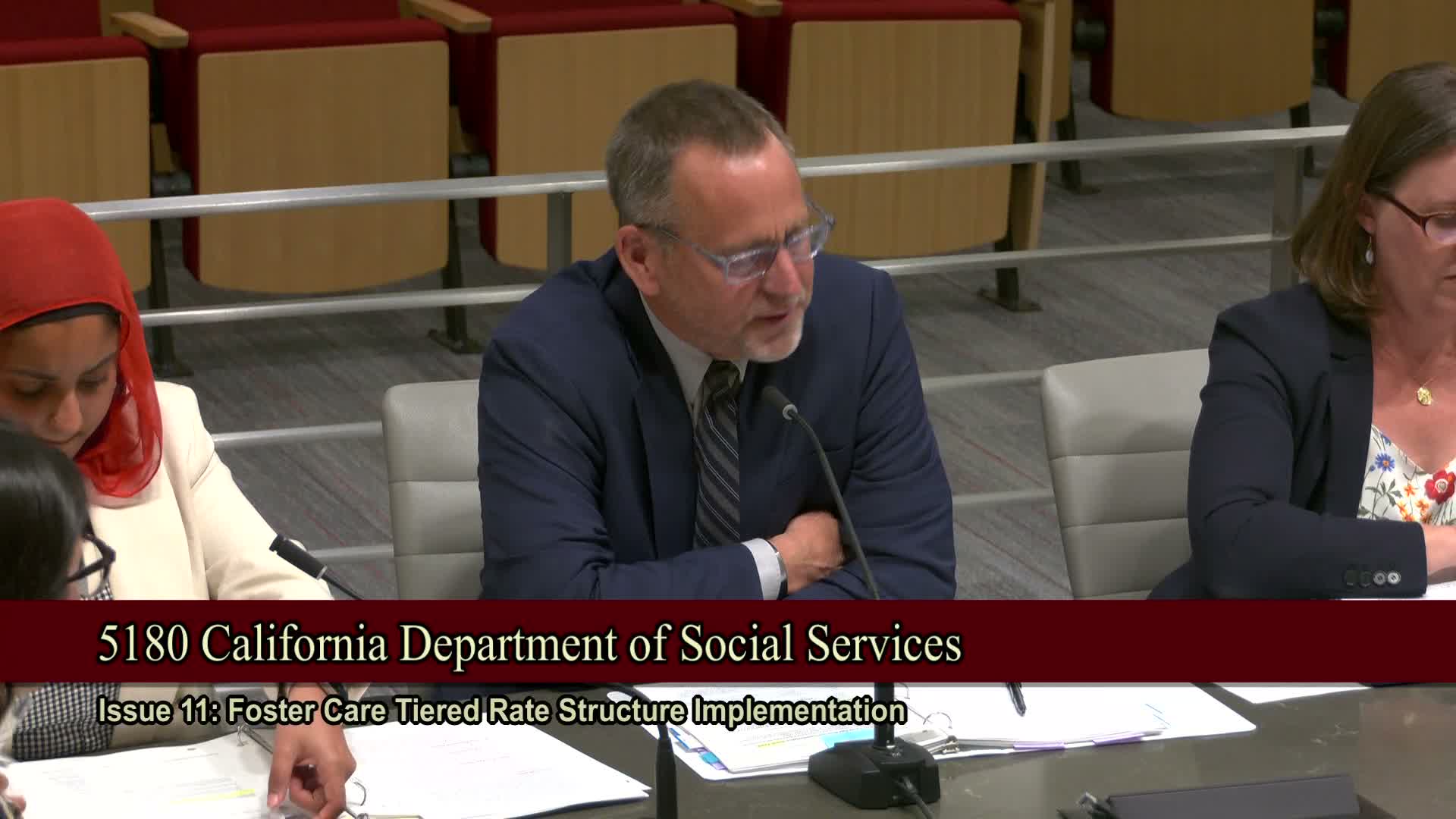
The Department of Social Services and county partners described a major overhaul of California’s foster‑care funding at a Senate subcommittee meeting on April 22, urging careful sequencing and full funding for a tiered rate structure (TRS) that ties dollars to child needs rather than placement type.
David Swanson Hollinger, chief deputy director at CDSS, said TRS is “the first reform of its kind in the nation,” intended to ensure children receive services and supports matched to their assessed needs regardless of where they live. The proposal reorganizes funding into components including care and supervision, an immediate‑needs high‑fidelity wraparound benefit, and a strengths‑building program to support normalized childhood experiences.
Angie Schwartz (Deputy Director, Children & Family Services Division) described implementation steps: finalizing foundational guidance by the end of the calendar year, using the first half of 2027 for training and capacity building, and pursuing a July 2027 launch contingent on appropriation. CDSS said it has issued core notices of action, is preparing contracts for third‑party administrative roles, and is conducting a statewide wraparound capacity assessment with partners including UCLA and external technical assistance providers.
County welfare directors and advocates supported the goals but warned of operational challenges. Carlos Marquez (County Welfare Directors Association) said counties are ready to partner but need clear guidance, payment models and sufficient lead time to adjust contracts and workflows; he flagged concerns about funding for the immediate‑needs third‑party administrator, which CDSS has not yet built into the governor’s budget. Analysts told the committee that while substantial work is underway, the state’s structural‑deficit projections do not yet reflect full TRS costs.
The Department of Finance estimated a state cost of roughly $340 million in the first year of phased implementation and about $705 million at full implementation in later years (total funds larger when federal and county shares are included). Panelists repeatedly cautioned against decoupling TRS components (for example, funding immediate‑needs wraparound without strength‑building or care‑and‑supervision payments), arguing that partial implementation would leave families and providers without the full set of services needed to keep children safely in family settings.
Youth and caregiver advocates described how TRS could change everyday life for children in care by funding peer supports, transportation, extracurricular activities and other normalizing experiences. Christina Tanner (Youth Law Center) and Chantelle Johnson (Youth Law Center) said the reform should reduce disruptive placements and expand supports that let children remain connected to families and community.
CDSS said it is continuing detailed work on STRTP (short‑term residential therapeutic program) costs and on how to ensure STRTPs deliver true short‑term therapeutic services while TRS shifts incentives toward family‑based care. Counties asked the administration for county‑level latent‑class analysis and other data to identify service gaps and medically fragile populations so they can plan capacity.
Next steps: CDSS will finalize policy guidance, complete capacity analyses and complete contracting for administrative support. The legislature must appropriate TRS funding and may consider alternatives or phased approaches; stakeholders urged that if full funding is unlikely by July 2027, leaders should develop a plan B that preserves core integrated services rather than fragmenting the model.