Get Full Government Meeting Transcripts, Videos, & Alerts Forever!
Get email alerts on the Childcare Budget And Rate Reform topic
No spam. Unsubscribe anytime.
Senate subcommittee presses CDSS on unspent childcare dollars, slot activation and rate reform timeline
Summary
At a California State Senate subcommittee hearing, CDSS and finance officials outlined budget numbers and implementation steps for childcare slot expansions, explained federal and Prop 64 revenue reductions, and faced lawmakers’ demands for clearer timelines, flexibility to shift funds to vouchers and faster automation to support single-rate reform.
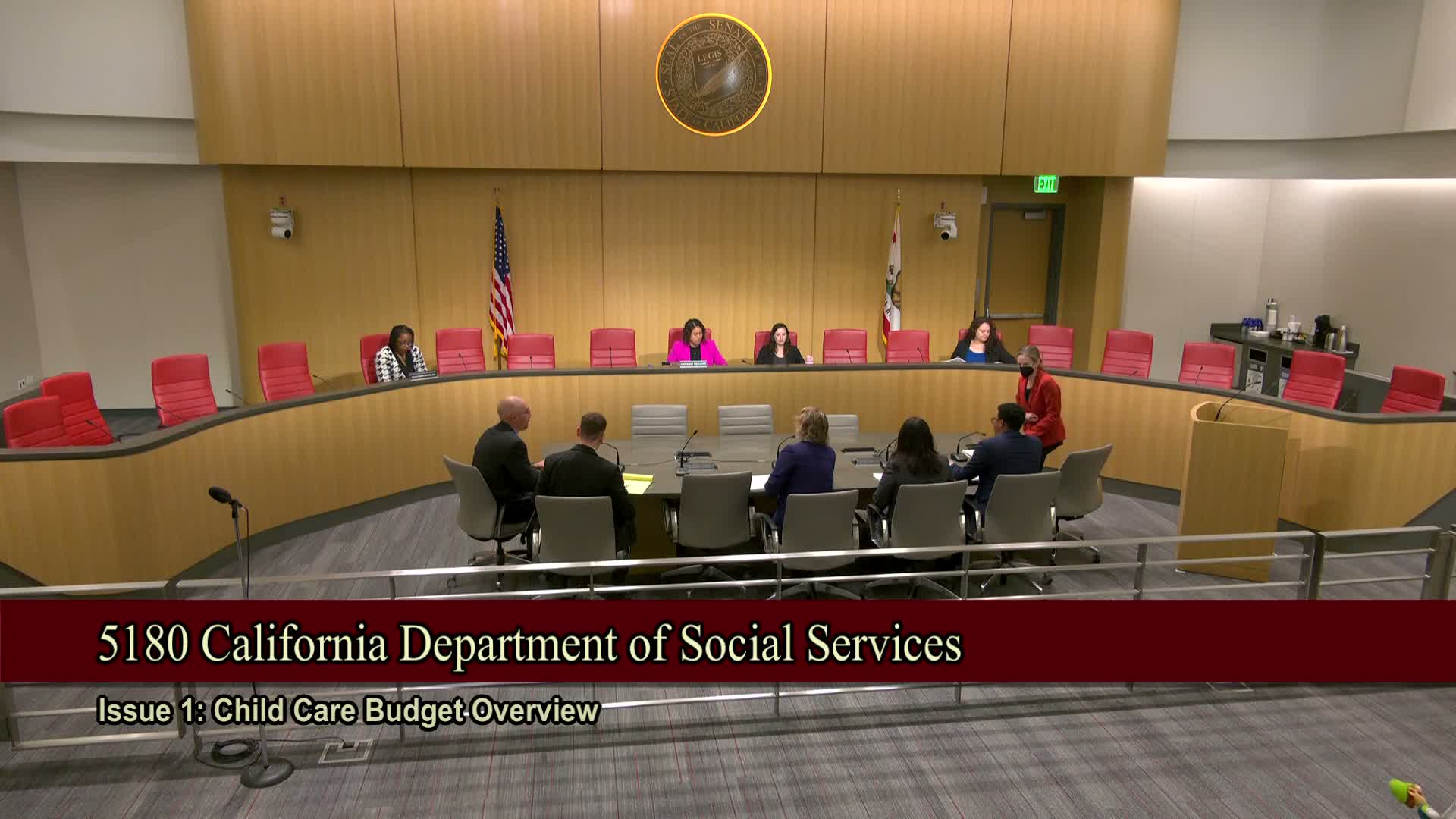
California’s push to expand subsidized childcare moved under a microscope at a Senate subcommittee hearing on April 22 as Department of Social Services officials walked members through the governor’s budget, recent program milestones and the obstacles slowing activation of awarded slots.
Claire Ramsey, chief deputy director at the Department of Social Services, told the panel the governor’s FY26–27 budget proposes $6.8 billion for CDSS childcare programs and a one‑time $11.5 million Prop 64 transfer to support disaster‑impacted providers. Ramsey said California has nearly doubled total funding for childcare and development programs in recent years and raised the maximum number of children served from about 294,100 (2019–20) to more than 366,700 per month.
But the department also reported an $86.1 million federal CCDF reduction for federal FY2025 tied to a federal formula update and a projected $22.7 million Prop 64 drop for FY26–27. CDSS said those two changes could translate to roughly a 4,176‑slot reduction among CCTR (center‑based) slots and that staff will deliver a refined estimate in May.
Lawmakers pressed the administration on why many awarded CCTR contract slots remain uncontracted. CDSS officials and deputy directors said common delays include locating and preparing facilities (permits, inspections), completing community care licensing, recruiting and training staff, and enrolling families—tasks often outside the department’s direct control. CDSS said it is offering targeted technical assistance, office hours, expedited licensing reviews and an updated continuing application to identify contractors that can expand sooner.
Members also questioned hundreds of millions in unspent general childcare funds that reverted to the General Fund in prior years. LAO staff recommended aligning general childcare appropriations with lower CCDF and Prop 64 revenues to avoid widening the state’s structural deficit; they also asked for more detail on the proposed $11.5 million mini‑grant program for wildfire‑affected providers.
Several senators suggested policy fixes: change reversion timing so unspent contract funds can shift to vouchers after a set period (12–24 months), permanently reallocate undeployed contract dollars to vouchers, and reduce the share of slots reserved for long‑lead contracts in favor of vouchers that can be used more quickly. LAO and CDSS staff cautioned that permanently converting contract funds into ongoing voucher capacity would require statutory and budgetary changes to sustain those slots.
Panelists from the field urged both immediate and structural reforms. Tony Jordan of the Stanislaus County Office of Education said local data show large unmet demand for infant‑toddler care and recommended addressing rate and adjustment‑factor disparities between state preschool (CSPP) and CDSS programs. Laura Pryor, research director at the California Budget and Policy Center, said the state currently enrolls roughly 16% of eligible children and urged a revenue plan to pay providers the true cost of care, expand mixed‑delivery options and close racial and geographic inequities.
CDSS also described policy proposals in trailer‑bill language: adopting the federally approved alternative methodology for rate setting (to support the single‑rate structure), applying a COLA to cost‑of‑care‑plus payments, clarifying temporary‑absence rules for family child care homes, defining excessive unexplained absences for potential disenrollment, and standardizing fee collection to ensure contractors receive full voucher amounts. The department acknowledged it inadvertently excluded CalWORKs childcare and the Emergency Child Care Bridge Program from its initial COLA calculation and intends to revise that proposal.
The chair and members repeatedly demanded firm timelines. CDSS officials said they are advancing the single‑rate design, completing policy decisions and convening implementation focus groups, but they declined to commit to a single final date for full automation and rollout, noting many technical and policy choices remain. CDSS said some automation work must be sequenced after policy choices (age definitions, transportation reimbursement and other program rules) are finalized to avoid rework.
Public commenters, including providers, county superintendents and advocacy coalitions, urged preserving 4,200 CCTR slots already in development, funding the Senate plan for 44,000 additional slots, adopting prospective pay (prepayments), and ensuring the proposed $11.5 million Prop 64 grants reach family‑based and license‑exempt providers impacted by wildfires.
Next steps: CDSS will provide updated slot‑impact estimates in May, refine the Prop 64 mini‑grant design, and continue joint stakeholder work on the alternative methodology and automation sequencing. Lawmakers said they will push for clearer deadlines and legislative options to reallocate funds if contracts remain inactive.