Get Full Government Meeting Transcripts, Videos, & Alerts Forever!
Get email alerts on the Committee Package Votes topic
No spam. Unsubscribe anytime.
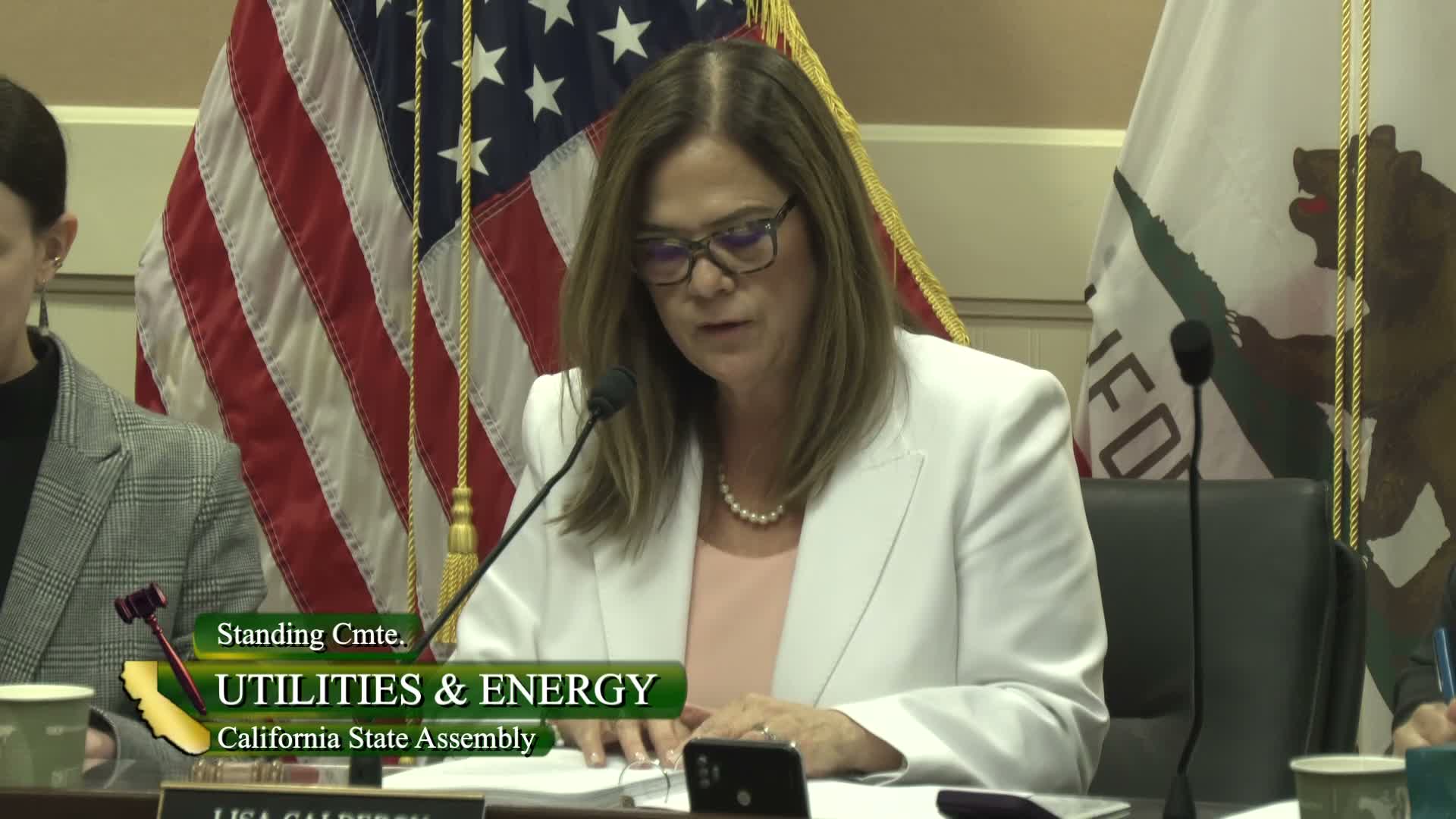
Assembly Utilities and Energy Committee advances package of energy bills after lengthy debate
Summary
The Assembly Committee on Utilities and Energy moved a package of energy and utility bills — including measures on community solar, electrification incentives, grid‑utilization metrics, thermal energy networks, and a study on advanced nuclear — to appropriations or placed them on call after extended testimony from advocates, utilities, and labor.
The Assembly Committee on Utilities and Energy met in a multi‑hour hearing that advanced a slate of energy bills and heard extended testimony on the costs, safety and implementation of policies tied to California’s move away from fossil fuels.
Chair (Chair) opened the hearing and set procedures for testimony and registration before the committee took up AB 18 13, AB 23 13 (Home Energy Choice Act), AB 19 75 (grid utilization metric), AB 26 12 (plug‑in photovoltaic standards), AB 18 49 (decarbonized gaseous fuels study), AB 20 88 (thermal energy networks), and several other measures.
AB 18 13 — community renewable projects Assemblymember Ward, the bill’s author, framed AB 18 13 as a way to expand access to shared solar for renters and low‑income customers, noting that "45% of all California households and 70% of low income households are renters," and argued community projects paired with storage could close that gap. Supporters including Matt Friedman of the Utility Reform Network and Marian Borgeson of NRDC said community solar can be built quickly and deliver bill savings; utility witnesses (Pacific Gas & Electric, San Diego Gas & Electric, Southern California Edison) expressed procedural and cost‑shift concerns and asked for more time to review the committee amendments. The author said incentives would be capped and the bill includes PUC direction and emergency exemptions. The committee later took a motion on the measure (see votes at a glance).
AB 23 13 — Home Energy Choice Act Supporters described AB 23 13 as a voluntary option that lets homeowners offered a gas service‑line replacement opt instead for electrification, using a portion of replacement funds for incentives. Earthjustice’s Matt Vespa said the approach "will lower costs for all gas customers" by avoiding more expensive pipeline replacements; utilities warned using the repair and replacement fund could drain monies earmarked for high‑priority safety work and create a cost shift. The author and witnesses pointed to an emergency exemption and PUC deadlines as guardrails and said they would work with opponents on implementation.
AB 19 75 — grid utilization metric Assemblymember Schultz said AB 19 75 would require the CPUC to develop a straightforward metric of distribution system utilization to identify where distribution‑connected batteries and solar can avoid costly upgrades. Developers and pilot participants said local battery projects had deferred major transformer and line replacements in Kern County and elsewhere.
Other measures discussed The committee heard presentations on AB 26 12 to develop standards for qualified plug‑in photovoltaic systems; AB 18 49 to have CARB assess long‑term needs for decarbonized gaseous fuels; AB 20 88 to authorize thermal energy networks (TENS) with technical and workforce safeguards; AB 25 43 on EV charging resilience during emergencies; and AB 25 18, a San Diego County pilot to set energization timelines for priority public‑benefit projects.
Committee process and next steps Multiple bills were moved to appropriations or placed “on call” pending absent members. The committee repeatedly left roll calls open for absent members to add their votes at a later time; where motions were recorded the clerk noted "do pass as amended to appropriations" or "pass as amended to appropriations" for many items. The committee also dispensed with the consent calendar.
Votes at a glance (as recorded in the hearing) - AB 18 13 (community renewable projects): Motion made to pass as amended to appropriations; roll left open for absent members. (Committee action: advanced/placed on call.) - AB 23 13 (Home Energy Choice Act): Extensive testimony; author accepted amendments and committed to work with utilities and stakeholders; motion and final disposition recorded in committee (advanced/placed on call pending absent members). - AB 19 75 (grid utilization metric): Motion to pass as amended to appropriations called and advanced by the committee when quorum was established. - AB 26 12 (plug‑in PV standards): Advanced to appropriations as amended. - AB 18 49 (decarbonized gaseous fuels study): Motion to pass as amended to appropriations; supporters and opponents debated scope and definition of "decarbonized gas." - AB 20 88 (TENS): Committee moved the bill (do pass as amended to appropriations). - AB 23 69 (transmission/resource adequacy): Advanced as amended to appropriations; author stressed methodology changes to count energy‑only resources toward adequacy. - AB 26 47 (advanced nuclear study): Committee voted to move the study bill to appropriations after pro/con testimony; opponents urged fiscal restraint and flagged waste/cost concerns. - ACA 9 (CPUC structural reforms): Committee adopted the measure and sent it to appropriations.
Why this matters Committee members repeatedly returned to two central trade‑offs: (1) how to accelerate clean resources while protecting ratepayers from cost shifts and funding shortfalls; and (2) how much program design and detail to leave to the CPUC, CARB or other implementing agencies versus setting statutory guardrails in law. Those trade‑offs drove much of the questioning and the requests from utilities and labor for additional time to review committee amendments.
What to watch next - Appropriations hearings for the bills above, where fiscal impacts and implementing language will be examined in more detail. - Follow‑up negotiations between authors, IOUs, CCAs, labor and environmental groups over guardrails for AB 23 13 and funding protections for pipeline safety. - CPUC and CARB rulemaking or guidance if bills that delegate design authority move forward.
Ending After several hours of testimony and multiple roll calls — with some measures left "on call" to accommodate absent members — the committee advanced a broad set of proposals that together target faster deployment of local storage and solar, clearer building and equipment standards, new study work on hard‑to‑electrify fuels and technologies, and pilots to address operational delays.