Get AI Briefings, Transcripts & Alerts on Local & National Government Meetings — Forever.
Dr. Michael McNamara emphasizes rural access and oversight in state medical board confirmation hearing
Summary
At a House Health and Social Services Committee confirmation hearing, Dr. Michael McNamara described his orthopedic background and told lawmakers he supports creative licensing to expand rural access while stressing oversight. Lawmakers pressed him on scope-of-practice questions and a prior board letter backing HB 342; no vote was taken.
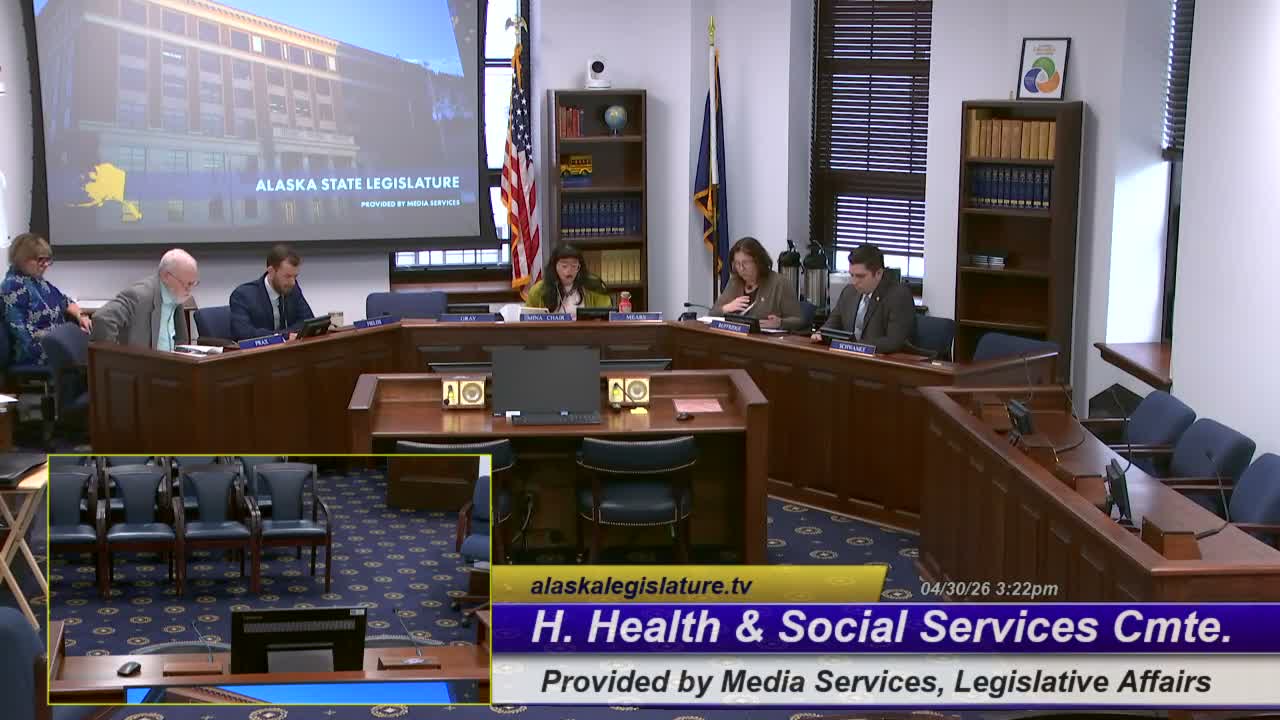
Dr. Michael McNamara described his surgical training and his interest in serving on the Alaska State Medical Board during a confirmation hearing before the House Health and Social Services Committee on April 30.
McNamara, an orthopedic surgeon who said he was appointed by Governor Denn Levy about five months ago, told the committee he trained at the University of Washington, completed residency work in San Antonio, spent six years at Elmendorf Air Force Base and has served roughly 25 years as president and executive director of the Alaska Surgery Center of Anchorage. "I've always wanted to be on the medical board but just been too busy," he said, adding he expects to retire next month and have time to serve.
Lawmakers focused their questions on access to specialty care in rural Alaska, scope-of-practice changes and recent contentious board actions. Representative Mears asked whether specialty care gaps still send patients out of state; McNamara said Alaska has made "marked" improvements but that some complex cancers and cardiac cases continue to be referred elsewhere and that more specialty-trained clinicians and outreach to villages are needed.
Representative Brooks asked about expanding scope of practice for other licensed professionals. McNamara said he has worked with physician assistants for more than 30 years and supports "creative" licensing or credentialing approaches to increase access while maintaining oversight and training: "Looking for creative ways to provide more care makes total sense," he said.
Representative Fields raised concerns about naturopaths and a shortage of primary care providers, noting constrained higher education funding for WWAMI and limited internship positions outside Anchorage. McNamara said the WWAMI program has helped bring more primary care providers to Alaska but agreed training capacity and incentives for rotations to communities such as Nome and Kotzebue warrant attention. He suggested scholarships or community-sponsored rotations as one option to encourage trainees to practice in rural areas.
Representative Gray, who identified themself as a physician assistant and said they worked in gender-affirming care at the Alaska VA, asked McNamara why he voted to sign on to a State Medical Board letter supporting HB 342, legislation about physician liability for reassignment procedures for minors. McNamara said he is new to the board, that the decision predated much of his tenure and that he relied on input from the Department of Law, the governor's office and other board members when he signed onto the prior decision. "I may have recused myself from that vote," he said, adding he intends to learn more before taking positions on such matters.
The committee chair also asked about the board's role in commenting on scope-of-practice issues handled by other professional boards and referenced a past board letter opposing pharmacist authority to prescribe certain medications, including mifepristone. McNamara said the board seeks interagency input and that board meetings are open to the public; he encouraged greater public participation at board meetings.
The chair opened public testimony on the nomination; no one in the room or online asked to speak and the chair closed public testimony. The committee did not take a confirmation vote. In accordance with AS 39 5 80, committee members were asked to sign a report and the hearing was adjourned at 3:52 p.m.; the committee's next meeting was announced for May 7 at 3:15 p.m. in Davis 106.
The hearing concentrated on McNamara's experience, rural workforce challenges and the State Medical Board's recent involvement in debated scope-of-practice and clinical-care policy issues. No formal committee vote or recommendation on the confirmation was recorded at the hearing.