Get AI Briefings, Transcripts & Alerts on Local & National Government Meetings — Forever.
Senate committee advances SB 281 to add genetic counselors, respiratory care practitioners; electronic‑fingerprint amendment withdrawn
Summary
The Senate Health and Social Services Committee adopted a committee substitute for SB 281 and voted 3–2 to advance the bill that would add genetic counselors and respiratory care practitioners to the list of professions licensed by the Department of Commerce, Community and Economic Development; an amendment to allow applicants to submit fingerprints electronically was withdrawn after agencies raised access and security concerns.
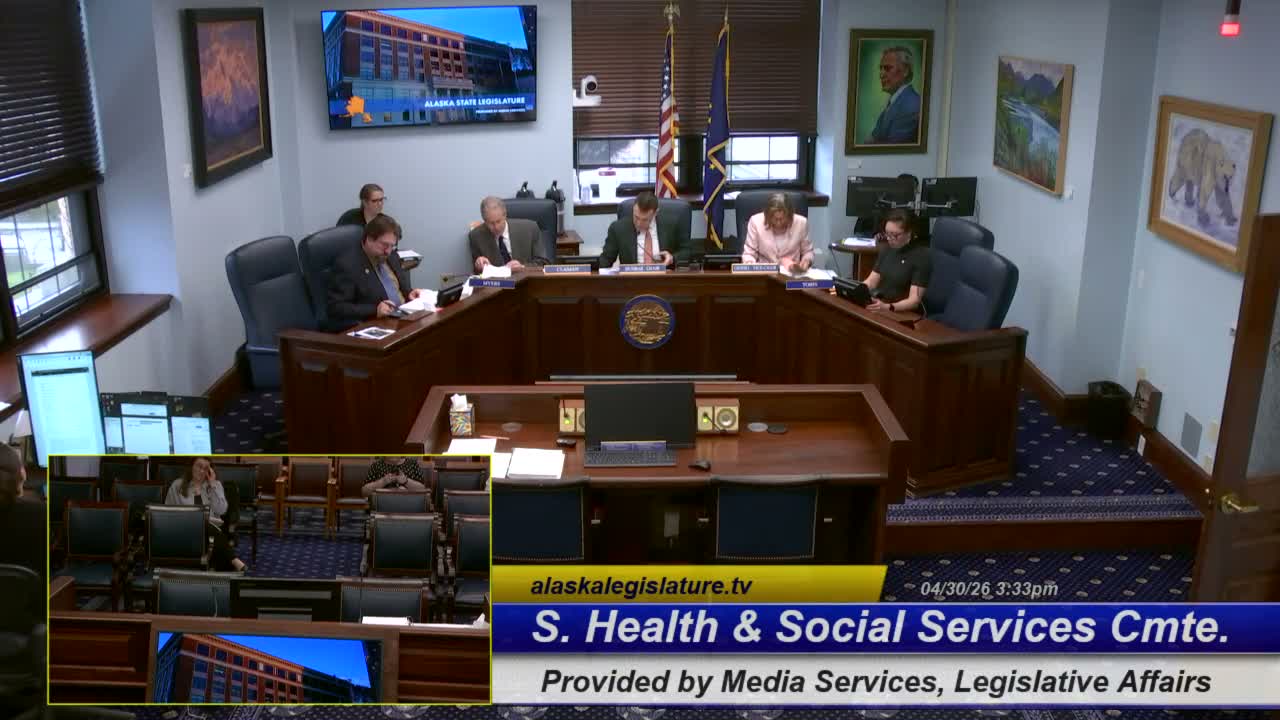
The Senate Health and Social Services Committee advanced SB 281 (version H) on April 30 after adopting a committee substitute that adds several health professions to the roster of licensed providers and sets a repeal date for one program. The committee voted 3–2 to report the bill from committee.
Ariel Harbison, staff to Chair Dunbar, summarized the changes in the committee substitute, saying it adds genetic counselors in multiple sections (with an Appendix A providing a detailed licensing sectional) and adds respiratory care practitioners in other sections (Appendix B). Harbison also noted a provision that directs governor-appointed members to be chosen for public‑interest qualifications and geographic representation, and a section that repeals the Bridging Health Transformation Program on Dec. 31, 2031.
The committee considered amendment H.1, which would have required applicants to submit fingerprints to the licensing board in an electronic format approved by the Department of Public Safety (DPS). DPS told the committee it can accept electronic fingerprints from government entities and does not expect the change to create processing problems if boards submit prints electronically. "We can currently accept electronic fingerprints from the board or from other government agencies," a DPS official said.
Sylvan Robb, director of the Division of Corporations, Business and Professional Licensing (CBPL), told the committee CBPL operates offices only in Anchorage and Juneau and that many Alaskans lack ready access to electronic fingerprint capture. Robb said requiring applicants to submit electronic prints could slow licensing and increase costs until DPS establishes a reliable mechanism to accept prints from third‑party vendors. "At this time ... we would need individuals to come in to be fingerprinted," Robb said, urging the committee to retain the qualifier "where available." DPS witnesses explained that many live‑scan captures are printed and submitted as hard cards and that DPS receives electronic submissions only from government entities authorized to request criminal-history checks; DPS also flagged security and authorization concerns about accepting prints directly from private vendors.
After the discussion, the member who proposed the amendment withdrew it, saying the technical and access barriers remain unresolved. The committee then took a roll-call vote on the bill as amended in committee. The clerk recorded the following votes: Senator Diesel—No; Senator Myers—Yes; Senator Tobin—No; Senator Clayton—Yes; Senator Dendel—Yes. With a 3–2 vote, SB 281 version H passed out of committee.
Chair Dunbar asked members to stay after the hearing to sign paperwork. The committee will meet next on May 5.