Get Full Government Meeting Transcripts, Videos, & Alerts Forever!
Get email alerts on the Sb 130 topic
No spam. Unsubscribe anytime.
House Finance Committee hears broad industry support for SB 130 to expand fisheries product development tax credit
Summary
Industry leaders told the House Finance Committee on May 4 that extending and expanding SB 130 would help modernize processing, keep more value in Alaska and support rural communities; the Department of Revenue presented FY2027 fiscal scenarios averaging about $1 million in foregone revenue under the bill.
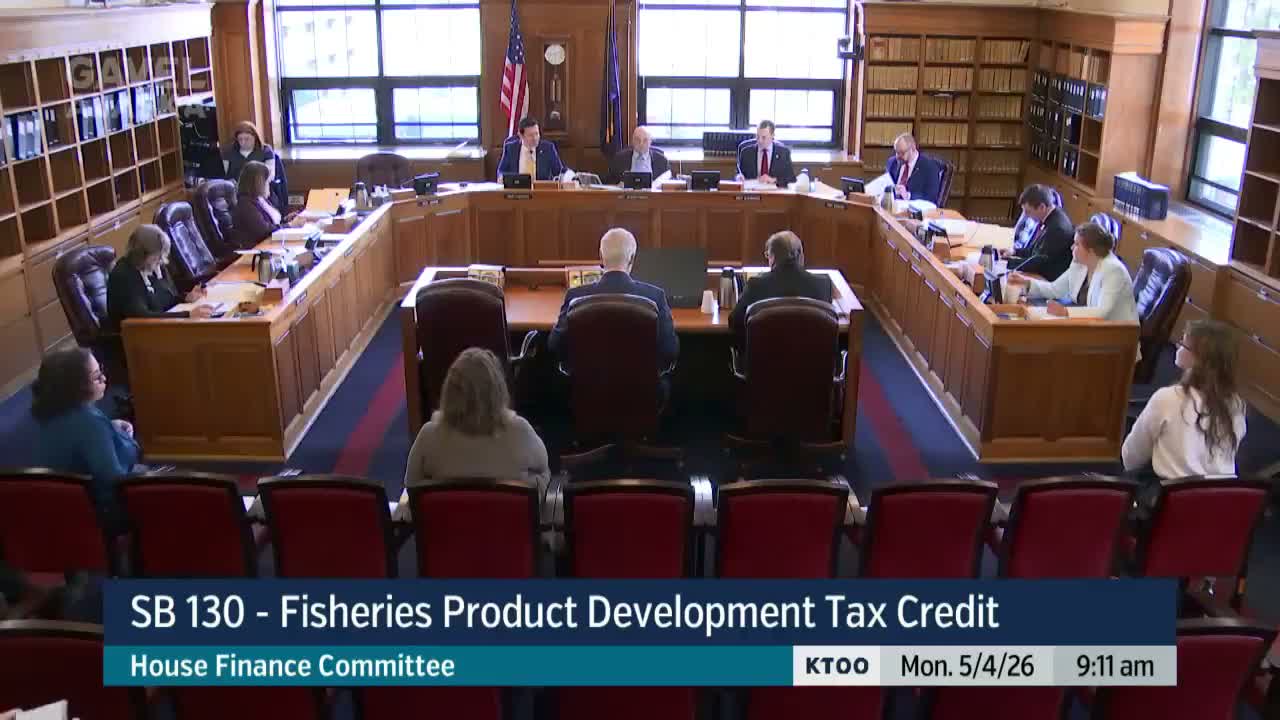
The House Finance Committee on Monday heard extensive public testimony backing Senate Bill 130, which would extend and broaden Alaska’s fisheries product development tax credit to encourage investment in processing, cold‑chain and value‑added equipment.
Industry leaders from Alaska and beyond told committee members the credit helps processors modernize, raises the price paid to fishermen and supports coastal communities. "This credit is a critical tool for sustaining and modernizing Alaska's seafood processing infrastructure," said Bella Johnson, government affairs manager for Pacific Seafood.
Why it matters: Proponents said modest tax credits for capital equipment and quality‑improvement technology let processors add value onshore rather than exporting raw product for further processing elsewhere. That added value can increase fishermen’s pay and grow the state and local tax base, supporters said.
Department of Revenue fiscal estimate: A Department of Revenue official reviewed the fiscal note control code (KQIAZ) and three deduction scenarios for FY2027: an average impact of roughly $1,000,000, a high scenario near $1,060,000 and a low scenario about $900,000. The official said the fiscal note captures tax‑impact scenarios but does not by itself measure whether the credit has increased value‑added production; that assessment is typically addressed through program reporting and industry data.
Industry examples and technical detail: Trident Seafood’s Shannon Carroll described prior use of the credit to install a mincing and vertical plate freezer line in Cordova, saying the company spent about $1,000,000 on that line in 2019 and has since run roughly 33,000,000 pounds through it. "This investment directly creates more value for every single fish that comes through our plant," Carroll said, adding that recovered products have supported higher‑value pet and human food markets and helped cover fixed operating costs in remote plants.
Other testifiers included Robert Denables of Southeast Conference, Juanita Ayers of the Southwest Alaska Municipal Conference (SWAMPI), Abby Frederick of Silver Bay Seafoods, Cassandra Scripps of Copper River Seafood and Sinclair Wilt of Westwood Seafoods. Common themes were the need to modernize aging infrastructure, reduce waste, and preserve jobs and municipal revenues in remote fisheries communities.
Program design questions: Committee members asked whether the program has produced measurable increases in value‑added output and whether the expansion should include caps or regular reporting. Senator Gary Stevens, sponsor of the bill, and Tim Lampkin, staff to the seafood task force, said the credit grew from a salmon focus to include herring, pollock and other species over time and noted that sunset provisions are included so the legislature can evaluate program performance. "That's why we put sunset provisions on programs like this," Lampkin said.
Scale and fiscal context: Representatives noted the fisheries business tax operates at a larger scale: the Department of Revenue reported roughly $30,000,000 in fisheries business tax collections for FY2025. Members discussed whether a $1 million credit could be justified if it supported substantial increases in value‑added revenue and business‑taxable base.
What the committee did: The committee did not take a vote. Members indicated interest in possible amendments and deferred further action, including a separate scheduled recap of House Bill 104, to a later hearing. The committee adjourned at 9:53 a.m.
What’s next: No final action was taken on SB 130 at this hearing. Committee members signaled they may consider amendments before a future vote and asked for additional data on program outcomes and utilization to inform decisions.