Get AI Briefings, Transcripts & Alerts on Local & National Government Meetings — Forever.
Sponsor outlines broad teacher retention package in HB 231; committee hears supportive testimony and holds bill over
Summary
Representative Robin Nayock Freer presented House Bill 231, a multi‑part package addressing teacher recruitment and retention (exit interviews, broadband, housing subsidies, international accreditation pathways, retirement choices and retention bonuses). Superintendents praised mentoring and international‑hire supports; the committee held the bill over for further review.
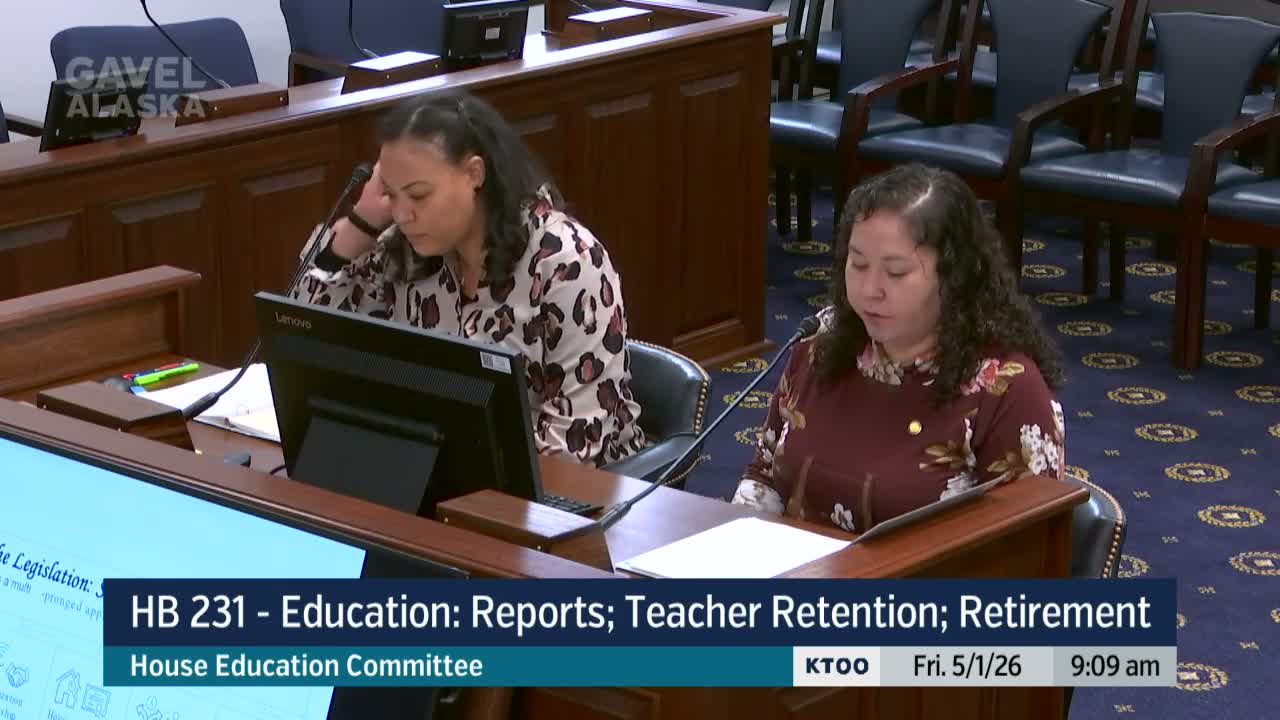
Representative Robin Nayock Freer told the House Education Committee that House Bill 231 is a multi‑pronged bill intended to implement recommendations from the teacher retention and recruitment playbook and to address Alaska’s urgent need for educators.
"At its core, this legislation addresses Alaska's urgent need to attract and retain educators," Rep. Freer said in the sponsor overview, summarizing sections that mandate third‑party exit interviews and turnover metrics, fund broadband alignment and mentoring, establish educator housing subsidy and upgrade grants, accept some pathways for international teacher accreditation, create transition windows between defined‑benefit and defined‑contribution options for certain 'grow your own' educators, and authorize retention bonuses of $5,000 to $15,000 for teachers and paraprofessionals.
Public testimony was largely supportive. Cindy Micah, superintendent of the Kodiak Island Borough School District, said mentoring for principals and leaders is essential: "Quite simply, strong schools require strong leaders," she told the committee, and described Kodiak’s experience using international hires combined with mentorship and certification supports to reduce turnover.
Committee members asked detailed questions about international hiring pathways and costs. Micah described moving from J‑1 to H‑1B routes and said the district is pursuing green‑card processes for a cohort of international teachers; she estimated the batch green‑card effort will cost about $10,000 per teacher over two years. Jennifer Schmidt (district support/advocacy) told the committee that single‑district green‑card processes cost roughly $8,000–$10,000 per teacher.
DEED Deputy Director Kelly Manning described department work to address regulatory barriers, including evaluating Praxis cut scores and considering foreign coursework evaluation so qualified international educators can obtain professional certificates rather than time‑limited emergency certificates. Manning also said DEED leadership is working with Alaska’s congressional delegation on potential fee relief for educator H‑1B visas.
Sponsor Freer acknowledged the retention‑bonus language carries a substantial fiscal note and said targeting for hard‑to‑fill positions could be discussed, but she preserved the broad package to keep integrated recommendations together.
Committee action: Co‑chair Story held House Bill 231 over for further consideration after testimony and Q&A.
Why it matters: The bill bundles multiple retention strategies — data collection, broadband, housing supports, credentialing pathways and direct pay incentives — during a legislative session with limited remaining days, raising questions about fiscal impact and implementation timelines.
The committee took no vote on passage; the bill was held over for further work.