Get AI Briefings, Transcripts & Alerts on Local & National Government Meetings — Forever.
House Finance hears sponsor and agency analysis of paid parental leave proposal
Summary
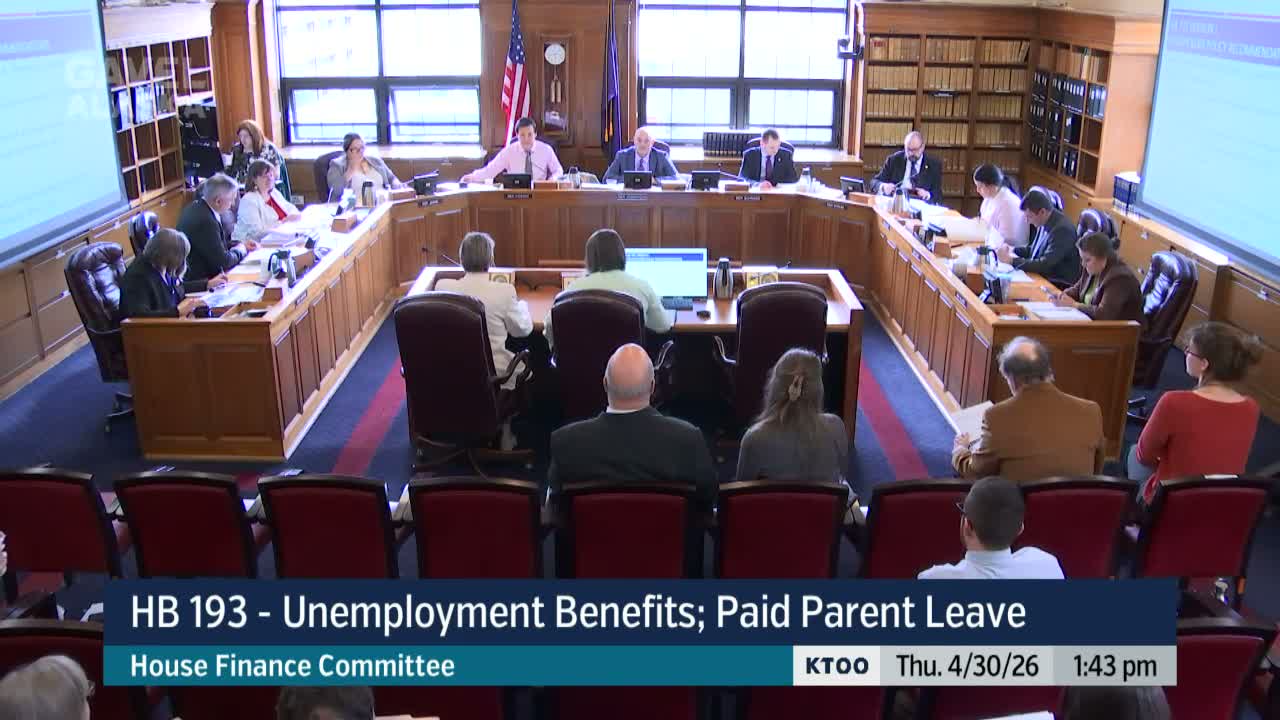
The House Finance Committee on April 30 reviewed HB 193, a proposal to create a paid parental leave program and update unemployment insurance financing; the sponsor presented stakeholder recommendations (shorter duration, lower weekly benefit, small‑employer exemptions, wage‑base indexing) and the Department of Labor outlined multiple fiscal scenarios and large uncertainties in cost estimates.
Representative Carolyn Hall presented HB 193 to the House Finance Committee as a paired package of unemployment insurance updates and a new paid parental leave program, describing a set of stakeholder policy recommendations the committee could consider as amendments.
Hall told the committee the recommendations aim to protect Unemployment Insurance (UI) trust fund solvency while providing parental leave. She said stakeholders suggested trimming the proposed duration from 8–26 weeks to an 8–12 week range and lowering the proposed maximum weekly benefit to either $425 or $470, rather than the $817 figure in the bill’s current benefit schedule. Hall also outlined options to exempt employers with 50 or fewer employees, allow small and seasonal employers to opt in voluntarily, exempt the paid parental leave fund from sweeps, and index benefits to the Alaska taxable wage base rather than the consumer price index. “These recommendations are not in version L,” Hall told members; they are policy options based on business and stakeholder feedback that the committee could choose to adopt by amendment.
The department of labor’s director for employment and training services, Paloma Harbor, and economist-actuary Lennon Weller presented modeling showing how the bill alters employee and employer tax flows. Harbor explained that under the current bill employees would no longer pay the small UI employee contribution; some of that share would instead seed the new paid parental leave fund, and employers’ contributions would be rebalanced depending on trust‑fund solvency. “There will no longer be employee contributions to unemployment insurance under this bill,” Harbor said in review of the current version.
Weller described scenarios using different maximum benefit amounts and indexing choices. He said results vary widely: with higher benefit maximums and inflation indexing, employer contributions would need to ramp up sooner; with lower weekly maxima, the timeline before employer taxes increase lengthens. He summarized modeled ranges rather than exact final costs, noting the department lacks precise claimant data. “We don’t have good data on how many births are to covered workers or how many eligible workers will claim,” Weller said, and the department’s analysis produced a wide estimated range of annual benefit costs depending on assumed participation rates.
Committee members pressed on mechanics and costs: how the fund could be protected from sweeps, whether insulating the fund would require a constitutional change or different statutory language, how PPL would coordinate with short‑term disability and FMLA, and the technology and staffing needed to pay benefits. The department said a workers‑compensation administration approach would likely require capital investments (a system build estimated at roughly $10 million in one fiscal note) and a handful of full‑time positions to adjudicate claims and investigate fraud; other agency fiscal notes showed substantial uncertainty in benefit costs and suggested statutory language to permit spending on demand to avoid repeated supplemental requests.
Because the policy bulleted list on the screen represented stakeholder recommendations rather than statutory text, Hall told the committee she is willing to work with members on sponsor‑drafted amendments. The committee set an amendment deadline of May 6 at 5 p.m. for this bill.
The committee took no final policy vote on substantive changes to HB 193 at this hearing; members were invited to draft and negotiate amendments before the deadline. The Department of Labor emphasized that further analysis — particularly better data on eligible births and claimant behavior — would materially narrow the cost range and clarify timing of employer contribution changes.