Get AI Briefings, Transcripts & Alerts on Local & National Government Meetings — Forever.
Panel remembers 50 years of Alaska REAAs, warns state must maintain rural school facilities
Summary
Department of Education staff and two former commissioners told the House Education Committee that Regional Educational Attendance Areas (REAAs) enabled local control across rural Alaska but that facility ownership and maintenance remain unresolved, with capital funding largely dependent on state grants.
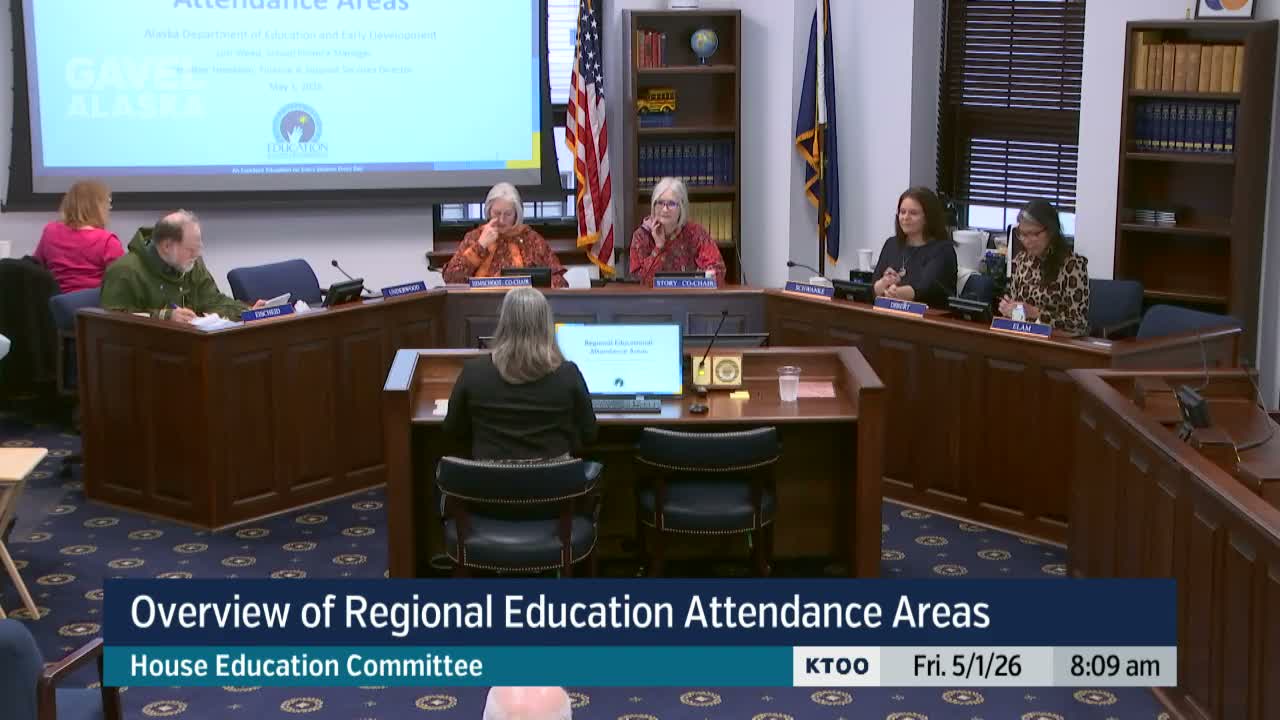
Lori Weed, the Department of Education and Early Development’s school finance manager, told the House Education Committee that Regional Educational Attendance Areas (REAAs) were established by statute in the mid‑1970s to extend local school governance across Alaska’s unorganized boroughs and to implement the constitution’s promise of a system open to all students.
"There are currently 52 school districts and the state‑operated boarding school, Mount Edgecumbe High School," Weed said, describing the funding differences between municipal districts and REAAs: operating funds come primarily from state aid through the foundation formula while REAAs rely almost entirely on state grants for capital work under AS 14.11.
Former commissioner Marshall Linde, who helped design the REAA system, told the committee the districts were created quickly with heavy involvement from Alaska Native leaders and regional organizations and that the design aimed to make future borough transitions simple. "I look at the creation of the REAs as one of the better things we did," Linde said, crediting local leaders and noting the program began amid optimism in the early 1970s.
Linde and other witnesses described a patchwork of facility ownership: eight REAAs hold title to all their properties, while others operate under a mix of district ownership, leases or state ownership and use permits. Linde told the committee he views the legislature — which acts as the assembly for the unorganized borough — as ultimately responsible for state‑owned facilities and criticized lawmakers for failing to maintain support for those properties.
Former DEED commissioner Jerry Covey told members the move away from a BIA‑run system toward locally governed REAAs reflected constitutional aims for statewide access to education and relied on dedicated department leadership and community collaboration.
Committee members pressed presenters on long‑term revenue constraints. Linde said the elimination of a state income tax and changes to the Permanent Fund Dividend have reduced state flexibility and predicted that restoring funding will require new revenue or changes to the PFD.
Why it matters: REAAs cover much of Alaska’s land area and serve many rural communities. The committee’s briefing highlighted that while the governance model has endured for 50 years, the mechanics of facility ownership and capital funding remain points of tension that affect school maintenance and community services.
The committee received the presentations and held questions; no formal action was taken on REAA governance during the hearing.