Get AI Briefings, Transcripts & Alerts on Local & National Government Meetings — Forever.
Senate committee hears bill to create 'Welcoming Alaska' office to coordinate immigrant and refugee services
Summary
Senators heard SB 169 to create a Welcoming Alaska office in the Department of Labor and Workforce Development to replace the Office of Citizenship Assistance, coordinate departmental liaisons, offer grants, and oversee refugee resettlement previously administered by nonprofits; witnesses urged the bill to capture federal funds and streamline services.
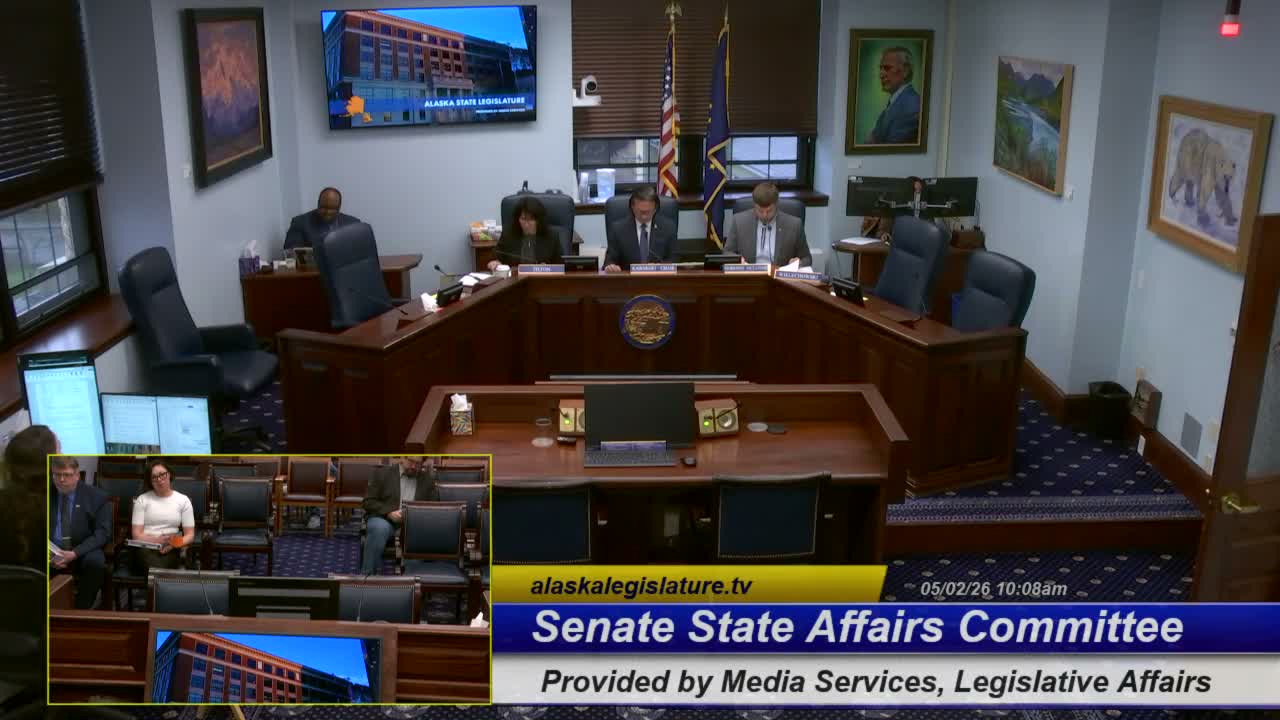
A Senate State Affairs Committee hearing on May 2 scrutinized SB 169, which proposes creating a Welcoming Alaska office inside the Department of Labor and Workforce Development to centralize help for newcomers, assist local school districts with visa‑related costs, and coordinate departmental liaisons.
Sponsor Senator Lukey Gale Tobin, who said the proposal grew from constituent experiences in Nome, described broad goals: reduce barriers to visas and housing, help foreign‑born educators navigate federal immigration processes, and expand the duties of an underused Office of Citizenship Assistance through a nine‑member advisory committee and departmental liaisons.
"We took model legislation from states like Minnesota and Michigan," Tobin said, adding the office would offer grants, operate a toll‑free hotline for referrals, and provide virtual and in‑person information centers subject to appropriation. The bill also would add the office's executive director to positions treated as partially exempt and repeal the 2004 statute that created the Office of Citizenship Assistance.
Staff to the sponsor, Mike Mason, provided a sectional analysis, noting new statutory sections (AS 23.05.131–.134 in committee materials) to establish the office and its authorities, and a study requirement with a report to the Legislature by 07/01/2027 and an effective date listed in the draft as 07/01/2026.
Committee members pressed fiscal questions. Senator Bjorkman asked whether the office's funding would roll from the existing Office of Citizenship Assistance line; Mason pointed to budget materials in the packet and said that line item (noted in committee materials as "478.9") would be part of the transition and that the department indicated three existing FTEs would be reestablished with a possible need for up to four more positions.
Invited witnesses and public testifiers largely supported the bill. Isis Espatresano, identified as the former Alaska state refugee coordinator and currently director of programs at the Rasmuson Foundation, said recent federal guidance (Office of Refugee Resettlement Policy Letter 25‑04) is moving administrative refugee resettlement funding toward state administration and that placing refugee administration in state government would strengthen oversight, align agencies, and allow existing direct‑service providers to continue work under state contracting.
"These are federal dollars already coming into Alaska and will cover associated staffing costs within state administration," Espatresano said, and she urged the committee to amend the bill in an upcoming committee substitute to reflect refugee resettlement provisions.
Caitlin McTiernan of the American Immigration Council described similar state offices in 24 states and cited 2023 American Community Survey figures the organization presented showing roughly 54,000 immigrants in Alaska in 2023 (about 7% of the state population and 10% of the workforce); she argued a statewide office can help translate that workforce into economic and civic benefits.
Case managers and adult‑education professionals from across Alaska told the committee a centralized office would reduce duplicative searching for licensing, school registration, and permitting information, and speed new arrivals into jobs, small businesses and community participation.
One caller opposed aspects of the bill on political grounds, warning the office could be used to assist undocumented migrants and urged that local officials coordinate with federal immigration enforcement; the committee did not adopt any enforcement language during the hearing.
The committee left the record open for additional public testimony and indicated a committee substitute (CS) incorporating suggested refugee provisions would be presented at the next meeting. No final vote or statutory changes were enacted at the May 2 hearing.
What's next: The committee held SB 169 for further hearing and asked the sponsor to return with a committee substitute that will include refugee resettlement language to align with federal guidance.